Photo
Browse an alphabetical list of photographs. These historical images portray people, places, and events before, during, and after World War II and the Holocaust.
<< Previous | Displaying results 301-325 of 2608 for "Photo" | Next >>
-
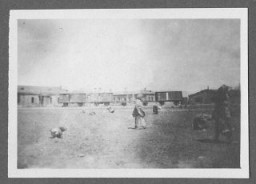
Armenian refugees
PhotoRefugees foraging at Alexandropol, Russian Armenia. Photograph taken by John Elder. In 1917, Elder, a divinity student from Pennsylvania, joined the American Committee for Armenian and Syrian Relief team that was aiding refugees. For two years, Elder did volunteer work with Armenian orphans. During that time, he photographed refugees and conditions at camps.
-
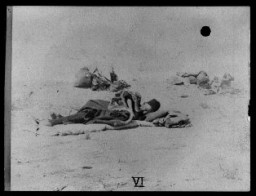
Armenian refugees in the desert
PhotoArmenian refugees in the desert. A man in the foreground lies on the ground on a layer of bedding. 1915-20.
-
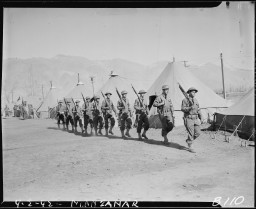
Army Military Police guard the Manzanar Relocation Center
PhotoArmy Military Police guarding the boundaries of the Manzanar Relocation Center in California, one of ten relocation camps where American residents of Japanese ancestry were forcibly deported, April 2, 1942.
-
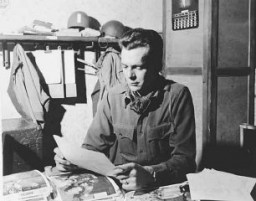
Arnold E. Samuelson.
PhotoPortrait of US combat photographer Arnold E. Samuelson. France, 1944-1945. Samuelson took some of the best known photographs of Holocaust survivors upon the liberation of the camps.
-
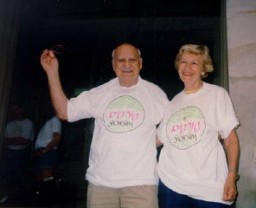
Aron and Lisa accompanying high school students to Poland
PhotoAron and Lisa in Poland, ca. 1994, while accompanying high school students as part of a "Shoreshim" group.
-
-
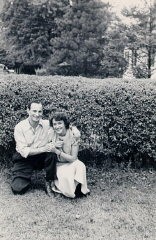
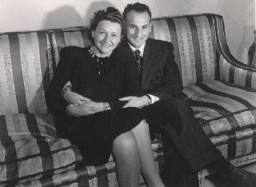
Aron and Lisa when they came to America
PhotoAron and Lisa when they came to America. Photograph probably taken in Chicago, Illinois, 1947.
-
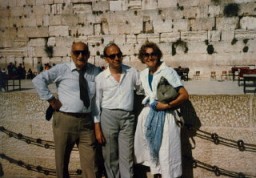
Aron and Lisa with Tadek Soroka
PhotoAron and Lisa with Tadek Soroka, the Pole who helped them escape, on the occasion of Soroka's recognition as a "Righteous among the nations" by Yad Vashem. Jerusalem, Israel, 1983.
-
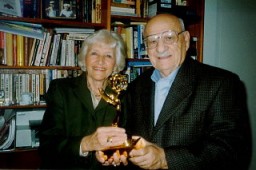
Aron and Lisa with their Emmy
PhotoAron and Lisa with the Emmy they won for their 1997 documentary, A Journey of Remembrance. Photograph taken in Northbrook, Illinois, 1998.
-
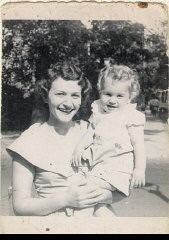
Aron and Lisa's firstborn child
PhotoAron and Lisa's firstborn child, Howard. Chicago, Illinois, 1949.
-
Aron and Lisa's three sons
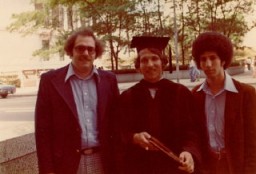
PhotoAron and Lisa's three sons (Howard, Gordon, and Daniel) at the middle son's graduation from the University of Wisconsin. Madison, Wisconsin, ca. 1972.
-
-
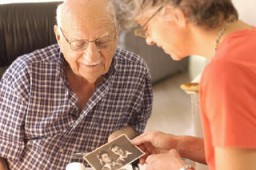
Aron Derman and Neenah Ellis look at one of Aron's photographs
PhotoAron Derman and Neenah Ellis look at one of Aron's family photographs. 2004.
-
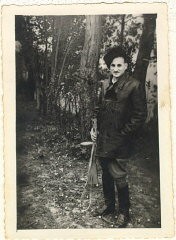
Aron Derman while he was with Polish partisans in 1944.
PhotoAron Derman while he was with Polish partisans in 1944. In this photograph, Aron wears a fur hat that he made and boots that he finished himself (he found them in the ghetto, unfinished, and sewed them up). Lisa Nussbaum was also a member of the partisans. Aron recounted that for a short while, Lisa was in charge of 200 women. Photograph taken in 1944, in a partisan base in the Naroch forest.
-
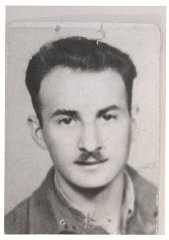
Aron in Budapest, 1945
PhotoAron in Budapest, 1945, while en route from Poland to Italy with Brihah, moving to Palestine. In Aron's words: "We got connected with the Brihah in Poland, got directions to go to Bratislava and on to Budapest. On our trip, we didn't know where we going from city to city, only our final destination." July 5, 1945, Budapest, Hungary.
-
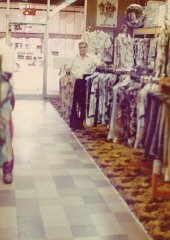
Aron in Howard's men's clothing store
PhotoAron standing in Howard's men's clothing store (named for his eldest son) at 9125 Commercial Avenue in Chicago. He opened the store in 1949 and owned it for 30 years. Chicago, Illinois, early 1970s.
-
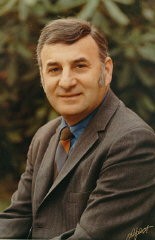
Aron in Teaneck, New Jersey, in the early 1970s
PhotoAron in Teaneck, New Jersey, in the early 1970s. This photograph was taken by Hyman Alpert, known as "Trigger." Alpert, a cousin of Aron's, was a musician with the Glenn Miller Orchestra. Alpert went on to become a photographer in Teaneck.
-
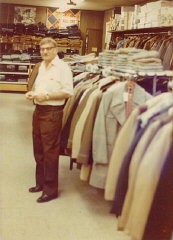
Aron standing in Howard's men's clothing store
PhotoAron standing in Howard's men's clothing store (named for his eldest son) at 9125 Commercial Avenue in Chicago. He opened the store in 1949 and owned it for 30 years. Chicago, Illinois, early 1970s.
-
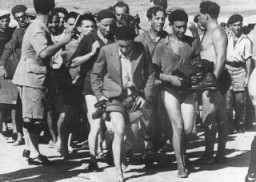
Arrest of passengers from the Aliyah Bet ship Parita
PhotoA British policeman (left) organizes the arrest of passengers from the Aliyah Bet ("illegal" immigration) ship Parita after they disembarked near Tel Aviv. Palestine, August 22, 1939.
-
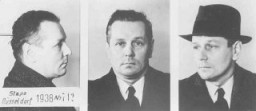
Arrested for homosexuality
PhotoA waiter from Düsseldorf who was arrested by the Gestapo for allegedly having sexual relations with other men. Düesseldorf, Germany, 1938. [RW 58-61940] The Nazi regime considered homosexuality a moral vice that threatened the current and future strength of the German people. They carried out a campaign against male homosexuality that included shutting down gay and lesbian meeting places and arresting men under Paragraph 175, the statute of the German criminal code that banned sexual relations between…
-
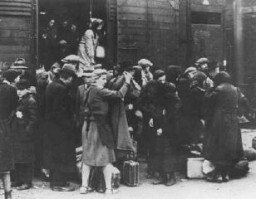
Arrival at Auschwitz
PhotoA transport of Jews from Hungary arrives at Auschwitz-Birkenau. Poland, May 1944.
-
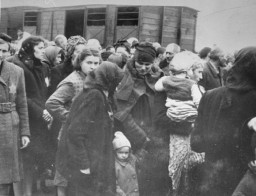
Arrival at Auschwitz
PhotoJews from Subcarpathian Rus get off the deportation train and assemble on the ramp at the Auschwitz-Birkenau killing center in occupied Poland. May 1944.
-
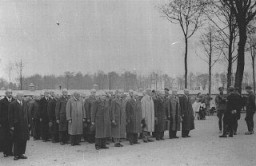
Arrival at Buchenwald
PhotoNewly arrived prisoners at the Buchenwald concentration camp. Buchenwald, Germany, 1938-1940.
-
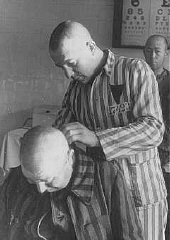
Arrival at Sachsenhausen
PhotoShaving an inmate upon arrival at the Sachsenhausen concentration camp. Germany, February 1941.
-
Arrival at Westerbork
PhotoArrival of a transport at the Westerbork camp. Westerbork, the Netherlands, October 1942.