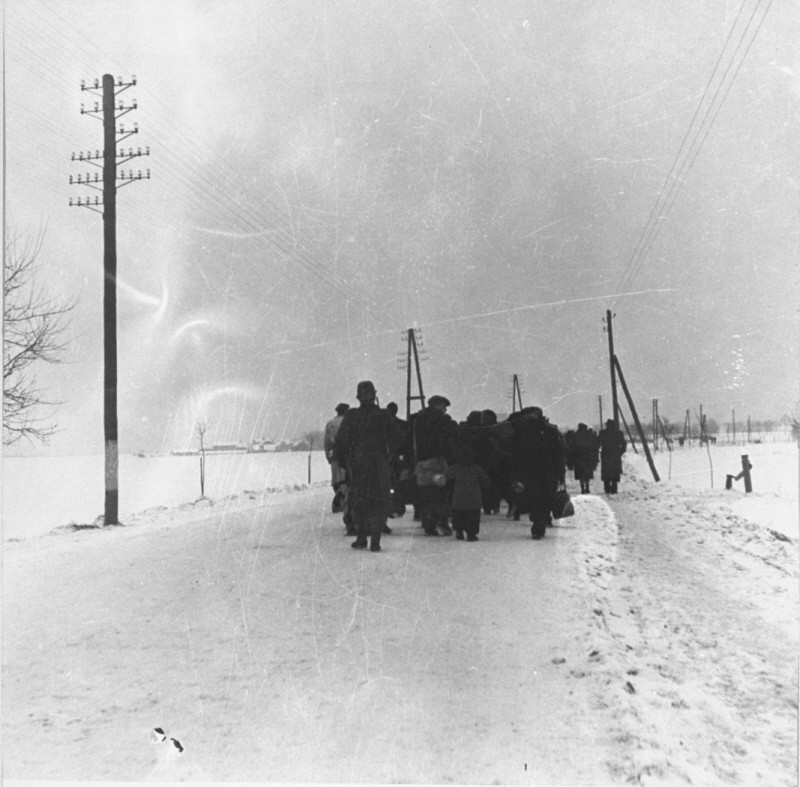
A transport of Jewish prisoners marches through the snow from the Bauschovitz train station to Theresienstadt. [LCID: 69720]

Oral History

Browse an alphabetical list of survivors’ oral histories. These interviews describe firsthand accounts and personal experiences during the Holocaust and World War II.

Filter by title:

| Displaying results 51-55 of 55 for "Oral History" | Next >>

  • Ludmilla Page describes conditions in Oskar Schindler's munitions factory in Brünnlitz

    Oral History

    In 1941, Ludmilla and her new husband Leopold were imprisoned in the Kraków ghetto in German-occupied Poland. In 1943, the couple was transferred to the Plaszow labor camp. There they were subjected to grueling conditions and arbitrary violence. In fall 1944, businessman Oskar Schindler helped save some Jewish forced laborers by relocating them and his munitions factory from Kraków to Brünnlitz in the Sudetenland. Because of Leopold's previous relationship with Schindler, the couple was included in this…

    Ludmilla Page describes conditions in Oskar Schindler's munitions factory in Brünnlitz
  • Ludmilla Page describes German industrialist Oskar Schindler

    Oral History

    In 1941, Ludmilla and her new husband Leopold were imprisoned in the Kraków ghetto in German-occupied Poland. In 1943, the couple was transferred to the Plaszow labor camp. There they were subjected to grueling conditions and arbitrary violence. In fall 1944, businessman Oskar Schindler helped save some Jewish forced laborers by relocating them and his munitions factory from Kraków to Brünnlitz in the Sudetenland. Because of Leopold's previous relationship with Schindler, the couple was included in this…

    Ludmilla Page describes German industrialist Oskar Schindler
  • Ludmilla Page describes leaving Auschwitz and arriving at the Brünnlitz munitions factory in the Sudetenland

    Oral History

    In 1941, Ludmilla and her new husband Leopold were imprisoned in the Kraków ghetto in German-occupied Poland. In 1943, the couple was transferred to the Plaszow labor camp. There they were subjected to grueling conditions and arbitrary violence. In fall 1944, businessman Oskar Schindler helped save some Jewish forced laborers by relocating them and his munitions factory from Kraków to Brünnlitz in the Sudetenland. Because of Leopold's previous relationship with Schindler, the couple was included in this…

    Ludmilla Page describes leaving Auschwitz and arriving at the Brünnlitz munitions factory in the Sudetenland
  • Ludmilla Page describes sabotage during production of munitions in Oskar Schindler's factory in Brünnlitz

    Oral History

    In 1941, Ludmilla and her new husband Leopold were imprisoned in the Kraków ghetto in German-occupied Poland. In 1943, the couple was transferred to the Plaszow labor camp. There they were subjected to grueling conditions and arbitrary violence. In fall 1944, businessman Oskar Schindler helped save some Jewish forced laborers by relocating them and his munitions factory from Kraków to Brünnlitz in the Sudetenland. Because of Leopold's previous relationship with Schindler, the couple was included in this…

    Ludmilla Page describes sabotage during production of munitions in Oskar Schindler's factory in Brünnlitz
  • Ludmilla Page recalls arriving in Auschwitz instead of Oskar Schindler's munitions factory in Brünnlitz

    Oral History

    In 1941, Ludmilla and her new husband Leopold were imprisoned in the Kraków ghetto in German-occupied Poland. In 1943, the couple was transferred to the Plaszow labor camp. There they were subjected to grueling conditions and arbitrary violence. In fall 1944, businessman Oskar Schindler helped save some Jewish forced laborers by relocating them and his munitions factory from Kraków to Brünnlitz in the Sudetenland. Because of Leopold's previous relationship with Schindler, the couple was included in this…

    Ludmilla Page recalls arriving in Auschwitz instead of Oskar Schindler's munitions factory in Brünnlitz

Thank you for supporting our work

We would like to thank Crown Family Philanthropies, Abe and Ida Cooper Foundation, the Claims Conference, EVZ, and BMF for supporting the ongoing work to create content and resources for the Holocaust Encyclopedia. View the list of donor acknowledgement.