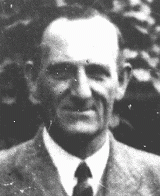
Carl was born to Jewish parents living in a German village near the Belgian border. He fought in World War I and received the Iron Cross, a German military honor. He married Johanna Falkenstein and they settled down in a house across the street from his father's cattle farm. Carl ran a small general store on the first floor of their home. The couple had two daughters, Margot (born in 1928) and Lore (born in 1931).
11933-39: After the Nazis came to power in Germany, life became increasingly difficult for German Jews like the Heumann family. Carl struggled to find work. In the late 1930s Carl moved his family to the city of Bielefeld, where he worked for a Jewish relief organization.
1940-1944: After World War II began in September 1939, life became increasingly difficult for the Heumanns and other German Jews. Beginning in September 1941, German Jews had to wear a yellow Star of David badge on their clothes, marking them as Jewish.
In June 1943, the Heumanns were deported to the Theresienstadt ghetto near Prague. They remained there until May 1944, when German authorities deported Carl and his family to Auschwitz. At Auschwitz, they were initially housed in the “Czech family camp” (section BIIb) of Auschwitz-Birkenau. Prisoners in the section had some privileges, such as wearing civilian clothes instead of camp uniforms. But, they still suffered from starvation and lacked proper shelter or sanitation. Carl did not survive the Holocaust, though his exact fate is unknown. Of the immediate family, only Margot survived. She last saw her father when they said goodbye at Auschwitz.
Item ViewKurt Klein (1920-2002) was born on July 2, 1920 in Walldorf, Germany, a town with a small Jewish population. Kurt was 12 when Adolf Hitler and the Nazis came to power in Germany in January 1933. The Klein family experienced antisemitic persecution throughout the 1930s and decided to leave Germany. Kurt immigrated to the United States in 1937, but his parents, Ludwig and Alice, were unable to leave. In 1940, the Kurt's parents were deported from Germany to France as part of the mass deportation of Jews from Baden. Ludwig and Alive were imprisoned in the Gurs internment camp. In August 1942, they were deported from France to Auschwitz, in German-occupied Poland, where they were likely murdered upon arrival. In 1942, Kurt joined the United States Army and was trained at Camp Ritchie in military intelligence. In Europe, he interrogated prisoners of war. In May 1945, he took part in the surrender of the Czech town of Volary. Kurt returned the next day to assist over 100 Jewish women who had been abandoned there during a death march. Kurt's future wife, Gerda Weissmann, was one of the women in this group.
Item ViewAs prewar antisemitism intensified, Hessy's family fled from Germany to Paris, France. France fell to the German army in June 1940. Hessy's family was smuggled into the "zone libre" (free zone) in southern France. The family received a US visa in 1941, but was unable to leave before the visa expired and could not obtain an extension. In 1942, the family obtained visas to enter Cuba, where they settled before immigrating to the United States in 1949.
Item ViewAmid intensifying anti-Jewish measures and the violence of Kristallnacht (often referred to in English as the "Night of Broken Glass"), Johanna's family decided to leave Germany. They obtained visas for Albania, crossed into Italy, and sailed in 1939. They remained in Albania under the Italian occupation and, after Italy surrendered in 1943, under German occupation. The family was liberated after a battle between the Germans and Albanian partisans in December 1944.
Item ViewWe would like to thank Crown Family Philanthropies, Abe and Ida Cooper Foundation, the Claims Conference, and BMF for supporting the ongoing work to create content and resources for the Holocaust Encyclopedia. View the list of all donors.