

Jewish Refugees Aboard the SS Quanza
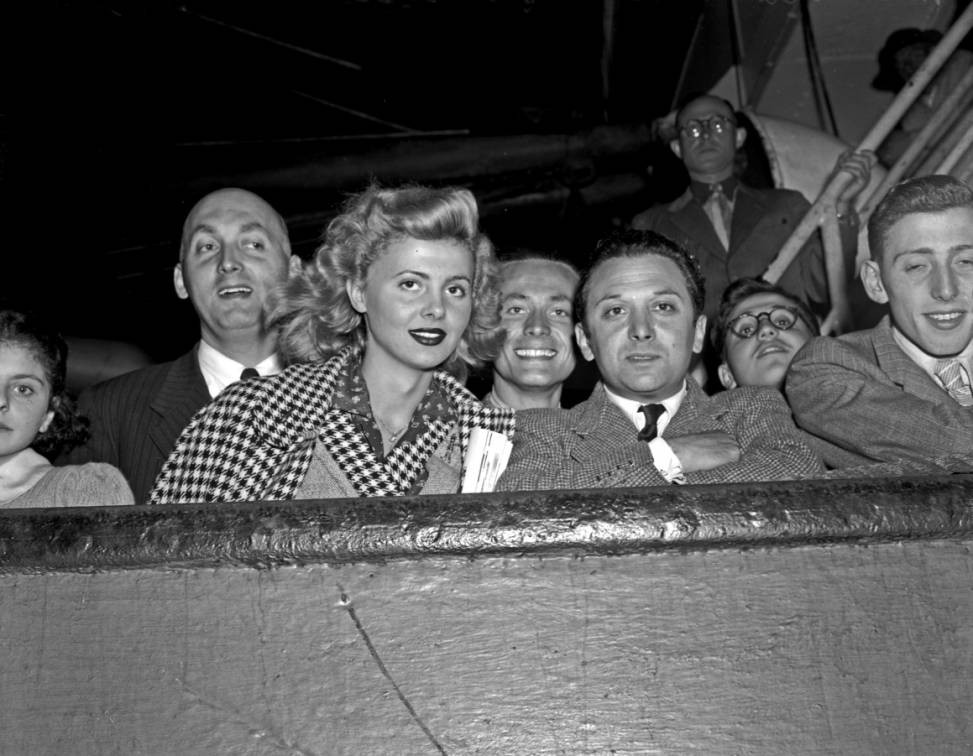
In August 1940, the SS Quanza sailed from Lisbon, Portugal, to New York City and then Veracruz, Mexico. Onboard were more than 300 passengers, including Jews fleeing Nazi persecution. When the ship arrived in Veracruz, some passengers were told they had invalid visas. Fearing they would have to return to Nazi-occupied Europe, these passengers sought help from family, friends, and aid organizations in the United States.
Key Facts
-
1
The Quanza was a Portuguese passenger ship that sailed from Lisbon, Portugal, to New York City and then Veracruz, Mexico, in August 1940. In Mexico, the Mexican government refused entry to 81 passengers, claiming that their visas were not valid.
-
2
Before returning to Portugal, the ship stopped in Norfolk, Virginia. There, a local lawyer sued the shipping company on behalf of the passengers. The ship had to remain in the harbor until the court case could be resolved.
-
3
Eventually, with the help of some Americans and the President’s Advisory Committee for Political Refugees, the passengers were allowed to enter the United States. None of them were forced to return to Europe.
As Nazi Germany conquered Europe during World War II (1939–1945), it became more and more difficult for people to escape from under Nazi control. By the summer of 1940, options were limited for those who hoped to flee across the Atlantic.
Lisbon, the capital of Portugal, was the main port of departure for the few passenger ships still crossing the Atlantic Ocean. Throughout the war, Portugal remained neutral. This meant that it did not officially take sides or fight in the war. As a result, Portuguese ships sailed under a neutral flag. They were protected from German submarines that were targeting enemy ships moving between continents.
One of the ships to sail from neutral Portugal was the SS Quanza. The Quanza was a passenger and cargo steamship. In August 1940, the ship began a voyage with more than 300 passengers onboard. Among the passengers were Jewish people fleeing Nazi persecution. Most of the passengers on the Quanza had permanent or temporary visas for the United States and disembarked on the ship’s first stop in New York City. A little more than a hundred passengers had Mexican visas and planned to disembark in Veracruz. They hoped either to stay in Mexico or to travel to other Central or South American countries.
Upon arrival in Veracruz, the Mexican government declared that 81 of the passengers had invalid visas. Mexican authorities refused to let them disembark. The passengers worried they would be forced to return to Europe. Many were aware that just over a year earlier, in June 1939, passengers aboard the MS St. Louis had been turned away from Cuba and sent to western Europe.
As the SS Quanza began its journey back to Europe, it sailed to Norfolk, Virginia, for coal. The frantic passengers contacted a variety of people for help. These included US government officials, First Lady Eleanor Roosevelt, family members, friends, and aid organizations in the United States. These calls resulted in the passengers finding legal ways to stay in the United States.
From Lisbon to New York and Veracruz
The SS Quanza sailed from Lisbon on August 9, 1940, carrying more than 300 passengers. On the ship’s passenger lists, about 40 percent of the passengers were marked as “Hebrew.” This indicated that they were Jewish.
First Stop: Passengers Disembark in New York City
When the Quanza arrived in New York City on August 19, approximately 200 passengers disembarked. Some were American citizens returning home from war-torn Europe. Others had obtained immigrant visas from an American consulate in Europe; they planned on staying in the United States permanently. Among these people were Jewish refugees and political opponents of the Nazis. The passengers also likely included people considered Jewish under Nazi law, but who did not practice the Jewish religion and were not listed as “Hebrew” on the ship’s manifest. Some of the other disembarking passengers held transit visas that allowed them to temporarily enter the United States before proceeding to another country.
Second Stop: Passengers Denied Entry in Veracruz
After a few days in New York harbor, the Quanza sailed to Veracruz, Mexico, with the remaining passengers onboard. But when the ship docked in Veracruz, Mexican officials denied entry to 81 passengers. Seventy-five of them were Jewish; several others were non-Jewish women married to Jewish men.
Most of these passengers had planned to travel through Mexico on transit visas to destinations in Central or South America. But the Mexican government claimed that the official in Lisbon had not been authorized to grant the transit visas. The Mexican authorities ignored the passengers’ valid entry visas to their final destinations. Mexico refused to allow these passengers to leave the ship.
The Passengers Fear Return to German-Occupied Europe
The Quanza passengers who had been refused entry into Mexico did not want to return to Europe. Even though Portugal was a neutral nation in 1940, the passengers feared Nazi Germany might invade and occupy Spain and Portugal in the future.
They were also aware of the fate of the MS St. Louis the previous year. In June 1939, most of the 937 St. Louis passengers had been denied entry to Cuba. The Cuban government had forced the St. Louis to return to Europe. The St. Louis passengers were eventually granted entry to Great Britain, the Netherlands, Belgium, and France. But in May 1940, Nazi Germany invaded western Europe, and the St. Louis passengers were once again under Nazi control.
The Quanza passengers feared that their lives were similarly in danger.
The SS Quanza Turns Back: Passengers Plead for Action
On September 5, 1940—almost a month after departing Europe—the SS Quanza left Veracruz to return to Lisbon. In order to complete the return voyage, the captain planned to stop for more coal in Norfolk, Virginia.
During the six-day voyage from Veracruz to Virginia, the 81 passengers who had been denied entry to Mexico began sending telegrams to officials in the United States government. They begged to be allowed to disembark in Norfolk even though they did not have United States immigrant or transit visas. They also contacted and mobilized family members, friends, and any other influential connections they had in the United States. These Americans began to ask the US government to intervene on the passengers’ behalf.
Rabbi Stephen Wise, who led numerous American Jewish organizations, contacted Assistant Secretary of State Breckinridge Long, who headed the Visa Division. Long agreed that the State Department would “consider generously anything that was possible…under the law.” Movie studio MGM Pictures wrote to the State Department to ask for temporary visas for two actors on board whose stage names were Marcel Dalio and Madeleine Lebeau. The actors would later play supporting roles in the movie Casablanca.
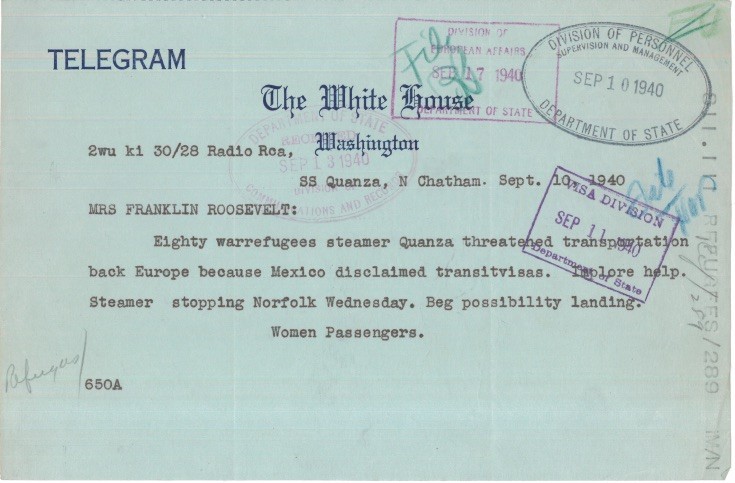
A group of female passengers sent a telegram to First Lady Eleanor Roosevelt. Mrs. Roosevelt was known for her sympathy toward refugees. The telegram read, “Implore help. Steamer stopping Norfolk Wednesday. Beg possibility landing.”
Docking in Norfolk, Virginia: Legal Actions and Refugee Aid
On the morning of September 11, 1940, the SS Quanza arrived in Norfolk, Virginia, to refuel. By this time, individual Americans were taking action to assist the ship’s passengers. Family members of some refugees on board the ship hired lawyers. These lawyers argued that the company was holding specific passengers hostage. They filed habeas corpus claims with the local courthouse, stating that the passengers were being unlawfully imprisoned.
One local lawyer, Jacob Morewitz, took a different legal approach. Morewitz, who specialized in maritime law, decided to libel the ship. This meant that he was effectively suing the shipping company on behalf of four passengers, the Rand family of Czechoslovakia. He argued that the shipping company had not delivered them to their intended destination. As a result, the Quanza had to remain in the harbor until a judge held a hearing on the case or until the shipping company posted a bond of $5,000. Morewitz’s legal actions meant that the Quanza could not leave Norfolk for at least three days. A Coast Guard unit monitored the ship to ensure it did not move.
The refugees also contacted American Jewish aid organizations. These included the National Refugee Service, the Hebrew Immigrant Aid Society (HIAS), the National Council for Jewish Women, and the American Jewish Joint Distribution Committee (JDC). Some of these groups, as well as the American Christian Committee, sent representatives to Norfolk. They delivered food and other necessary supplies to the refugees, who were all kept on board the ship. The organizations also started planning to help the passengers with housing, transportation, and guarantees of assistance if they were eventually permitted to disembark in Norfolk.
The US Government Takes Action
US government officials received many phone calls, telegrams, and meeting requests from people concerned about the Quanza passengers. They felt pressure to take action.
US Department of State
On September 12, Assistant Secretary of State Breckinridge Long agreed that some passengers could be considered for temporary admission into the United States. Children could potentially enter the country with the support of the United States Committee for European Children. This aid organization placed refugee children from Europe with foster families in the United States. First Lady Eleanor Roosevelt served as its honorary chairperson. The passengers holding valid entry visas for third countries could receive transit visas. These visas would enable them to stay in the United States until they could board a ship to their final destination.
Long also agreed that adult passengers without transit visas could be evaluated to see if they fell into the category of “political refugee.” He did not believe that all passengers would qualify and anticipated that some of them would have to return to Europe.
The President’s Advisory Committee for Political Refugees
The United States had no refugee or asylum law at this time. But after the German annexation of Austria (the Anschluss) in March 1938, President Roosevelt created the President’s Advisory Committee for Political Refugees. This committee was made up of American political, religious, and diplomatic leaders. In the summer of 1940, after Nazi Germany invaded and occupied countries in western Europe, the committee suggested a program to grant “emergency visitors’ visas” to people who were political opponents of the Nazis. These were basically tourist visas without an expiration date. They allowed recipients to stay in the United States indefinitely. The President’s Advisory Committee collected names of people who faced the danger of repression under Nazi German authorities and who fell into the category of “political refugee.” State Department consulates in Europe would then grant the emergency visas allowing these people to enter the United States.
Patrick Murphy Malin, a member of the President’s Advisory Committee, traveled to Norfolk to examine the passengers. Immigration inspectors from the Department of Justice went with him. After three days, Malin concluded that all of the passengers on board the Quanza could enter the United States temporarily. This included:
- five people (2 mothers and 3 children) who entered with the support of the US Committee for European Children;
- 35 people who entered with transit visas to third countries; and
- 41 people entered as “political refugees” with emergency visitors’ visas.
US officials reminded the Quanza passengers that their visas were temporary. They stressed that the refugees should leave the United States as soon as possible.
The Passengers Disembark in Norfolk, Virginia
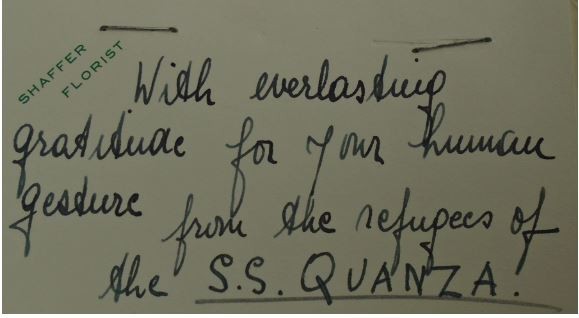
On Saturday, September 14, 1940, the SS Quanza passengers were allowed to disembark in Norfolk.
Aid organizations arranged for passengers who could not afford a hotel to stay in private homes for the night. On Sunday morning, the former passengers boarded a bus for New York City. There, they stayed with family or received the support of aid organizations until they could make other arrangements.
Backlash from the Department of State
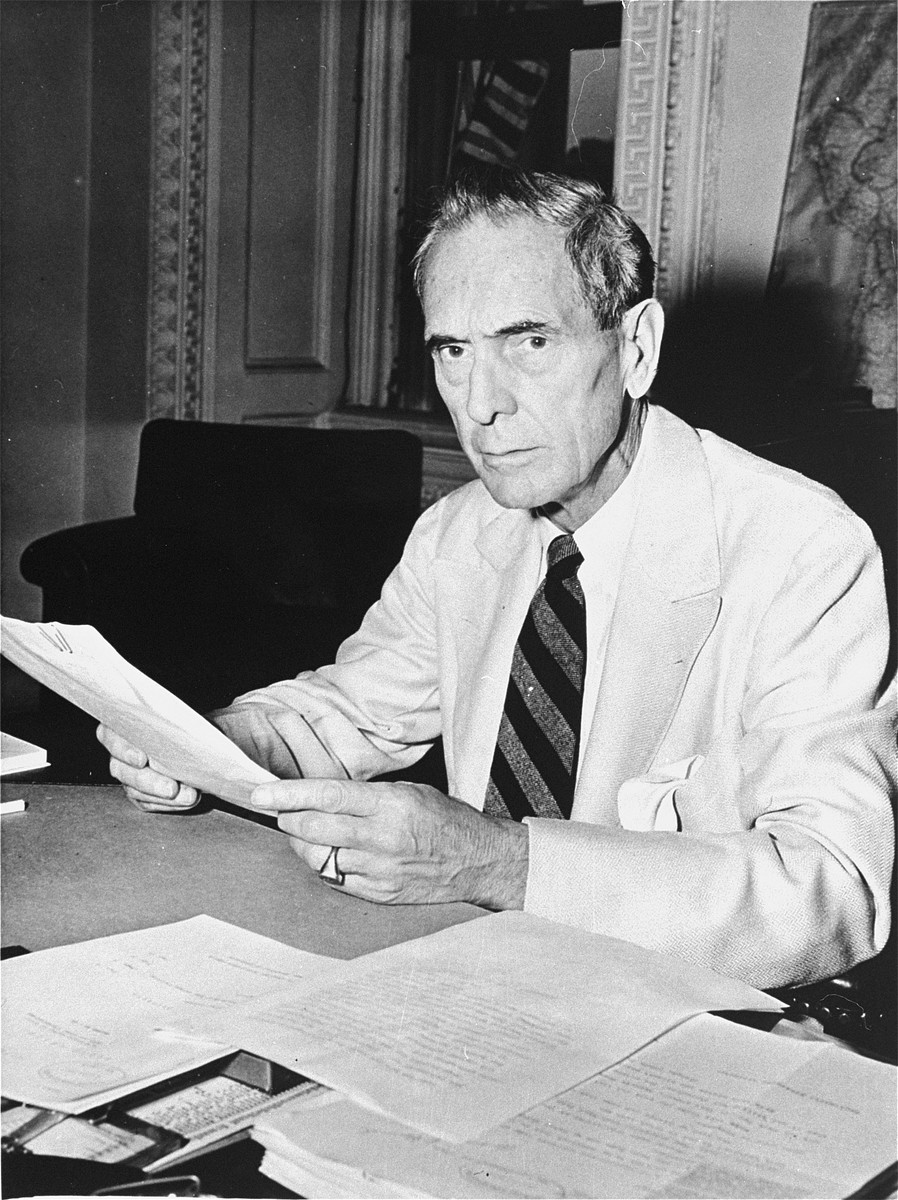
Assistant Secretary of State Breckinridge Long disagreed with the decision to temporarily admit all of the Quanza passengers. He argued that “political refugees” meant people who were “leaders of the intellectual liberal movement in Europe who were in danger of their lives.” To Long, most of the Quanza passengers did not qualify as political refugees. He believed that Patrick Murphy Malin had violated the law by allowing all of them to enter the United States temporarily.
On September 18, 1940, Long complained to President Franklin Roosevelt that the President’s Advisory Committee was being too generous in requesting emergency visitors’ visas. Long told the president that some of the people approved by the committee were “not of the desirable element” and might be German spies. Although Long did not manage to cancel the program, the State Department demanded that the President’s Advisory Committee carefully research each “political refugee” before submitting their name.
Preventing Future Incidents
In October 1940, the American Jewish Joint Distribution Committee alerted the State Department that a group of Jewish refugees was planning to charter a ship from Lisbon to Costa Rica. If they were turned away, they planned to proceed to the United States and appeal to be admitted in the same way the passengers of the Quanza had.
Secretary of State Cordell Hull asked American officials in Lisbon to investigate. Hull told the officials that the US government did not want any future incidents like the Quanza.
The American Jewish Joint Distribution Committee also informed its representatives, and the refugees whom they were trying to help, not to get involved in the scheme. Within a few days, American officials reported that the plan had been canceled.
The Fate of the Quanza Passengers
Almost all of the passengers on the Quanza eventually left the United States, but most only temporarily. Instead of traveling to the third countries where they had originally intended to go, they went to American consulates in Canada and applied for US immigrant visas. The refugees quickly re-entered the United States as permanent immigrants.
Footnotes
-
Footnote reference1.
Memo from Breckinridge Long to Eliot Coulter, September 7, 1940, RG 59, General Visa Correspondence 1940–1944, Box 150, 811.111/Refugees/459, National Archives at College Park, MD.
-
Footnote reference2.
Passenger cable to Eleanor Roosevelt, September 10, 1940, RG 59, General Visa Correspondence 1940–1944, Box 149, 811.111/Refugees/289, National Archives at College Park, MD.
-
Footnote reference3.
Memo of conversation between Patrick Murphy Malin, September 15, 1940, RG 59, General Visa Correspondence 1940–1944, 811.111/Refugees/416, National Archives at College Park, MD.
-
Footnote reference4.
Letter from Breckinridge Long to Franklin Delano Roosevelt, September 18, 1940, Selected Digitized Documents Related to the Holocaust and Refugees, 1939–1945, Official File 3186 - Political Refugees, July–September 1940, Franklin D. Roosevelt Presidential Library and Museum, Hyde Park, NY, http://www.fdrlibrary.marist.edu/archives/collections/franklin/index.php?p=collections/findingaid&id=505.