
Krakow Ghetto: Key Dates
September 1939
The German army occupies Krakow.
October 26, 1939
German-occupied Poland, with the exception of the provinces directly annexed to the so-called Greater German Reich, is placed under civilian rule and becomes known as the Generalgouvernement. Hans Frank becomes Governor General. Krakow becomes both the administrative capital of the Generalgouvernement and of District Krakow within the Generalgouvernement.
German authorities issue a decree requiring Jews and Poles residing in the Generalgouvernement to perform forced labor.
December 1, 1939
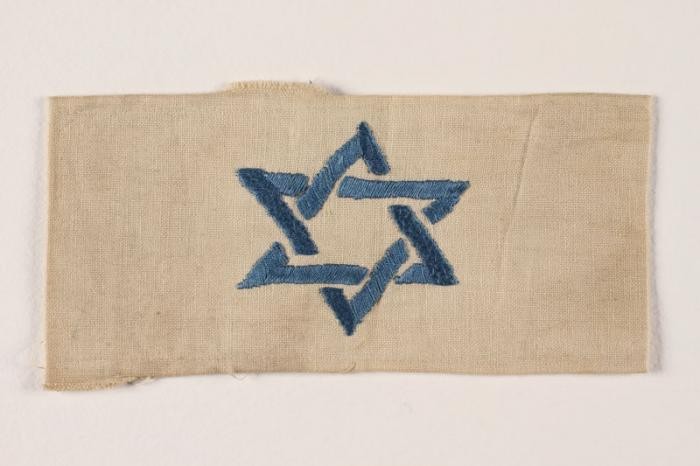
German authorities require Jews residing in the Generalgouvernement to wear white armbands with blue Stars of David for purposes of identification.
January–March, 1940
German authorities require Jews residing in the Generalgouvernement to register all property and assets.
May, December 1940
German authorities expel some 55,000 Krakow Jews out of the city into the surrounding countryside.
March 21, 1941
German authorities establish a ghetto in which they require the remaining Jews living in the city to reside. Located in the Podgorze section of Krakow, the ghetto houses between 15,000 and 20,000 Jews.
June 1941
The SS and Police Leader for Krakow establishes a forced-labor camp for Jews in Krakow-Plaszow. During the next year, the SS and police establish eight other forced-labor camps for Jews in Plaszow, with the central camp on Jerozolimska Street. Among these camps is the forced-labor camp for Jews deployed in the German Enamel Products firm owned by Oskar Schindler.
March 23–24, 1942
The Gestapo (German secret state police) arrests 50 Jewish intellectuals residing in the Krakow ghetto and deports them to Auschwitz, where all of them are registered as prisoners.
MARCH 1942
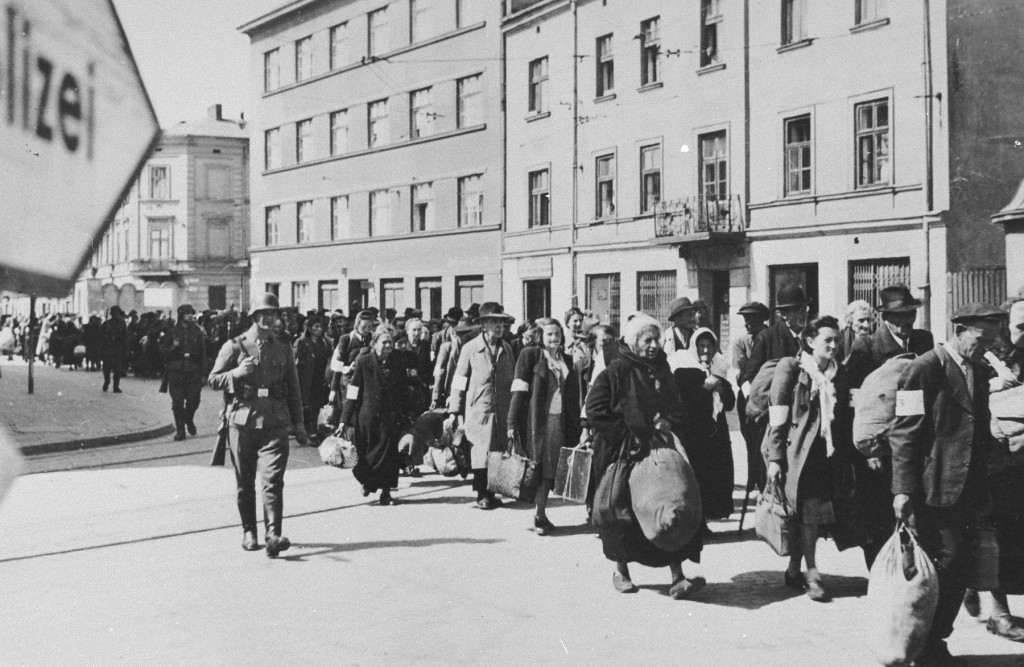
The SS and police deport 1,500 Jews from the Krakow ghetto via Plaszow to the Belzec killing center.
June 1 and 6, 1942
The SS and Police deport up to 7,000 Jews from the Krakow ghetto via Plaszow to the Belzec killing center. The Plaszow camp staff kills nearly 1,000 of these Jews before the train resumes its journey to Belzec.
October 28, 1942
The SS and Police deport approximately 6,000 Jews to Plaszow. They kill at least 600 during the operation in the ghetto, 300 of them children. After a selection to determine individuals suited for labor, the SS sends the overwhelming majority of Jews on this transport to the Belzec killing center.
December 23, 1942
Members of the Jewish Fighting Organization, the underground resistance group in the ghetto, and partisans from the Communist People's Army attack the Café Cyganeria, an establishment catering to German military personnel, and kill several Germans.
March 13–16, 1943
SS and police authorities liquidate the Krakow ghetto. During the operation the SS kill approximately 2,000 Jews in the ghetto and transfer another 2,000 Jews, the members and families of the Jewish council, and the Krakow ghetto police force to Plaszow. The SS and Police transport approximately 3,000 more Krakow Jews to Auschwitz-Birkenau, where the camp authorities select 499 men and 50 women for forced labor. The rest, approximately 2,450 people, are murdered in the gas chambers.
September–December 1943
The camp authorities and guards at the Plaszow forced-labor camp for Jews murder virtually all of the Jewish prisoners in a series of mass shootings.
JANUARY 1944
The SS Economic and Administration Main Office takes over the Plaszow camp and converts it into the Krakow-Plaszow concentration camp. The SS liquidates the remaining forced-labor camps for Jews in the Krakow and Radom Districts of the Generalgouvernement and concentrates the Jewish forced laborers in Krakow-Plaszow. In spring 1944, the SS also transports Hungarian Jews to Krakow-Plaszow.
January 14, 1945
The SS guards evacuate the last 636 Jews from Krakow-Plaszow in the direction of Auschwitz.
January 17, 1945
Hans Frank and his administration flee Krakow.
January 19, 1945
Soviet troops enter Krakow.
Critical Thinking Questions
- Learn about the lives of the Jews in the community of Krakow before 1939.