

The Nazi Persecution of “Asocials”
The Nazi German regime persecuted certain Germans whom they viewed as social outsiders. This included marginalized and impoverished people, especially those who lacked permanent addresses and stable jobs. The Nazis derogatorily referred to these people as “asocials.” The Nazi German regime forcibly sterilized and wrongfully imprisoned tens of thousands of people as asocials.
Key Facts
-
1
In Nazi Germany, authorities imprisoned tens of thousands of people labeled as asocial in jails, workhouses, labor camps, and concentration camps.
-
2
German doctors, scientists, social workers, public health officials, and police officers were among the authorities that persecuted people as asocials during the Nazi era.
-
3
In concentration camps, prisoners categorized as “asocials” were required to wear a black triangle badge on their camp uniform.
In Nazi Germany, authorities persecuted tens of thousands of people they derogatorily called “asocials” (Asozialen). People labeled as “asocials” often lacked permanent addresses or stable jobs. They were seen as outsiders in German society.
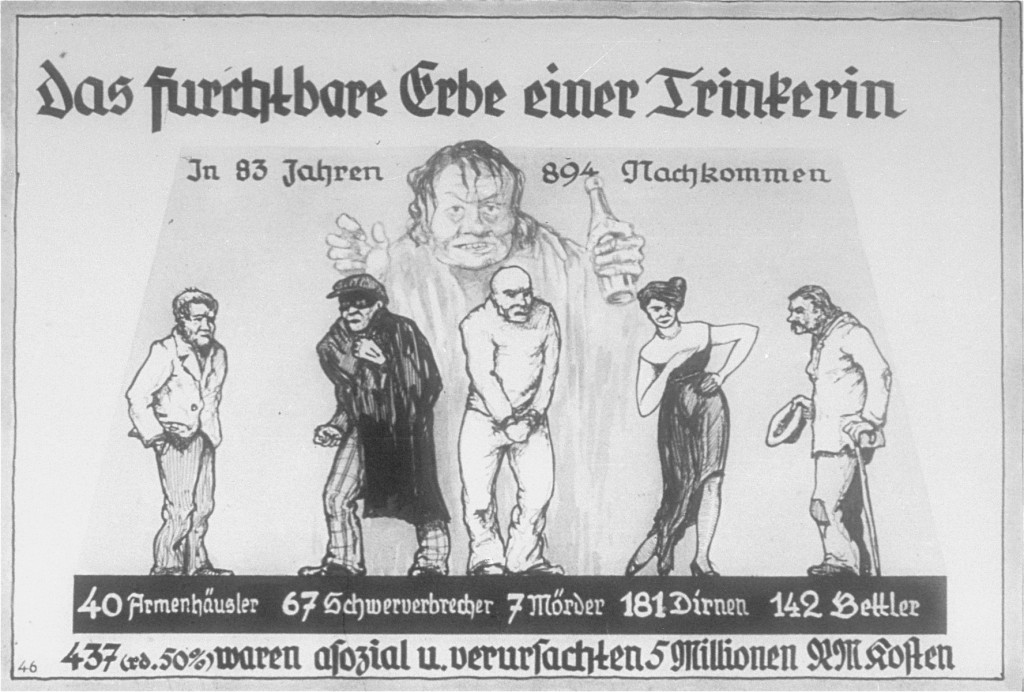
The Nazis viewed these Germans as biologically inferior and socially deviant. The Nazis understood “asociality” (Asozialität) as a hereditary threat to the German people’s community (Volksgemeinschaft). They wanted not only to discipline Germans they saw as asocial, but to eliminate asociality entirely.
During the Nazi era, many different German authorities persecuted people they called “asocials.” The regime identified these people based on information from police officers, social workers, civil servants, public health officials, and medical professionals. The German police and judicial authorities also played a very important role in this process. They imprisoned tens of thousands of people labeled as asocials in prisons, workhouses, and even concentration camps. At first, they did so on the basis of laws and policies that predated the Nazi era. But by the late 1930s, the Nazi criminal police (the Kripo) used preventive detention (Vorbeugungshaft) to target asocials. Preventive detention was a new power granted to the Kripo by the Nazi dictatorship. It allowed the Kripo to imprison certain types of people, including people labeled as asocials, without charging them with a crime.
Many people targeted by the Nazis as asocial had experienced exclusion and discrimination before the Nazi era. Many had been arrested multiple times for begging, vagrancy, or prostitution. But the Nazi regime harassed and terrorized them to a much greater extent than previous governments had. The Nazi regime wrongfully imprisoned, forcibly sterilized, and, in some cases, murdered asocials. However, there was no organized program of mass murder that targeted people labeled as asocials.
What Did the Term “Asocial” Mean in Nazi Germany?
The German word asozial directly translates into English as asocial or antisocial. It most closely refers to older and less common definitions of these words. Asozial refers to a person considered to be outside mainstream society or who did not conform to social norms, especially in the areas of housing, work, and family life.
The term “asocial” did not simply mean any nonconformist. Nor was it just a catchall word for anyone the Nazi regime disliked. The term “asocial” had a specific meaning related to social class. It applied almost exclusively to people who were both impoverished and socially marginalized. These people were considered social outsiders in German society because they broke laws related to begging, vagrancy, or prostitution or because they did not work. Many people labeled as asocials likely had mental disabilities or psychiatric disorders.
Specifically, the category of asocials included people the regime saw as vagabonds, beggars, homeless people, prostitutes, procurers (pimps), and alcoholics. It also included people (often able-bodied men) who were labeled “workshy” (Arbeitsscheu). The term “workshy” described a person unwilling to hold a steady job and/or financially support their family.
Roma and other people derogatorily labeled as “Gypsies” were often treated as “asocial.” This was based on stereotypes about Romani people and a distrust of itinerant lifestyles.
Nazi Ideology: Excluding Asocials from the People’s Community
Nazi ideology shaped how the regime treated marginalized and impoverished people in Germany. The Nazi campaign against asociality was part of the Nazis’ attempt to create a utopian people’s community (Volksgemeinschaft). The Nazi vision of the people’s community was based on Nazi racial ideology. This meant that only people identified as “German-blooded” could belong to it. It also meant that Jewish, Romani, and Black people were excluded from the definition of Volksgemeinschaft.
Only those people whom the Nazis considered genetically and socially valuable could be members of the people’s community. The Nazis called these people Volksgenossen (national comrade or member of the people). A “national comrade” was defined as someone of “German blood.” But not all people with “German blood” were welcome in the people’s community. The Nazi regime considered some people inferior outcasts even if they had “German blood." They labeled these people “community aliens” (Gemeinschaftsfremde). Nazi German authorities often used the terms “asocial” and “community alien” interchangeably.
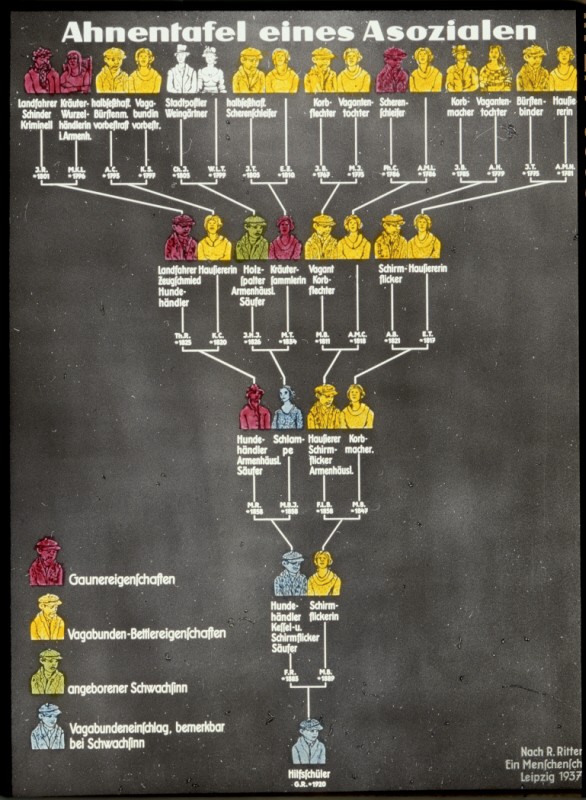
In the Nazi view, these so-called asocials posed both a behavioral and biological danger to the people’s community. First, the Nazis believed that their supposedly asocial behavior kept them from contributing to society. Such behavior might include not holding a regular job or not maintaining a permanent address. In this view, asocials were a drain on the people’s community because they were not contributing economically. Second, the Nazis saw “asocials” as a biological danger. They believed their behaviors resulted from genetic inferiority. They thought asocials passed on their supposedly asocial traits to their children. They also believed that asocial parents were more likely to have children who would grow up to be criminals.
Arresting Asocials: The “Beggar Raids” of 1933
After the Nazis came to power in Germany in January 1933, various German authorities began to target people they saw as “asocials.” In the first years of the Nazi regime, the authorities focused on people visible on the streets. In particular, they targeted people believed to be beggars or prostitutes. Germans who worked on the streets or lived in shelters had little chance of escaping the Nazi regime’s attention.
In September 1933, the Nazi regime organized its first coordinated attack on asocials. It was known as the “Beggar Raids” (Bettlerrazzien). This arrest wave was a joint effort of the Propaganda Ministry and German police forces, with support from the SA and the SS (Nazi Party paramilitaries). Police officers and members of the SS and SA carried out raids on overnight shelters, hostels, and other locations.
About 10,000 people were arrested as beggars and vagrants during these raids. In many cases, those arrested were charged with vagrancy under existing German laws. They were released after they served their sentences. In other cases, they were detained in early concentration camps, including Dachau. The small Gumptershof concentration camp was established specifically to house around 50 people arrested during these raids. The Nazi-controlled press celebrated the regime’s efforts as “cleaning up the streets.”
Exclusion of “Asocials” from Public and Private Social Assistance in Nazi Germany
After coming to power, the Nazi German regime quickly took full control over public welfare institutions. They began to restrict who was eligible for public assistance. The Nazis also took over or closed various private charitable organizations. Those charities that were allowed to continue to operate aligned themselves with the Nazi regime. This gave people who needed social assistance fewer options.
The largest and most important charity in Nazi Germany was run by the Nazi Party. It was called the National Socialist People's Welfare (Nationalsozialistischen Volkswohlfahrt, NSV). The NSV raised money and distributed benefits according to Nazi ideology. Other charities were subsumed under the new German Association of Voluntary Public Welfare (Arbeitsgemeinschaft der Freien Wohlfahrtspflege Deutschlands). These charities included the German branches of the Red Cross and Carita. These charities remained independent in name only. In practice, they operated under an umbrella organization led by the NSV.
Forced Sterilization of Asocials
The Nazi regime forcibly sterilized many people whom they labeled as asocials. These people were sterilized under a new Nazi law called the Law for the Prevention of Offspring with Hereditary Diseases (Gesetz zur Verhütung erbkranken Nachwuchses or “Hereditary Health Law”). This law was enacted on July 14, 1933. It mandated the forced sterilization of people identified as having any of the nine conditions named in the law. These conditions were assumed to be hereditary. The nine conditions listed in the law were:
- “congenital feeblemindedness”;
- schizophrenia;
- “circular (manic-depressive) insanity” [today, bipolar disorder];
- hereditary epilepsy;
- “hereditary St. Vitus’ dance (Huntington’s chorea)” [today, Huntington’s disease];
- hereditary blindness;
- hereditary deafness;
- severe hereditary physical deformity; and
- “severe alcoholism.”
Some people labeled as asocials were also diagnosed with these conditions and sterilized. However, even people who did not seemingly fit the diagnostic criteria were sterilized under the law. The Nazi regime used the first category, “congenital feeblemindedness,” as a catchall. Among those sterilized as congenitally feebleminded were people whom the regime considered socially deviant or who could not pass tests that supposedly measured social conformity. Many people whom the regime labeled as asocials were sterilized under the law for these reasons.
The Turning Point: The December 1937 Decree on Preventive Crime Fighting
A turning point in the Nazi persecution of people labeled as asocials came in late 1937. On December 14, 1937, the Reich Ministry of the Interior issued a decree relating to the preventive detention (Vorbeugungshaft) of asocials and professional criminals in concentration camps. The decree was titled the “Basic Decree on Preventive Crime Fighting by the Police” (Grundlegender Erlaß über die vorbeugende Verbrechensbekämpfung durch die Polizei). It expanded the power of the Nazi Kripo. The Kripo was granted the power to detain thousands of people who had never been convicted of a crime in concentration camps. This included people identified as asocials. These people could be subjected to arbitrary arrest, police surveillance, and indefinite internment in concentration camps.
The timing of the December 1937 decree coincided with the SS desire to expand the prisoner population for forced labor. That year, new camps were added to the concentration camp administration system. This included the Flossenbürg concentration camp. Flossenbürg was intended to house people imprisoned as “asocials” and “professional criminals.” However, “asocial” prisoners were also imprisoned in camps throughout the concentration camp system.
The June Action, 1938
In 1938, the Nazi German regime carried out several arrest waves. These waves targeted people labeled as asocials and professional criminals. Using the powers identified in the December 1937 Decree, Nazi authorities detained thousands of people and imprisoned them extralegally in concentration camps. These targeted arrests are commonly known as “Operation Workshy” (Aktion Arbeitsscheu).
In April 1938, Gestapo (Secret State Police) officials arrested 1,782 persons whom they labeled as “workshy.” They sent them to concentration camps as “asocials.”
Then in June 1938, the Kripo carried out a much broader arrest wave. On June 1, 1938, the leader of the Security Police, Reinhard Heydrich, sent a memo to all fifteen Kripo main offices located throughout Nazi Germany. He informed them of an upcoming arrest wave targeting “asocials” and “professional criminals.” This wave was scheduled for June 15–18, 1938. Heydrich instructed each Kripo office to arrest at least 200 men capable of working. They were ordered to send them to concentration camps in accordance with the December 1937 decree. Heydrich specified that the police should arrest:
- “vagrants” (“Landstreicher”);
- “beggars” (“Bettler”);
- “Gypsies” (“Zigeuner”);
- “procurers” (“Zuhälter”); and
- persons with a criminal record “who have shown that they do not want to fit into the order of the national community.”
Heydrich also instructed the police to target Jewish men with even minor criminal records.
The Kripo officials exceeded expectations. Policemen arrested people at railroad stations, bars, and homeless shelters. They did so with the help of social workers, welfare employees, and others. During this action, the Kripo arrested and imprisoned around 12,000 men as “asocials” or “professional criminals.” Hundreds of Jewish men were arrested as part of this operation. This was the first mass arrest of Jews in Nazi Germany. Several hundred Romani men were also arrested and sent to concentration camps during this arrest wave.
The Black Triangles: Asocials in the Concentration Camps
The Nazi regime imprisoned tens of thousands of people in concentration camps as “asocials.” Eventually, many of these prisoners were required to wear a black triangle on their camp uniforms as part of the prisoner classification system. There were asocial prisoners in concentration camps as early as 1933. However, asocials only became a significant prisoner group in concentration camps in 1938, after the December 1937 decree.
Women imprisoned as asocials had often been accused of sexual transgressions. Some had worked as prostitutes. Others had children out of wedlock and/or with multiple men. Some lesbians were arrested as asocials. A small number of women imprisoned as asocials were forced to work in camp brothels.

Delayed Recognition as Victims of Nazi Persecution
In February 2020, the German parliament officially recognized people persecuted by the Nazi German regime as asocials as victims of Nazism for the first time. Before this date, individuals arrested and imprisoned by the Nazis as asocials had gone largely unrecognized as Nazi victims. For example, West Germany’s 1953 compensation law only recognized people persecuted for political opposition and those persecuted “on the grounds of race, religion, or ideology.” Some scholars have referred to asocials as among the “forgotten victims” of the Nazis.
Scholars continue to research and uncover the stories of people persecuted as “asocials.” Their stories help illuminate not only the experiences of marginalized and impoverished Germans under the Nazis, but also the far-reaching impact and tragic consequences of Nazi ideology.
Footnotes
-
Footnote reference1.
Before and during the Nazi era, German policemen and judicial authorities charged people under Paragraphs 361 and 362 of the German criminal code, enacted in 1871. These statutes allowed the imprisonment of anyone who wandered as a vagrant, begged or sent their children to beg, or who did not have proper housing. Also subject to imprisonment were men who “indulged in gambling, drinking or idleness to such an extent” that they could not care for their dependents. Men who received welfare but refused to work “because of work-shyness” could also be imprisoned along with women who worked in prostitution.