

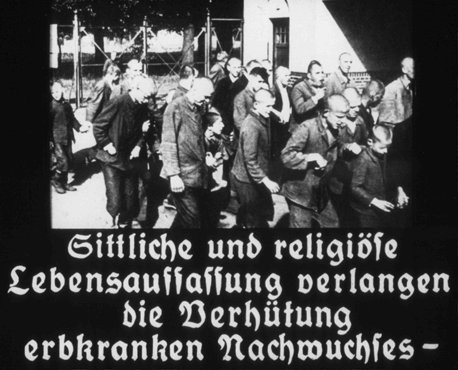
Forced Sterilization: A Form of Nazi Persecution
Forced sterilization was a key form of Nazi persecution and a tool of Nazi genocide. Between 1933 and 1945, the Nazi German regime forcibly sterilized hundreds of thousands of people. The Nazis considered these people to be racially inferior or biologically flawed. Their goal was to prevent them from passing along their supposedly inferior racial or genetic traits to future generations.
Key Facts
-
1
Among those groups forcibly sterilized during the Nazi era were people with mental or physical disabilities; Roma and other people derogatorily labeled as “Gypsies”; and Black and multiracial people in Germany.
-
2
In Nazi Germany, vasectomy was the usual sterilization method for men. Tubal ligation was the usual method for women.
-
3
At Auschwitz and other concentration camps, doctors performed inhumane experimental sterilizations on hundreds of prisoners without their consent.

Forced sterilization was a form of Nazi persecution and a tool of Nazi genocide. Sterilization is a medical procedure that prevents a person from reproducing. Forced sterilization means that the medical procedure was carried out on a person without proper consent.
From 1933 to 1945, the Nazi German regime forcibly sterilized people whom they considered to be racially inferior or biologically flawed. The Nazis’ goal was to prevent them from passing along their supposedly inferior racial or genetic traits to future generations. The Nazi regime forcibly sterilized hundreds of thousands of people. Among those sterilized were people with disabilities, Roma, and Black people in Germany. Nazi leaders believed that these people represented threats to the health, strength, and purity of the “Aryan” race.
In Nazi Germany, vasectomy was the usual sterilization method for men. Tubal ligation was the usual method for women. The Nazi regime also castrated some men accused of homosexuality and certain sexual crimes. During World War II, SS doctors carried out inhumane sterilization experiments on concentration camp prisoners at Auschwitz and Ravensbrück.
Today, under international law, forced sterilization can be prosecuted as a war crime or a crime against humanity.
Forced Sterilization: A Tool of Eugenics
Forced sterilization is a tool of eugenics. In the early twentieth century, eugenics was a popular field of scientific study. It argued that society could be improved by selective breeding. Supporters and practitioners of eugenics are called eugenicists. The field of eugenics has largely been discredited.
Eugenicists thought that social problems—such as criminality and poverty—stemmed from hereditary, not environmental, factors. They tried to identify hereditary causes for those problems. They also proposed biological solutions. One of their proposed solutions was the sterilization of people whom they considered to be criminal, inferior, or depraved. Many eugenicists advocated for voluntary or compulsory sterilization in order to prevent individuals whom they deemed inferior from reproducing.
The Nazi German regime (1933–1945) embraced eugenics. The Nazis used eugenic tools, such as forced sterilization, to target people whom they deemed racially or biologically inferior.
The Nazi Hereditary Health Law and the Forced Sterilization of People with Disabilities
On July 14, 1933, the Nazi dictatorship enacted the Law for the Prevention of Offspring with Hereditary Diseases (Gesetz zur Verhütung erbkranken Nachwuchses or “Hereditary Health Law”). This law mandated the forced sterilization of people identified as having any of the nine conditions assumed to be hereditary and named in the law. The conditions as listed in the law were:
- “congenital feeblemindedness”;
- schizophrenia;
- “circular (manic-depressive) insanity” [today, bipolar disorder];
- hereditary epilepsy;
- “hereditary St. Vitus’ dance (Huntington’s chorea)” [known today as Huntington’s disease];
- hereditary blindness;
- hereditary deafness;
- severe hereditary physical deformity; and
- “severe alcoholism.”
The goal of the law was to prevent the birth of children who also had these conditions.
Under the Nazi regime, the condition of “congenital feeblemindedness” (“angeborenem Schwachsinn”) was diagnosed broadly. The regime included in this category people whom they considered socially deviant or who could not pass tests that allegedly measured intelligence or social conformity. Many people labeled by police officers or social workers as “asocial” were sterilized as “feebleminded.” These included Black, multiracial, and Romani Germans.
Special Hereditary Health Courts
Under the Hereditary Health Law, individuals could voluntarily apply to be sterilized. But, they could also be nominated by others. Doctors, public health officials, health care administrators, and others submitted names of people whom they believed should be sterilized. Each case appeared before a special hereditary health court (Erbgesundheitsgericht, EGG). These courts were composed of a judge, a public health physician, and an outside expert physician. The courts lent an aura of due process to the sterilization measure. But, in the vast majority of cases, they decided in favor of forced sterilization.
Once the court decided in favor of forced sterilization, an approved doctor performed the surgery. If a patient refused to appear for the surgery, the police could force them to undergo the procedure. Hundreds of people, mostly women, died as a result of these forced sterilizations.
In total, an estimated 400,000 Germans were forcibly sterilized under the law.
Extralegal Forced Sterilization of Black and Romani People in Nazi Germany
The Nazi German regime also sterilized some people extralegally, or without legal cause. Included in this group were Black, multiracial, and Romani people.
Extralegal Forced Sterilization of Black and Multiracial People in Germany
The Nazi regime forcibly sterilized hundreds of Black and multiracial people in Germany because the Nazis hoped to prevent the birth of future generations of these groups. They sought to prevent what they saw as “race-mixing.”
In the 1930s, a secret Gestapo program coordinated the forced sterilization of a group of multiracial children in the Rhineland (derogatorily called “the Rhineland bastards” or “Rheinlandbastarde”). As part of these efforts, doctors forcibly sterilized at least 385 children and teenagers by the end of 1937. Because there was no legal basis for their sterilization, their families were pressured to consent to the procedure.
The Nazi regime also forcibly sterilized an unknown number of Black people and multiracial people in Germany without any legal basis during World War II (1939–1945).
Forced Sterilization of Roma and Sinti in Germany
The Nazi German regime forcibly sterilized approximately 2,500 Romani people for racial and biological reasons. About 500 of these sterilizations occurred under the Hereditary Health Law. They often took place on the recommendation of the police or following childbirth or medical treatment.
With the outbreak of World War II, the Nazi German regime increasingly carried out forced sterilizations of Roma outside of any legal framework. German authorities forcibly sterilized people whom they labeled as Zigeunermischlinge (“mixed race Gypsies”) instead of deporting them to Auschwitz. In early 1945, Dr. Franz Lucas sterilized about 40 Romani veterans of the German military at the Ravensbrück men’s camp. Roma were also subjected to cruel sterilization experiments at concentration camps.
Castration in Nazi Germany
The Nazi German judicial system also introduced castration as a legal practice. As of late 1933, courts could order mandatory castration for certain sexual offenders. In 1935, an amendment to the Hereditary Health Law indicated that a man convicted of certain sexual crimes could choose “voluntary” castration. According to the amendment, this choice would enable the man to “free himself from a degenerate sex drive that could lead to further offenses.” This amendment applied to men accused of violating Paragraph 175. Paragraph 175 was the German statute that criminalized sexual relations between men. In some cases, men imprisoned under this statute could secure early release if they volunteered to be castrated.
Sterilization Experiments on Prisoners in Concentration Camps
During World War II, doctors carried out medical experiments at concentration camps. Many of these experiments were painful and often deadly. They were performed on thousands of prisoners without their permission. Forced sterilization was one of these experiments.
Beginning in 1942, research gynecologist Dr. Carl Clauberg conducted medical experiments at the Auschwitz concentration camp complex. He intended to develop a method of non-surgical mass sterilization. He used several hundred, mostly Jewish women, as subjects. Dr. Clauberg injected toxins into their fallopian tubes, causing them to grow together. These chemical sterilizations often resulted in severe pain, sepsis, organ failure, and death. As Soviet forces approached Auschwitz, Clauberg relocated to the Ravensbrück concentration camp. There, he continued to experiment with sterilization of Romani prisoners.
SS officer Dr. Horst Schumann also conducted sterilization experiments at Auschwitz. He used X-ray machines to forcibly sterilize Jewish prisoners, male and female, by exposing their reproductive organs to X rays. The X rays left radiation burns and disfigurement that caused severe pain. These experiments sometimes resulted in deaths.