
The United States: Isolation and Neutrality between World War I and World War II
Between World War I and World War II, the United States adopted a foreign policy guided by isolationism. From 1939 to 1941, during the first two years of World War II, the United States remained officially neutral. At the same time, it took steps to prepare the nation for war. It also supported Great Britain and other countries in their fight against Nazi Germany. The United States’ policy of neutrality crumbled in December 1941, when the Japanese Empire attacked US territories, and Germany declared war on the United States.
Key Facts
-
1
After World War I (1914–1918), the United States sought to isolate itself from international affairs. The US government emphasized neutrality, decreased the size of the military, and decided not to join the League of Nations.
-
2
Between 1939 and 1941, President Franklin D. Roosevelt and the US Congress supported Great Britain and other Allied nations as they fought against Nazi Germany. They also took steps to prepare the United States for war.
-
3
The US commitment to neutrality ended in December 1941, when Japan attacked Pearl Harbor and Nazi Germany declared war on the United States.
In the years after World War I (1914–1918), the United States isolated itself from political conflicts abroad. Beginning in the mid-1930s, however, international unrest put US isolationism and neutrality to the test. During this time, the US Congress passed measures to help ensure that the United States would stay out of foreign conflicts. Nevertheless, the US government took steps after World War II began in September 1939 to prepare the country for war.
US Foreign Policy after World War I
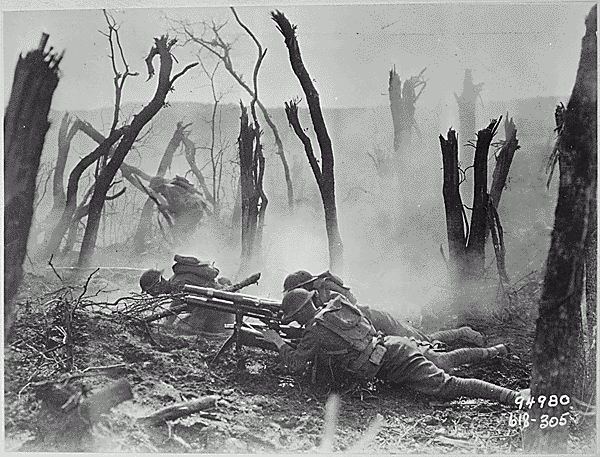
The brutality of World War I shocked Americans. In the relatively short time that the United States was involved in the war (April 1917 to November 1918), more than 116,000 American soldiers died. In addition, more than 200,000 were wounded. In the war’s aftermath, most Americans hoped the United States would not intervene in any future wars abroad. US foreign policy was guided by similar isolationist sentiment.
1919–1920
In January 1919, representatives from nearly 30 countries, including the United States, gathered at the Paris Peace Conference to negotiate the terms of peace after World War I. An outcome of the conference was the Treaty of Versailles, one of several agreements that ended the war.
President Woodrow Wilson strongly supported the Treaty of Versailles. But the US Senate refused to ratify it. Some senators opposed the treaty’s provision to form the League of Nations. This international organization (officially established in 1920) promoted cooperation among nations. Opposing senators were concerned that ratifying the treaty might compel the United States to fight in future conflicts abroad.
In the end, a policy of isolationism won out. The United States neither ratified the Treaty of Versailles nor joined the League of Nations, even though President Wilson wanted to do both.
The 1920s
In the decade after World War I, the US government signalled a growing commitment to isolationism. It continued to limit the size of the US military and cut funding for military personnel and arms.
In both 1921 and 1924, the US Congress passed laws designed to reduce immigration. These measures introduced quotas that severely limited immigration. They were another expression of American isolationism in government policy.
In 1928, the US Senate ratified the Kellogg-Briand Peace Pact, an international agreement among 15 nations. The countries agreed to solve conflicts peacefully and ban war as a means to resolve diplomatic disputes. Over time, an additional 47 nations signed the pact.
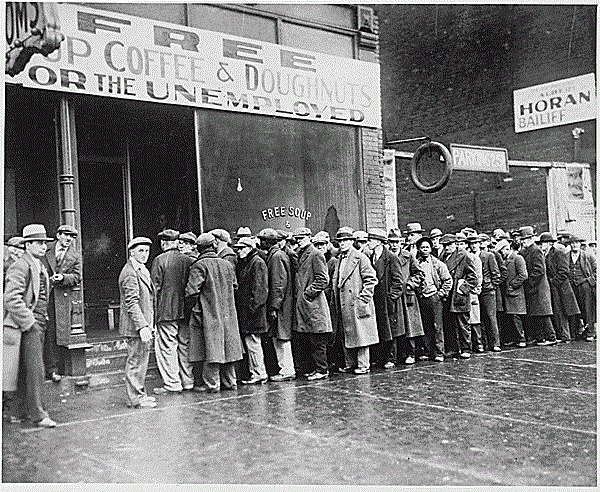
The onset of the Great Depression in 1929 strengthened the US government’s commitment to limiting immigration. Government officials who hoped to restrict immigration claimed that immigrants endangered the health of society. These officials also said immigrants had foreign, sometimes radical, political ideas that would pollute American culture.
1930s: International Unrest and US Neutrality
Political and military conflicts erupted in many parts of the world during the 1930s. The Empire of Japan invaded and conquered Manchuria in 1931. In 1935, Italy invaded Ethiopia. The following year, civil war began in Spain. In 1937, Japan went to war with the Republic of China. During these years, the Nazi German regime violated the terms of the Treaty of Versailles. For example, the regime rebuilt Germany’s military (1935) and stationed armed forces in the Rhineland (1936). It also annexed neighboring Austria (1938) and parts of Czechoslovakia (1938 and 1939). On September 1, 1939, Germany invaded Poland and started World War II.
These conflicts tested the United States’ commitment to staying out of conflicts abroad. Many Americans worried that the United States would have to intervene in another foreign war. American leaders and citizens alike disagreed over whether the United States should get involved if another world war were to begin.
Neutrality Acts for a Neutral Nation
During the 1930s, the US Congress passed a series of laws known as “Neutrality Acts.” The acts signaled both to the American people and to foreign countries that the United States intended to remain neutral in the event of war.
1935
The Neutrality Act of 1935 prohibited sending “arms, ammunition, and implements of war” from the United States to foreign nations at war. The act was renewed in 1936.
1937
In 1937, a second Neutrality Act prohibited Americans from traveling on ships owned by any warring nation. It also declared that the United States could not export weapons to warring nations and that American-owned ships could not carry any arms intended for war zones. The 1937 act did allow warring countries to purchase items (except arms) from the United States, as long as those nations immediately paid for the items they acquired and transported them on non-American ships. This was known as the “cash-and-carry” provision of the law.
1939
On September 3, 1939, two days after Germany invaded Poland, Great Britain and France declared war on Germany. The same day, President Roosevelt addressed Americans on the radio. He stated that the United States would remain a neutral nation, meaning that it would avoid getting involved in the war.
Congress passed a third Neutrality Act in November 1939. It lifted the arms embargo of 1937 and allowed the United States to trade with nations that were at war. The “cash-and-carry” provision of the law, established in 1937, now applied to weapons as well.
1940–1941: Arsenal of Democracy
By mid-1940, Nazi Germany had conquered multiple European countries. In addition, Great Britain was in danger of being defeated by Nazi Germany. The Roosevelt administration looked for ways to support Great Britain without having the United States officially enter the war.
Nevertheless, between 1940 and 1941, the US government took steps to prepare the United States in the event of war. These measures tilted the United States away from a strict policy of neutrality.
Destroyers for Bases
In May 1940, British Prime Minister Winston Churchill asked President Roosevelt to provide naval destroyers, aircraft, and anti-aircraft equipment. After several months of negotiations, Roosevelt announced the “destroyers for bases” deal on September 2, 1940. The United States exchanged 50 old US Navy ships for a 99-year lease to place US military bases on British-controlled territory in Canada and the Caribbean.
Peacetime Military Draft
In September 1940, the US Congress passed the Selective Training and Service Act. This act led to the first peacetime military draft in US history. It required all male citizens and residents of the United States between the ages of 21 and 36 to register for the draft. Men who were drafted were expected to serve for one year on active duty, followed by ten years in reserve, until the age of 45. Draft registration began in October 1940, and the first men drafted entered the military the next month.
Although some protests against the military draft were held on college campuses, most Americans expressed their approval of the draft.
Roosevelt’s “Arsenal of Democracy” Speech
In a radio address on December 29, 1940, President Roosevelt told Americans that the United States “must be the great arsenal of democracy.” He meant that the US government should provide planes, ships, guns, and ammunition to support Great Britain’s war effort.
Lend-Lease
In January 1941, US Congress members who supported President Roosevelt introduced H. R. (House Resolution) 1776. It was also known as the “Lend-Lease Act” or “An Act to Promote the Defense of the United States.” This act proposed granting the US president’s administration the power to lend war supplies to other nations deemed vital to US security.
Despite strong opposition from isolationists across the United States, the proposal passed easily. President Roosevelt signed the Lend-Lease Act into law on March 11, 1941. Great Britain became the first recipient of US aid. The Soviet Union, France, and China also received financial support.
Convoys
Even before the Lend-Lease Act passed in 1941, some American factories had begun to convert their operations to war-related manufacturing. Goods produced in North America already were being transported to Great Britain in convoys. Convoys were groups of merchant ships protected by naval escorts. These convoys, which brought food, equipment, and weapons into Britain, faced direct threats of attack from German U-boats.
December 1941: The United States Goes to War
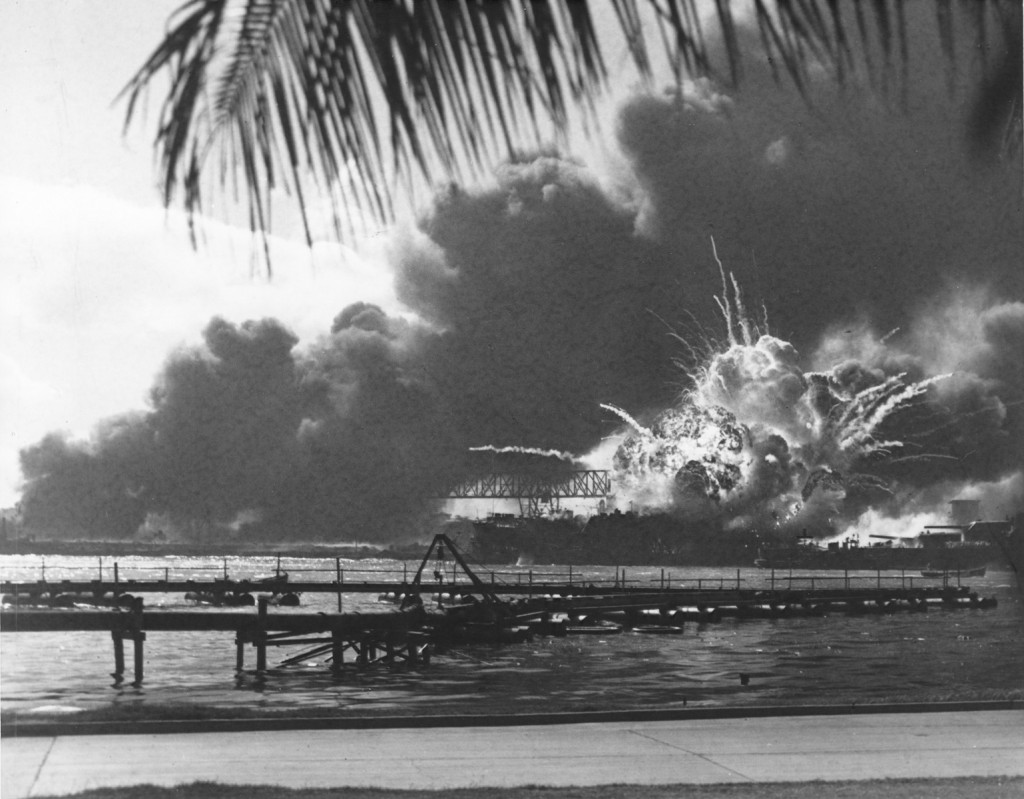
On December 7, 1941, the Imperial Japanese Navy launched a surprise aerial assault on multiple US territories, including the US Pacific Fleet at Pearl Harbor, Hawaii. The attack at Pearl Harbor destroyed eight battleships and numerous other boats and planes. More than 2,300 Americans were killed.
The nation’s commitment to neutrality ended with Japan’s attack. On December 8, the United States declared war on Japan. This was quickly followed by Germany’s declaration of war on the United States on December 11. The United States declared war on Germany that same day.
For the next three-and-a-half years, US military forces would fight a war to defend democracy on two fronts, in both the European and the Pacific theaters.
We are now in this war. We are all in it—all the way. Every single man, woman and child is a partner in the most tremendous undertaking of our American history.
—President Franklin D. Roosevelt, Radio Address on December 9, 1941, two days after Japan attacked Pearl Harbor
Footnotes
-
Footnote reference1.
Franklin D. Roosevelt, “Fireside Chat 16,” December 29, 1940, Miller Center, University of Virginia, transcript and audio, 36:56, https://millercenter.org/the-presidency/presidential-speeches/december-29-1940-fireside-chat-16-arsenal-democracy.
-
Footnote reference2.
Franklin D. Roosevelt, “Fireside Chat 19,” December 9, 1941, Miller Center, University of Virginia, transcript and audio, 27:24, https://millercenter.org/the-presidency/presidential-speeches/december-9-1941-fireside-chat-19-war-japan.
Critical Thinking Questions
What pressures and motivations affected American citizens and government officials to intervene or to stay out of war in Europe?
What could the international community, including the United States, have done to stop the rise of Nazism in Europe and its assault on Europe’s Jews?
When do nations have a responsibility to assist other countries that come under attack?
How can nations assist other nations in wartime besides providing troops and military support?