Auschwitz was a Nazi camp that functioned as both a concentration camp and a killing center. The Nazis murdered about one million Jewish people in the Auschwitz camp complex, most in the gas chambers of Auschwitz-Birkenau. In addition to being a site of mass murder and imprisonment for Jews, Auschwitz was a site of suffering and mass death for other groups of people including Poles, Roma, and Soviet prisoners of war, among others.
![Major Nazi camps in Europe, January 1944 [LCID: eur72160]](https://encyclopedia.ushmm.org/images/large/db2e26ad-3a0a-4946-9ce2-70e513ed39d5.gif "Major Nazi camps in Europe, January 1944 [LCID: eur72160]")
This map shows some of the Nazi camps that existed in German-occupied Europe in 1943–1944. These include killing centers, concentration camps, labor camps, and transit camps.
Between 1933 and 1945, Nazi Germany established tens of thousands of camps. The regime imprisoned millions of people in these camps. The Nazis used these sites for many purposes, including the imprisonment of real and perceived enemies and the mass murder of Jewish people. Nazi camps were sites of cruelty, torture, deprivation, unchecked disease, grueling forced labor, and extreme violence.
Item View
![Europe 1943-1944, Auschwitz indicated [LCID: auc62040]](https://encyclopedia.ushmm.org/images/large/e904823f-a280-4f5b-8914-03e1df871164.gif "Europe 1943-1944, Auschwitz indicated [LCID: auc62040]")
The Auschwitz-Birkenau killing center (indicated here) played a key role in the “Final Solution,” the Nazi plan to kill the Jews of Europe. The Nazis murdered approximately one million Jews at Auschwitz, most in the gas chambers of Auschwitz-Birkenau.
Item View![Major deportations to killing centers, 1942-1944 [LCID: eur78940]](https://encyclopedia.ushmm.org/images/large/7bbc2613-3771-45d9-b906-a740cc398124.gif "Major deportations to killing centers, 1942-1944 [LCID: eur78940]")
This map shows some of the major deportations of Jews from all over Europe to Nazi killing centers in 1942–1944. It depicts transports from transit camps, ghettos, and major cities. Most Jews on these transports were murdered in gas chambers upon their arrival at the killing centers. The Nazis and their allies and collaborators coordinated these deportations as part of the “Final Solution”—the Nazi plan to murder all of Europe’s Jews
On this map, the Majdanek camp is marked as a killing center. In the past, many scholars counted Majdanek (located just outside the city of Lublin) as a sixth killing center. However, based on newer research, Majdanek is usually classified as a concentration camp (officially Konzentrationslager Lublin).
Item View![Major deportations to Auschwitz, 1941-1944 [LCID: auc78060]](https://encyclopedia.ushmm.org/images/large/c9ec53c0-5a86-46de-872f-2489ebc9feda.gif "Major deportations to Auschwitz, 1941-1944 [LCID: auc78060]")
Auschwitz was a Nazi concentration camp complex located in German-occupied Poland. Unlike other Nazi concentration camps, it also included a killing center where the Nazis murdered Jews in gas chambers. In total, the Nazis deported 1.1 million Jewish people to Auschwitz from all over Europe. Most were murdered in the gas chambers upon arrival. In total, the Nazis murdered about one million Jews in Auschwitz.
Item View![Auschwitz environs, summer 1944 [LCID: auc42030]](https://encyclopedia.ushmm.org/images/large/341a5fd2-ed4d-4067-b988-f7b0fe940fdb.gif "Auschwitz environs, summer 1944 [LCID: auc42030]")
This map shows the Auschwitz camp complex in the summer of 1944.
The SS established Auschwitz in spring 1940 as a concentration camp for Polish political prisoners. It was located in German-occupied Poland on the outskirts of the town of Oświęcim. Over the next several years, the camp was expanded and transformed into a sprawling camp complex. In March 1942, the SS began operating a killing center at Auschwitz where they murdered Jewish people from all over Europe.
By 1944, the Auschwitz camp complex included multiple camps that served different purposes. The largest of the Auschwitz camps included the Auschwitz main camp (Auschwitz I); Auschwitz-Birkenau (Auschwitz II), which included the killing center; and Auschwitz-Monowitz (Auschwitz III). There were also numerous smaller subcamps.
At Auschwitz, the Germans killed about 1.1 million people, including approximately 1,000,000 Jews; 70,000 Poles; 21,000 Roma and Sinti; and 15,000 Soviet prisoners of war.
Item View![Auschwitz I camp, 1944 [LCID: auc22013]](https://encyclopedia.ushmm.org/images/large/b1e260a8-3289-49de-8cd6-dbfdd79df0b7.gif "Auschwitz I camp, 1944 [LCID: auc22013]")
Selected Features
1. Camp Commandant's House
2. Main Guard House
3. Camp Administrative Office
4. Gestapo
5. Reception Building/Prisoner Registration
6. Kitchen
7. Gas Chamber and Crematorium
8. Storage Buildings and Workshops
9. Storage of Confiscated Belongings
10. Gravel Pit: Execution Site
11. Camp Orchestra Site
12. "Black Wall" Execution Site
13. Block 11: Punishment Bunker
14. Block 10: Medical Experiments
15. Gallows
16. Block Commander's Barracks
17. SS Hospital
Item View![Auschwitz II (Birkenau) camp, summer 1944 [LCID: auc22023]](https://encyclopedia.ushmm.org/images/large/3d7ef175-0194-4d2e-b4d2-7e9535404954.gif "Auschwitz II (Birkenau) camp, summer 1944 [LCID: auc22023]")
In October 1941, the Nazi authorities at Auschwitz began building a second camp located in the Polish village of Brzezinka (called Birkenau in German). Beginning in March 1942, Auschwitz-Birkenau functioned as both a concentration camp and a killing center, where the Nazis murdered Jews in gas chambers. From November 1943 to November 1944, Auschwitz-Birkenau was designated as a separate camp and officially referred to as Auschwitz II.
Item View![Auschwitz III (Monowitz) camp, 1944 [LCID: auc22120]](https://encyclopedia.ushmm.org/images/large/78bb3b3a-955f-419b-878d-55dfc692f64f.gif "Auschwitz III (Monowitz) camp, 1944 [LCID: auc22120]")
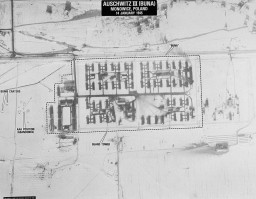
In late October 1942, the SS authorities at Auschwitz established a large subcamp that became known as Auschwitz-Monowitz. The SS established this subcamp to house Auschwitz prisoners assigned to forced labor at the I. G. Farben synthetic rubber and fuel plant. From November 1943 to November 1944, Auschwitz-Monowitz was designated as a separate camp and known as Auschwitz III. In November 1944, it became a separate concentration camp known as Monowitz. Prisoners sometimes called the camp “Buna.” Buna was the brand name for the synthetic rubber produced at the I. G. Farben factory.
Item View![Auschwitz subcamp system, Upper Silesia 1941-1944 [LCID: auc72074]](https://encyclopedia.ushmm.org/images/large/f967b4e3-1432-4992-b14c-2edaa0ac9a95.gif "Auschwitz subcamp system, Upper Silesia 1941-1944 [LCID: auc72074]")
Between 1941 and 1944, the SS authorities at Auschwitz established almost 50 subordinate camps, also called subcamps. These subcamps varied in their design and purpose, but all supported the economic and ideological goals of the SS. At the subcamps, prisoners were forced to work in farming, animal husbandry, forestry, construction, and various industries (such as coal mining, armaments production, and chemical factories).
Item View![Major death marches from Auschwitz, January 1945 [LCID: auc72080]](https://encyclopedia.ushmm.org/images/large/04d8c8d8-53fe-4d04-b3fb-438c2fab113b.gif "Major death marches from Auschwitz, January 1945 [LCID: auc72080]")
On January 17, 1945, the SS began evacuating the Auschwitz camp complex. The SS forced tens of thousands of prisoners, mostly Jews, on death marches. Prisoners from Auschwitz, Auschwitz-Birkenau, and Monowitz were forced to march either northwest for 55 kilometers (approximately 30 miles) to Gliwice (Gleiwitz) or due west for 63 kilometers (approximately 35 miles) to Wodzisław Śląski (Loslau). Once they arrived in Gliwice and Wodzisław Śląski, most prisoners were put on unheated freight trains and transported to other concentration camps in Germany. There were also death marches from Auschwitz subcamps. During the marches, SS guards shot anyone who fell behind or could not continue. Prisoners suffered from the cold weather, starvation, and exposure.
Item ViewWe would like to thank Crown Family Philanthropies, Abe and Ida Cooper Foundation, the Claims Conference, and BMF for supporting the ongoing work to create content and resources for the Holocaust Encyclopedia. View the list of all donors.