Following the German occupation of Hungary in March 1944, Bart was forced into a ghetto established in his home town. From May to July 1944, the Germans deported Jews from Hungary to the Auschwitz killing center in occupied Poland. Bart was deported by cattle car to Auschwitz. At Auschwitz, he was selected to perform forced labor, drilling and digging in a coal mine. As Soviet forces advanced toward the Auschwitz camp in January 1945, the Germans forced most of the prisoners on a death march out of the camp. Along with a number of ill prisoners who were in the camp infirmary, Bart was one of the few inmates who remained in the camp at the time of liberation. He survived to be liberated by hiding in the camp even after many other prisoners had been forced on a death march in January 1945.
Item ViewJames A. Rose, of Toledo, Ohio, was with the 42nd (Rainbow) Division.
Item ViewFrank F. Hamburger, Jr., of Columbus, Georgia, was with the 65th Infantry Division.
Item ViewGI Edward S. Weiss, a resident of Gaithersburg, Maryland, was at the Dachau concentration camp shortly after its liberation.
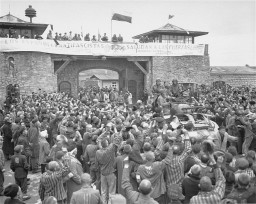
Item ViewDallas Peyton of Tucson, Arizona, was a member of the 70th Armored Infantry. In 1945, with other liberating troops, he entered the Dachau camp and encountered survivors and evidence of atrocities.
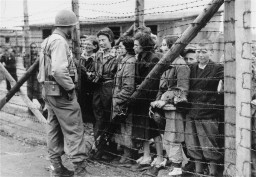
Item ViewGeorge was liberated by the American forces in May 1945. He had spent three years during the war in ten different concentration camps. In 1945 he was in the Wöbbelin camp in Germany. After liberation, he spent over two years in various displaced persons camps. George immigrated to the United States in October 1947.
Item ViewPat was one of thousands of US nurses who served in evacuation hospitals during the liberation of concentration camps in Europe. She cared for camp survivors, many of whom were in critical condition upon liberation.
Item ViewThe Germans occupied Kolo in 1939. In 1942 Alan was deported to the Łódź ghetto where he worked in food distribution. He took food each day to Mordechai Chaim Rumkowski, chairman of the Jewish council. In 1944 Alan was forced to unload trainloads of coal and munitions in Czestochowa. In 1945 he was sent to the Dora-Mittelbau camp. As the Soviet army advanced, the inmates were transferred to Bergen-Belsen, where British forces liberated them in April.
Item ViewAbraham Lewent (1924–2002) was born in Warsaw, Poland in 1924. The Lewent family was living in Warsaw when the Germans invaded Poland in September 1939. Later, the Lewents were confined to the Warsaw ghetto. In summer 1942, Abraham's mother and three younger sisters were rounded up during the Great Action—the mass deportation of Jews from the Warsaw ghetto to the Treblinka killing center. They were likely killed upon arrival. Abraham was not caught in the Great Action, because during the round up he hid in a small space in the ceiling. Afterwards, Abraham found a forced labor assignment at a nearby airfield. He returned to the ghetto in December 1942, reuniting with his father. During the Warsaw ghetto uprising in April–May 1943, Abraham and his father saw the ghetto being burned to the ground. They were eventually rounded up and sent to the Lublin concentration camp (called Majdanek). Abraham's father died there. Later, Abraham was sent to the Skarżysko-Kamienna labor camp, then to Buchenwald and several other camps. US troops liberated Abraham from a train in April 1945.
Item ViewThe Germans invaded Poland in September 1939. When Makow was occupied, Sam fled to Soviet territory. He returned to Makow for provisions, but was forced to remain in the ghetto. In 1942, he was deported to Auschwitz. As the Soviet army advanced in 1944, Sam and other prisoners were sent to camps in Germany. The inmates were put on a death march early in 1945. American forces liberated Sam after he escaped during a bombing raid.
Item ViewKurt Klein (1920-2002) was born on July 2, 1920 in Walldorf, Germany, a town with a small Jewish population. Kurt was 12 when Adolf Hitler and the Nazis came to power in Germany in January 1933. The Klein family experienced antisemitic persecution throughout the 1930s and decided to leave Germany. Kurt immigrated to the United States in 1937, but his parents, Ludwig and Alice, were unable to leave. In 1940, the Kurt's parents were deported from Germany to France as part of the mass deportation of Jews from Baden. Ludwig and Alive were imprisoned in the Gurs internment camp. In August 1942, they were deported from France to Auschwitz, in German-occupied Poland, where they were likely murdered upon arrival. In 1942, Kurt joined the United States Army and was trained at Camp Ritchie in military intelligence. In Europe, he interrogated prisoners of war. In May 1945, he took part in the surrender of the Czech town of Volary. Kurt returned the next day to assist over 100 Jewish women who had been abandoned there during a death march. Kurt's future wife, Gerda Weissmann, was one of the women in this group.
Item ViewGerda Weissmann Klein (1924-2022) was born on May 8, 1924 in Bielsko, Poland. Following the German invasion of Poland in September 1939, Gerda's brother, Arthur, and other Jewish men were ordered to report for forced labor. Eventually, Gerda and her parents learned that this had been a ruse. The men had actually been deported east in freight trains and forced across the border into Soviet occupied territory. In Bielsko, Nazi German authorities imposed anti-Jewish measures. Eventually, Gerda and her parents, Helene and Julius, were imprisoned in the Bielsko ghetto.
In June 1942, when the Germans liquidated the ghetto, Gerda was separated from her parents. She was sent to the Bolkenhain labor camp, where she was forced to work in a textile factory. From there, she was transferred to several other camps before being forced on a death march. American soldiers liberated her in early May 1945, in the Czech town of Volary. In 1946, she married Kurt Klein, one of her liberators. Klein was a German Jew who had immigrated to the United States from Germany in 1937. Gerda's parents and brother did not survive the Holocaust.
Item ViewRobert Patton, of Chapel Hill, North Carolina, was with the 65th Infantry Division.
Item ViewWe would like to thank Crown Family Philanthropies, Abe and Ida Cooper Foundation, the Claims Conference, and BMF for supporting the ongoing work to create content and resources for the Holocaust Encyclopedia. View the list of all donors.