On April 1, 1933—less than 3 months after rising to power—the Nazis staged a nationwide boycott of Jewish businesses. The boycott signaled the start of the Nazi movement to exclude Jews from all aspects of German society.
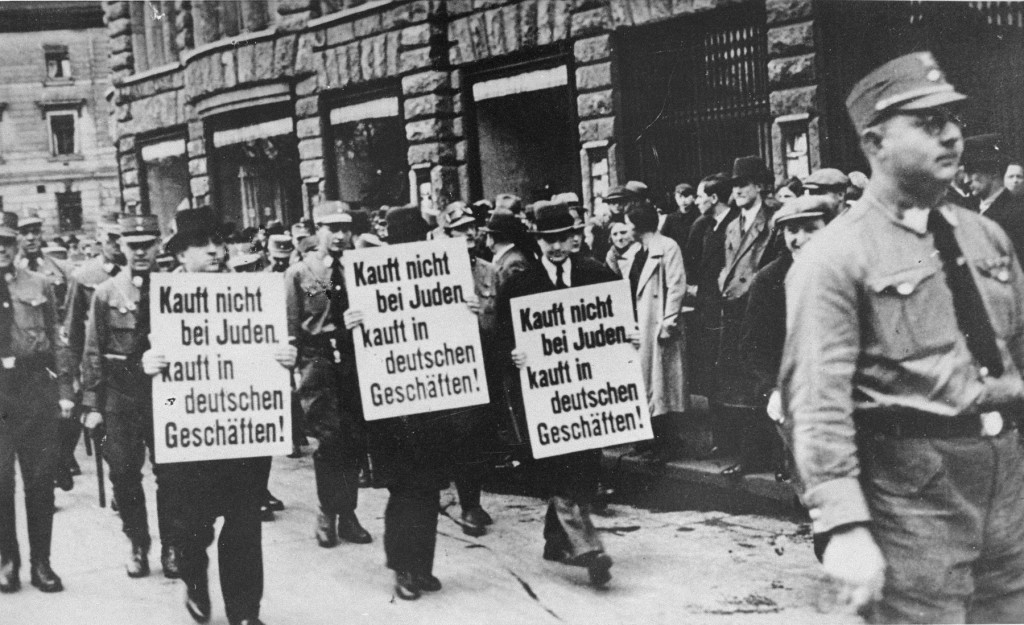
Three Jewish businessmen are forced to march down a crowded Leipzig street while carrying signs reading: "Don't buy from Jews. Shop in German businesses!" Leipzig, Germany, 1935.
Item View![Sign on truck carrying Storm Troopers (SA) urges "Germans! [LCID: 19599]](https://encyclopedia.ushmm.org/images/large/7f867fc9-c5d8-4ecd-a330-049a24a6a5f4.jpeg "Sign on truck carrying Storm Troopers (SA) urges \"Germans! [LCID: 19599]")
Scene during the boycott of Jewish businesses. A sign on truck carrying Storm Troopers (SA) urges "Germans! Defend yourselves. Don't buy from Jews." Berlin, Germany, April 1, 1933.
Item View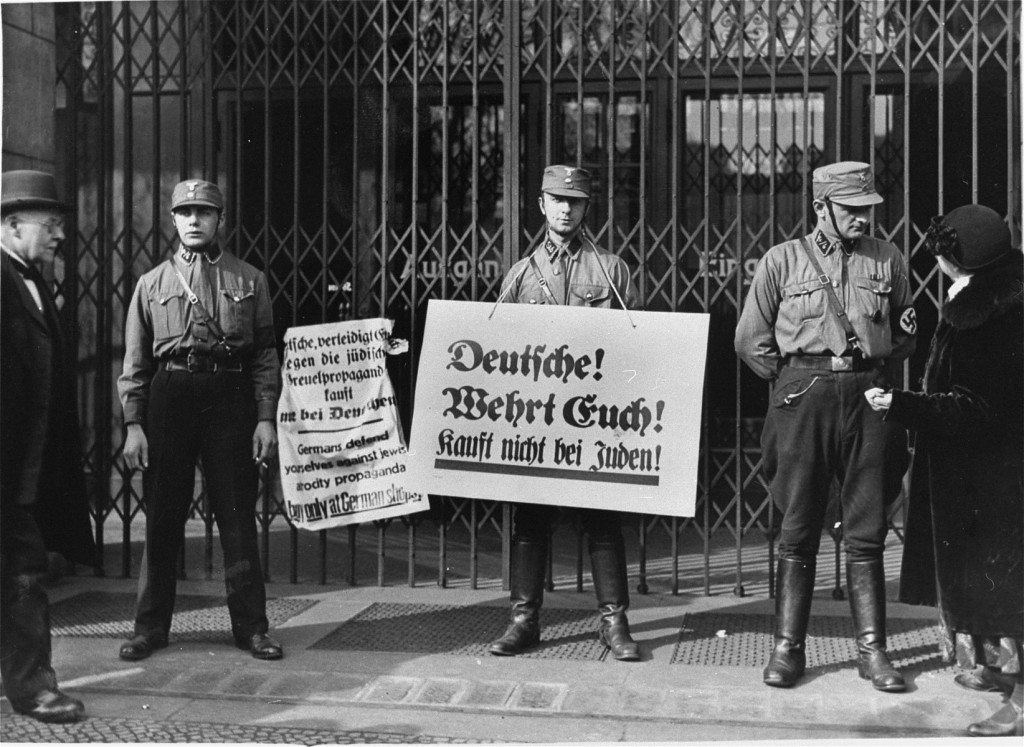
Members of the Storm Troopers (SA), with boycott signs, block the entrance to a Jewish-owned shop. One of the signs exhorts: "Germans! Defend yourselves! Don't buy from Jews!" Berlin, Germany, April 1, 1933.
Item View![An SA member instructs others where to post anti-Jewish boycott signs on a commercial street in Germany. [LCID: 73811]](https://encyclopedia.ushmm.org/images/large/2b450bc6-dd84-4463-b4b3-8d281995daed.jpeg "An SA member instructs others where to post anti-Jewish boycott signs on a commercial street in Germany. [LCID: 73811]")
An SA member instructs others where to post anti-Jewish boycott signs on a commercial street in Germany. A German civilian wearing a Nazi armband holds a sheaf of anti-Jewish boycott signs, while SA members paste them on a Jewish-owned business. Most of the signs read, "Germans defend yourselves against Jewish atrocity propaganda/Buy only at German stores." Germany, ca. April 1, 1933.
Item View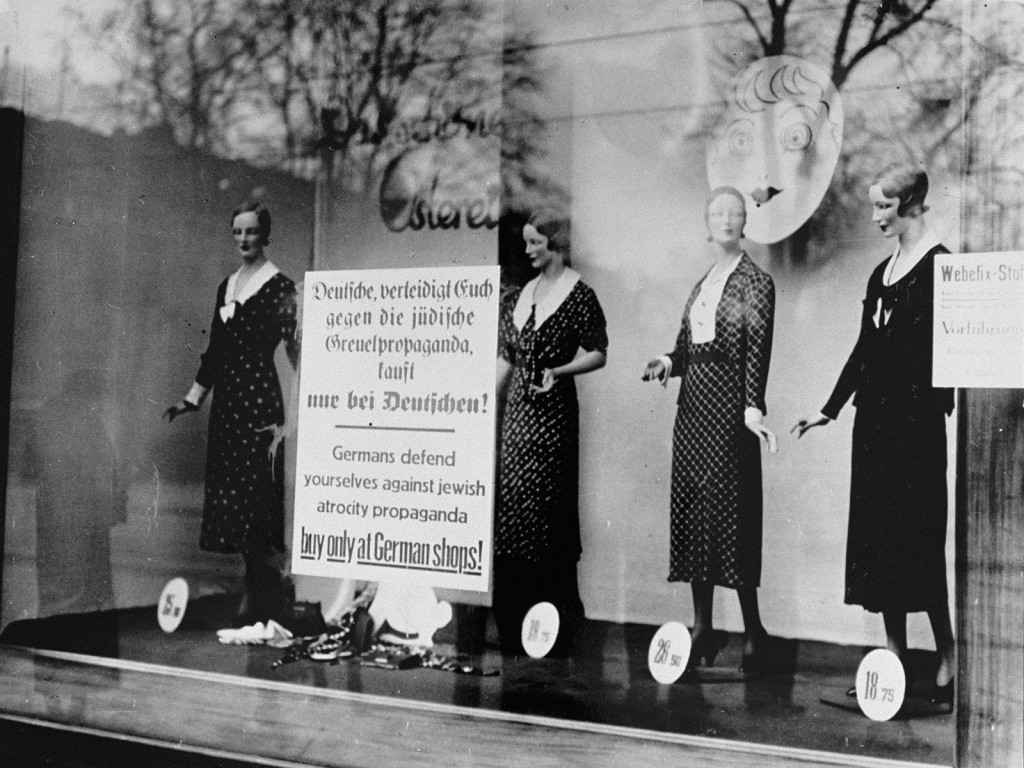
A boycott sign posted on the display window of a Jewish-owned business reads: "Germans defend yourselves against Jewish atrocity propaganda. Buy only at German shops!" Berlin, Germany, April 1, 1933.
Item ViewHanne Hirsch Liebmann (1924–2026) grew up in Karlsruhe, Germany. She was raised by her mother, Ella, who was widowed in 1925. In January 1933, when Hanne was 8 years old, the Nazis came to power in Germany. Nazis targeted the family's photo studio during the April 1933 anti-Jewish boycott. In November 1938, Hanne experienced the violence and terror of Kristallnacht. Then, in October 1940, the Nazi regime deported Hanne and her family to France, where they were imprisoned in the Gurs internment camp. In Gurs, Hanne met Max Liebmann, who had also been deported from Germany. In September 1941, the Children's Aid Society (OSE) rescued Hanne and placed her in a children's home in Le Chambon-sur-Lignon. In 1943, Hanne obtained false papers and crossed into Switzerland. There, she reunited with Max. They married and had a daughter. In 1948, the family immigrated to the United States. Hanne's mother was deported from France to Auschwitz in 1942. She did not survive the Holocaust.
Item View
We would like to thank Crown Family Philanthropies, Abe and Ida Cooper Foundation, the Claims Conference, EVZ, and BMF for supporting the ongoing work to create content and resources for the Holocaust Encyclopedia. View the list of donor acknowledgement.