This doll belonged to Zofia Chorowicz Burowska (1923–2004), a Jewish girl from Kraków, Poland. Zofia received this doll from her uncle before the war when she was 4 years old. During World War II, the doll was left with non-Jewish friends, Romualda and Feliks Ciesielski and their family.
When Nazi Germany invaded Poland in September 1939, Zofia was 16 years old. To avoid being forced into the Kraków ghetto in the spring of 1942, Zofia and her mother moved to the village of Wolbrom. In September 1942, German authorities separated her from her mother, who was then killed. Zofia was sent to a forced-labor camp for Jews (Julag) just outside of Kraków. There, she worked in the camp kitchen peeling potatoes. About a year later, German authorities sent Zofia to forced labor in a munitions factory in Skarżysko-Kamienna. In August 1943, she was transferred to a Buchenwald subcamp in Leipzig. As the war was ending in April 1945, she and the other female prisoners were forced on a death march. She was liberated by the Soviet army. After the war, she returned to Kraków and retrieved her doll.
Item View
Yona Wygocka Dickmann fashioned this jackknife from aluminum and part of a saw after the SS transferred her from Auschwitz to forced labor at an airplane factory in Freiburg, Germany, in November 1944. She used the knife to extend her daily ration of bread by cutting it in half.
Item View
Yona Wygocka Dickmann fashioned this aluminum comb from airplane parts after the SS transferred her from Auschwitz to forced labor in an airplane factory in Freiburg, Germany, in November 1944. She used the comb as her hair, shaven in Auschwitz, began to grow back.
Item View
This skirt was issued to Hana Müller (later Bruml) at Auschwitz in October 1944 as part of her prisoner uniform. She wore the skirt while imprisoned at Auschwitz and at Sackisch, a subcamp of the Gross-Rosen concentration camp. Hana shortened the skirt and sewed two pockets with the extra fabric. At Sackisch, she was forced to work in a German factory making airplane parts for the Nazi German war effort.
Item View
A German passport issued to Alice Mayer on February 24, 1939, in Bingen, Germany. Mayer's daughter, Ellen, is also listed on the passport. Both mother and daughter's names include the middle name "Sara." This middle name became a mandatory addition required by a law of August 17, 1938. Thereafter, all Jewish women in Germany with a first name of "non-Jewish" origin had to add "Sara" as a middle name on all official documents. Jewish men had to add the name "Israel". This enabled German officials to identify them as Jewish.
Item View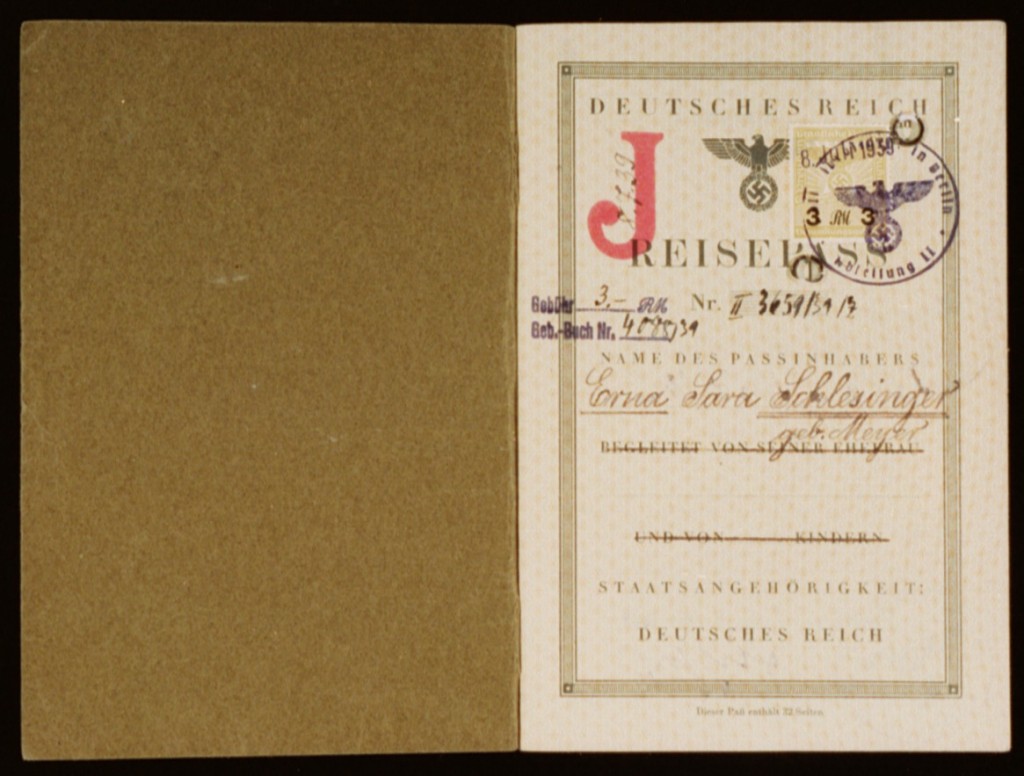
German police authorities issued this passport to Erna "Sara" Schlesinger on July 8, 1939, in Berlin. This first page of the passport illustrates the German laws that facilitated the identification of Jews in Germany. From 1938, German regulations required that Jewish women with a first name of "non-Jewish" origin use the middle name "Sara" on all official documents. Jewish men had to add the name "Israel". The letter "J" (standing for "Jude," that is, the word "Jew" in German) was stamped in red on the passports of Jews who were also German nationals. Erna Schlesinger immigrated to the United States in 1939.
Item View
Simone Weil earned this diploma, which certified her to teach kindergarten in France, from the School of Social Work in Strasbourg in 1940. Weil assumed a false identity in late 1943 to facilitate her resistance activities as a member of the relief and rescue organization Oeuvre de Secours aux Enfants (Children's Aid Society; OSE). Among the papers documenting Weil's new identity was a forged version of this diploma bearing the name "Simone Werlin".
Item View
Simone Weil used this forged diploma and other false papers to document a new identity assumed in late 1943. As Simone Werlin, she could avoid arrest and change residence to facilitate her rescue of Jewish children as a member of the relief and rescue organization Oeuvre de Secours aux Enfants (Children's Aid Society; OSE). Weil had earned the diploma, which certified her to teach kindergarten in France, from the School of Social Work in Strasbourg in 1940. The director of the school willingly forged this new version.
Item View
Simone Weil kept this blank identification card bearing her picture in case her cover as "Simone Werlin" were blown and she needed to establish a new false identity. Both resistance workers and sympathetic government employees provided her the necessary stamps and signatures. Such forged documents assisted Weil in her work rescuing Jewish children as a member of the relief and rescue organization Oeuvre de Secours aux Enfants (Children's Aid Society; OSE).
Item ViewWe would like to thank Crown Family Philanthropies, Abe and Ida Cooper Foundation, the Claims Conference, and BMF for supporting the ongoing work to create content and resources for the Holocaust Encyclopedia. View the list of all donors.