![A transport of Jewish prisoners marches through the snow from the Bauschovitz train station to Theresienstadt. [LCID: 69720]](https://encyclopedia.ushmm.org/images/large/781755a6-1ba5-4d8e-8b2b-9f25bdf3687f.jpg)
Browse an alphabetical list of artifacts from the Holocaust and World War II. Each object tells a story about the history and demonstrates human experiences during the time period.
<< Previous | Displaying results 111-120 of 235 for "Artifact" | Next >>
Military entry permit allowing Jadwiga Dzido to travel through occupied Germany to appear as a witness in the Medical Case trial at Nuremberg. 1946.

Reverse side of a military entry permit allowing Jadwiga Dzido to travel through occupied Germany to appear as a witness in the Medical Case trial at Nuremberg. 1946.

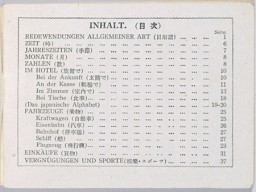
The table of contents from a Japanese-German phrase book purchased by German Jewish refugees shortly after their arrival in Japan. The phrase book offers useful expressions in Japanese relating to travel, hotel stays, eating, and shopping in Japan. Japan, 1940-1941. [From the USHMM special exhibition Flight and Rescue.]
This Star of David badge belonged to a female Jewish prisoner of Zwodau, a subcamp of Flossenbürg located in the Sudetenland region of Czechoslovakia (today in the Czech Republic). She gave the badge to John Hein, a US soldier who helped liberate Zwodau on May 7, 1945. Hein was a German-born Jewish soldier who served as an interpreter in the 1st Infantry Division.

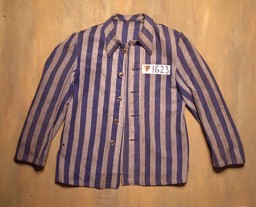
A blue and gray striped jacket from the Flossenbürg concentration camp. The letter "P" on the left front of the jacket indicates that it was worn by a Polish, non-Jewish prisoner. "P" stands for "Pole" in German. The jacket was donated to the United States Holocaust Memorial Museum by the prisoner who wore it, Julian Noga.
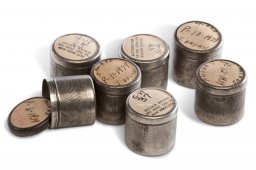
Julien Bryan stored his still photo negatives from Nazi Germany 1937 and Poland 1939 in these carefully marked metal canisters.
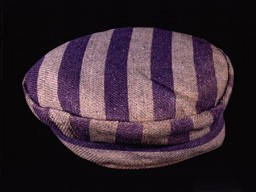
This striped cap was part of a concentration camp prisoner uniform. It belonged to Karel Bruml.Bruml was a Czech Jewish man who was imprisoned in the Theresienstadt ghetto in December 1941. From there, he was deported to Auschwitz in October 1942. At Auschwitz, Bruml was registered as a prisoner in the camp and given a prisoner number and uniform. He was transferred within the Auschwitz camp complex to Auschwitz-Monowitz (also called Auschwitz III or Buna). He remained in Auschwitz for more than two years…
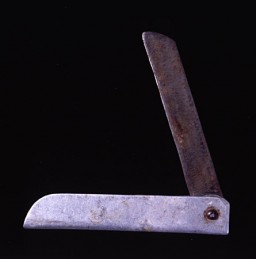
Yona Wygocka Dickmann fashioned this jackknife from aluminum and part of a saw after the SS transferred her from Auschwitz to forced labor at an airplane factory in Freiburg, Germany, in November 1944. She used the knife to extend her daily ration of bread by cutting it in half.
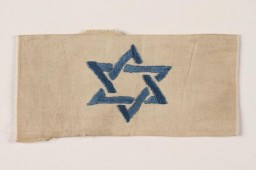
In December 1939, German authorities required Jews residing in the Generalgouvernement (which included Krakow) to wear white armbands with blue Stars of David for purposes of identification. The armband pictured here was donated to the United States Holocaust Memorial Museum in 2001 by Akiva Kohane.
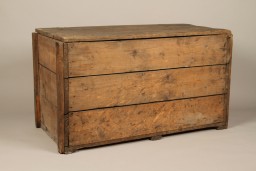
This large, lidded wooden chest was used by the Council for Aid to Jews (codenamed “Żegota”) to hide false identity documents from Nazi authorities.Żegota was an underground rescue organization of Poles and Jews in German-occupied Poland and operated from December 1942 to January 1945. Supported by the Polish government-in-exile, it coordinated efforts to save Jews in German-occupied Poland from Nazi persecution and murder. One of Żegota’s most impactful clandestine activities was producing and…
We would like to thank Crown Family Philanthropies, Abe and Ida Cooper Foundation, the Claims Conference, EVZ, and BMF for supporting the ongoing work to create content and resources for the Holocaust Encyclopedia. View the list of donor acknowledgement.