![A transport of Jewish prisoners marches through the snow from the Bauschovitz train station to Theresienstadt. [LCID: 69720]](https://encyclopedia.ushmm.org/images/large/781755a6-1ba5-4d8e-8b2b-9f25bdf3687f.jpg)
Browse an alphabetical list of artifacts from the Holocaust and World War II. Each object tells a story about the history and demonstrates human experiences during the time period.
<< Previous | Displaying results 161-170 of 235 for "Artifact" | Next >>
Eva Ostwalt was born in Cologne, Germany, to Jewish parents. She had two younger sisters, Kate and Trude. In 1927, Eva moved with her daughter, Heidemarie, and non-Jewish husband to Dresden. Eva and Karl later divorced, and Eva received custody of Heidemarie. Mother and daughter moved to Merano, Italy. When Eva’s passport expired in 1938, she had to return to Germany. Believing that Heidemarie would be safer with her father, Eva gave custody back to Karl in Dresden. Eva returned to Cologne, where both…
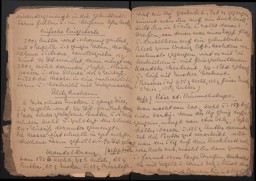
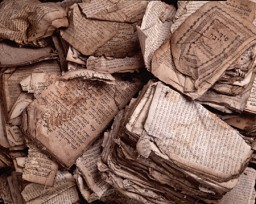
The pages photographed here are from Hebrew prayer books destroyed during the Kristallnacht ("Night of Broken Glass") pogrom of November 9 and 10, 1938. These pages were damaged by fire during the destruction of the synagogue in Bobenhausen, Germany. The Jewish community of Giessen donated them to the United States Holocaust Memorial Museum in 1989.
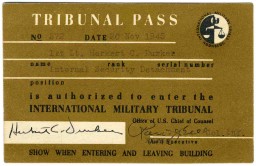
Entry pass to the court building at the International Military Tribunal. This pass was issued to a U.S. military guard.
Back side of an entry pass to the court building at the International Military Tribunal. This pass was issued to a U.S. military guard. The pass is printed in each of the IMT's four official languages.
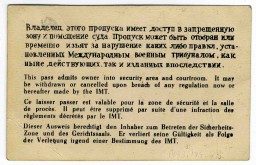
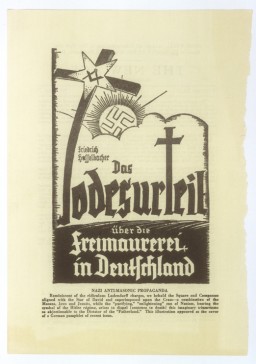
Illustration from cover of a German anti-Masonic pamphlet by Friedrich Haffelbacher, entitled "Das Todesurteil ueber die Freimaurerei in Deutschland" [The Death Sentence for Freemasons in Germany].
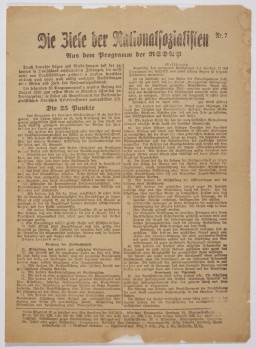
In the 25-point program, Nazi Party members publicly declared their intention to segregate Jews from "Aryan" society and to abrogate Jews' political, legal, and civil rights. Germany, 1931.
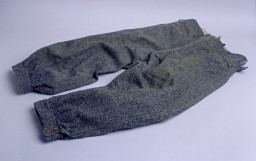
Pants worn by Marjan Glass as he dug anti-tank ditches for the defense of Warsaw, Poland, and then as he hastily fled the city ahead of the German advance on September 7, 1939. Glass, a lawyer, escaped with his wife and three-year-old son, and his wife's mother and brother. He left without taking the time to change from his soiled work clothing. [From the USHMM special exhibition Flight and Rescue.]
A Passover Haggadah published by rabbinical students in Shanghai in 1943. [From the USHMM special exhibition Flight and Rescue.]

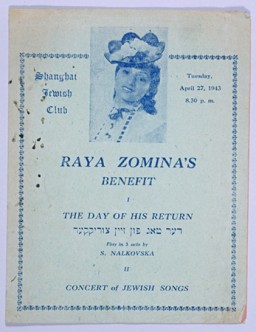
Program for an evening performance sponsored by the Shanghai Jewish Club. The program included the play "The Day of His Return" and a concert of Jewish songs. On April 27, 1943, the day of this performance featuring Warsaw Jewish actress Raya Zomina, fierce fighting continued in the Warsaw ghetto between German troops and Jews who chose to resist Nazi efforts to liquidate the ghetto. Terrifying rumors about the Holocaust reached the Jewish refugees in Shanghai, but they did not receive reliable news or…
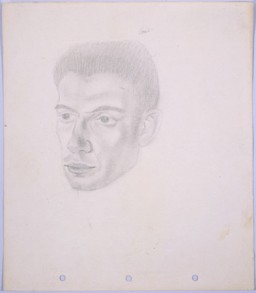
Portrait of Janek Goldstein, in pencil, by Yonia Fain. Goldstein, a friend of the artist in Shanghai, was the son of Bernard Goldstein, who was active in the Bundist underground of the Warsaw ghetto and participated in the 1943 uprising. [From the USHMM special exhibition Flight and Rescue.]
We would like to thank Crown Family Philanthropies, Abe and Ida Cooper Foundation, the Claims Conference, EVZ, and BMF for supporting the ongoing work to create content and resources for the Holocaust Encyclopedia. View the list of donor acknowledgement.