![A transport of Jewish prisoners marches through the snow from the Bauschovitz train station to Theresienstadt. [LCID: 69720]](https://encyclopedia.ushmm.org/images/large/781755a6-1ba5-4d8e-8b2b-9f25bdf3687f.jpg)
Browse an alphabetical list of artifacts from the Holocaust and World War II. Each object tells a story about the history and demonstrates human experiences during the time period.
<< Previous | Displaying results 181-190 of 235 for "Artifact" | Next >>
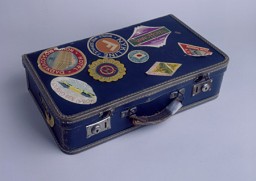
A suitcase used (ca. 1939) by a Jewish refugee fleeing Nazi-occupied Europe to Japan. The suitcase is covered with labels from various stops along the journey, including one from a hotel in Moscow (top left), one for the NYK Line (top middle), and six from hotels throughout Japan. [From the USHMM special exhibition Flight and Rescue.]
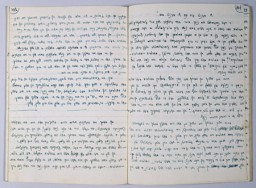
Yiddish writings of Josef Fiszman, a refugee writer from Warsaw. These are some Inside pages of a Fiszman's journal. The journal was written in Shanghai and is entitled "The Sun Never Shines At Night." [From the USHMM special exhibition Flight and Rescue.]
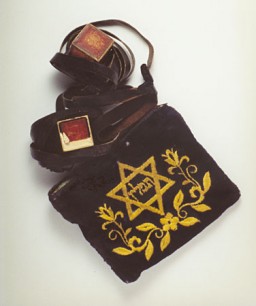
Set of tefillin in an embroidered bag. Tefillin are ritual objects worn by religious Jews during weekday morning prayers. This set was found on the body of a death march victim, who was buried near Regensburg, Germany.
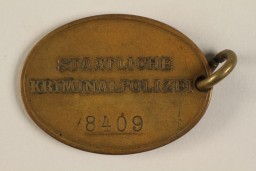
Reverse of the official identification tag (warrant badge) for the Kriminalpolizei or Kripo, the detective police force of Nazi Germany. It reads Staatliche Kriminalpolizei (State Criminal Police) and identifies the officer's number as 8409.
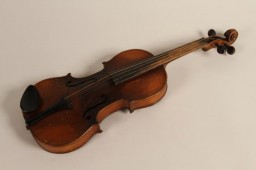
Violin owned by Rita Prigmore and originally used by her father, who played with his four brothers in a band in Germany before World War II. Rita and her family were members of the Sinti group of Roma (Gypsies). She and her twin sister Rolanda were born in 1943. Rolanda died as a result of medical experiments on twins in the clinic where they were born. Rita and her mother survived the war and moved to the United States, before returning to Germany to run a Sinti human rights organization that sought to…
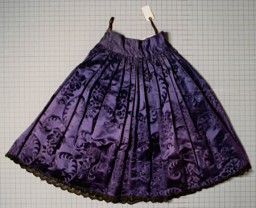
This taffeta and cotton skirt dates from the 1920s. It belonged to a Romani (Gypsy) woman who was born in Frankfurt, Germany, and who lived in Germany before the war. She was arrested by the Nazis and interned in the Auschwitz, Ravensbrück, Mauthausen, and Bergen-Belsen camps. She died in Bergen-Belsen in March 1945, shortly before the camp's liberation. Her husband and two of her six children were also killed in the camps.
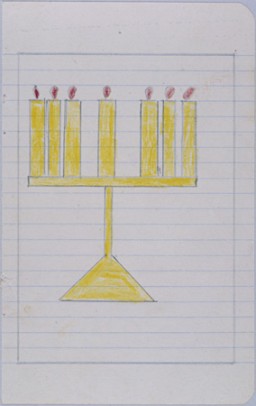
Sorle and Shalomis Gorfinkel presented this card to their parents on the occasion of Rosh Hashanah 5704, the Jewish New Year 1943. The Gorfinkel family was part of the Mir Yeshiva community in Shanghai.
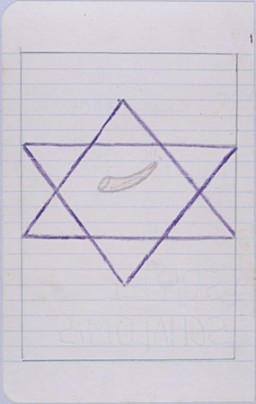
A Rosh Hashanah (Jewish New Year) greeting card. Sorle and Shalomis Gorfinkel presented this card to their parents on the occasion of Rosh Hashanah 5704, the Jewish New Year 1943. The Gorfinkel family was part of the Mir Yeshiva community in Shanghai.
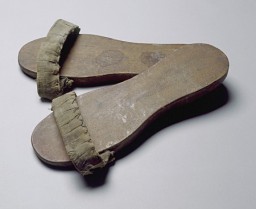
Wooden sandals worn by a member of the Mir Yeshiva in Shanghai. [From the USHMM special exhibition Flight and Rescue.]
We would like to thank Crown Family Philanthropies, Abe and Ida Cooper Foundation, the Claims Conference, EVZ, and BMF for supporting the ongoing work to create content and resources for the Holocaust Encyclopedia. View the list of donor acknowledgement.