![A transport of Jewish prisoners marches through the snow from the Bauschovitz train station to Theresienstadt. [LCID: 69720]](https://encyclopedia.ushmm.org/images/large/781755a6-1ba5-4d8e-8b2b-9f25bdf3687f.jpg)
Browse an alphabetical list of artifacts from the Holocaust and World War II. Each object tells a story about the history and demonstrates human experiences during the time period.
<< Previous | Displaying results 71-80 of 235 for "Artifact" | Next >>
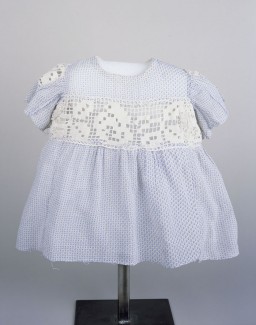
A blue and white child's dress worn by Sabina Kagan while living in hiding with the Roztropowicz family in Radziwillow, Poland, during World War II. Her rescuers used doll's clothing to make this dress.Sabina was just an infant when SS mobile killing squads began rounding up Jews in the Polish village of Radziwillow in 1942. Her parents persuaded a local policeman to hide the family. The policeman, however, soon asked the Kagans to leave but agreed to hide baby Sabina. Her parents were captured and killed.…
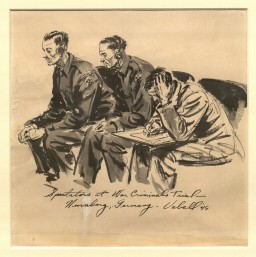
Courtroom sketch drawn during the International Military Tribunal by American artist Edward Vebell. The drawing's title is "Spectators at War Criminals Trial, Nuremberg, Germany." 1945.
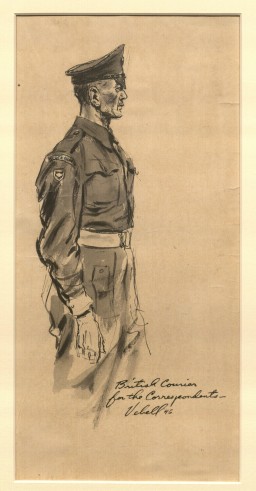
Courtroom sketch drawn during the International Military Tribunal by American artist Edward Vebell. The drawing's title is "British Courier for the Correspondents." 1945.
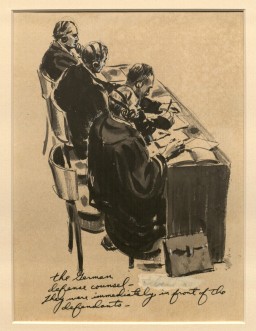
Courtroom sketch drawn during the International Military Tribunal by American artist Edward Vebell. The drawing's title is "German defense counsel -- they are immediately in front of the defendants." 1945.
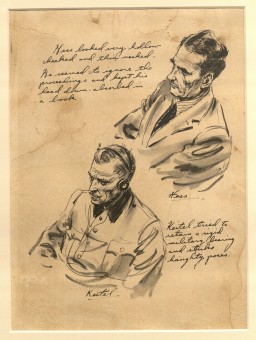
Courtroom sketch drawn during the International Military Tribunal by American artist Edward Vebell. The drawing depicts defendants Rudolf Hess and Wilhelm Keitel, with this accompanying text: "Hess looked very hollow cheeked and thin necked. He seemed to ignore the proceedings and kept his head down, absorbed in a book. Keitel tried to retain a rigid military bearing and strike haughty poses." Nuremberg, Germany, 1945.
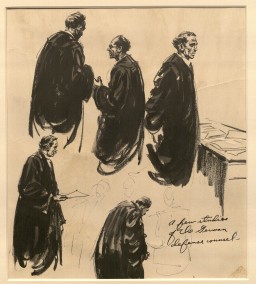
Courtroom sketch drawn during the International Military Tribunal by American artist Edward Vebell. The drawing's title is "A few studies of the German defense counsel." 1945.
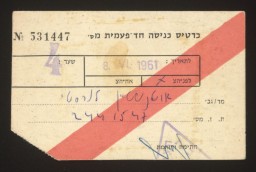
Single-use entry pass for the trial of Adolf Eichmann in Jerusalem, Israel. June 8, 1961.
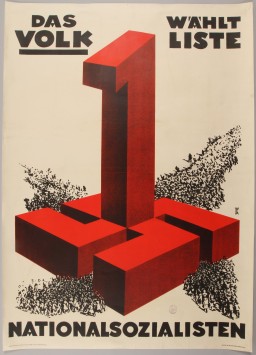
Election poster reading "The People Vote Listing One: Nationalsocialism," 1932-1933
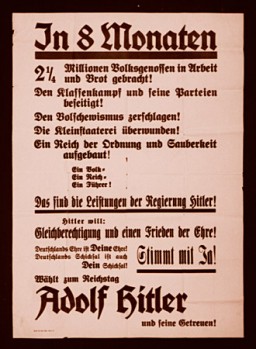
This election poster calls on Germans to vote in support of Hitler's hand-picked candidates to the Reichstag (the German parliament). The poster details Hitler's actions and reads, in part: 'In 8 months two and a quarter million Germans have work and bread again! Class warfare and its parties are eliminated! The Bolsheviks are smashed. Particularism is overcome! A Reich of order and cleanliness is established. One People. One Reich. One Leader. This is what Hitler has accomplished..."
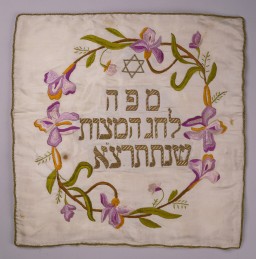
Following the Soviet occupation of Lithuania, the Lifszyc family began to search for ways to leave the country. David Lifszyc obtained a Curacao visa from the Dutch consulate. He also obtained an American visa because he was included on a list of distinguished rabbis submitted to the State Department by the Agudat Israel of America. After obtaining Soviet exit visas, the Lifszycs purchased tickets for Vladivostok on February 5, 1941. They started for Moscow, where they received Japanese transit visas. This…
We would like to thank Crown Family Philanthropies, Abe and Ida Cooper Foundation, the Claims Conference, EVZ, and BMF for supporting the ongoing work to create content and resources for the Holocaust Encyclopedia. View the list of donor acknowledgement.