
Honoring US Army Divisions as Liberators of Nazi Camps
Since the mid-1980s, the United States Holocaust Memorial Museum and the US Army Center of Military History have worked together to recognize US Army divisions that took part in liberating prisoners from Nazi concentration camps and other sites of detention.
Key Facts
-
1
Allied troops encountered concentration camps and other sites of Nazi crimes as they advanced across Europe in 1944 and 1945.
-
2
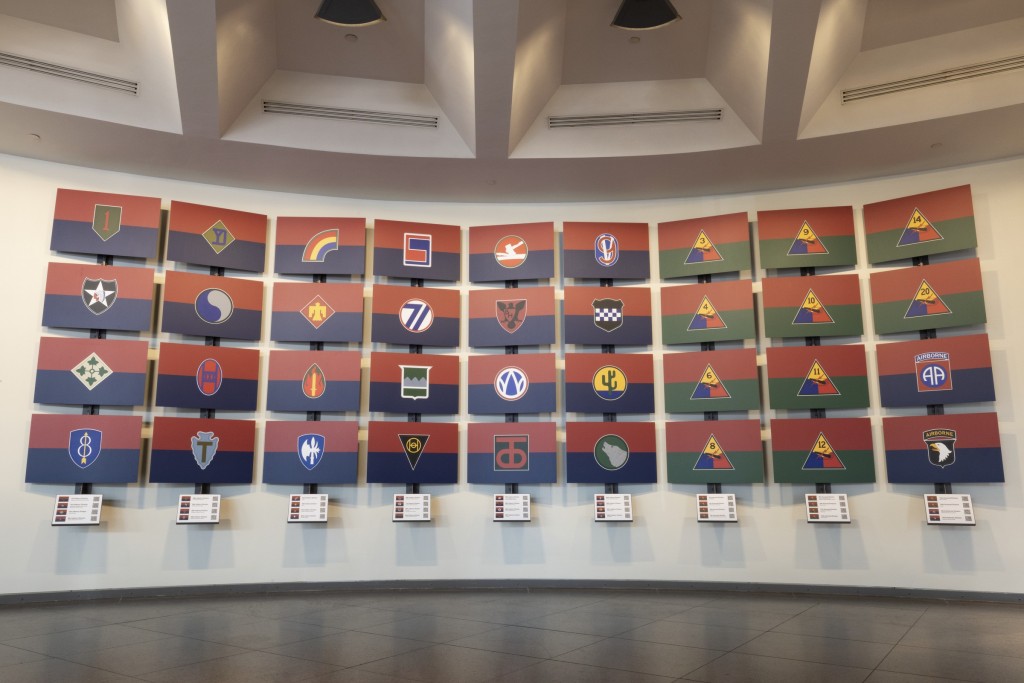
The United States Holocaust Memorial Museum and the US Army Center of Military History have recognized 36 US Army divisions for their role in the liberation of Nazi camps.
-
3
This honor is given to the first division(s) that arrived at a concentration camp or other detention site. Additional divisions that arrived within 48 hours are also honored as liberating units.
The United States Holocaust Memorial Museum (USHMM) and the US Army Center of Military History (CMH) recognize and honor US Army divisions that took part in liberating prisoners of Nazi camps and other sites of detention during World War II.
The Role of US Army Divisions in Liberating Prisoners from Nazi Camps
As World War II was coming to an end in 1945, US, British, Soviet, and Canadian troops encountered concentration camps, mass graves, and other sites of Nazi crimes. Members of the US armed forces were some of the first Americans to witness these Nazi atrocities. They may have read or heard about Nazi atrocities in the American press during the war. However, seeing the reality of these crimes was deeply shocking. Those soldiers who arrived at Nazi camps were horrified by the piles of corpses they found there. They also encountered critically ill and starving people, many on the verge of death. US troops helped provide many of these surviving prisoners with much-needed food, clothing, and medical aid.
After the war, US military veterans served as important witnesses to the Holocaust and other Nazi crimes. Many of them shared their experiences in oral and written testimonies.
For survivors of Nazi camps who were liberated by US troops, American service members were an important part of their wartime experiences. In postwar testimonies, survivors often describe the role of Americans in their liberation with appreciation, awe, and gratitude.
By recognizing the role of US Army divisions in the liberation of Nazi camps, the USHMM and CMH honor US service members, as well as remember victims of Nazi tyranny and brutality.
Honoring US Army Divisions as Liberating Units: Origins
The origins of this program date back to the inception of the United States Holocaust Memorial Museum.
In 1979, the President’s Commission on the Holocaust proposed the Days of Remembrance of Victims of the Holocaust. The inaugural ceremony took place on April 28–29, 1979. The dates coincided with the 34th anniversary of the liberation of the Dachau concentration camp by American troops. The following year, Congress voted unanimously to create the United States Holocaust Memorial Council. The Council’s mandate was to commemorate the six million Jewish victims of the Holocaust, as well as the millions of others killed by the Nazis and their collaborators.
In October 1981, the Council organized the first International Liberators Conference in Washington, DC. Its goal was to record the accounts of eyewitnesses from Allied nations who encountered Nazi concentration camps in 1945. Among the participants were US Army veterans who had taken part in the liberation of Nazi camps.
Building on this, two members of the United States Holocaust Memorial Council's Days of Remembrance Committee, Sigmund Strochlitz and Benjamin Meed, sought to formally recognize the US military’s role in liberation. Both Strochlitz and Meed were Holocaust survivors. In February 1985, they contacted Secretary of the Army John O. Marsh, Jr., with a request. They asked to present the flags of US Army divisions that participated in the liberation of Nazi camps at the annual Days of Remembrance ceremony held in the US Capitol Rotunda. They also asked to display them in the Holocaust museum that was then in the planning stages. That year (1985), the US Army was being honored on the 40th anniversary of the liberation of Nazi camps. Secretary Marsh approved the request.
In the first year of the program, the US Army Center of Military History (CMH) identified ten US liberating divisions: the 3rd, 4th, 6th, 10th, and 11th Armored Divisions and the 42nd, 45th, 80th, 90th, and 103rd Infantry Divisions.
By April 1993, when the United States Holocaust Memorial Museum opened, an additional ten divisions had been identified: the 12th, 14th, and 20th Armored Divisions; the 4th, 8th, 71st, 89th, 99th, and 104th Infantry Divisions; and the 82nd Airborne Division.
Guidelines for Granting Liberator Status to US Army Divisions
The program to honor US Army divisions as liberators generated interest among veterans’ groups. In response to their requests, the USHMM and the CMH developed guidelines for certifying liberating units. In the late 1980s, these guidelines were set as follows:
- to recognize units only at the divisional level;
- to recognize liberator status based on written divisional records at the National Archives and Records Administration (not oral testimony); and
- to recognize those divisions arriving at a site within 48 hours of the initial arrival of US troops.
To facilitate this process, the divisional association or individual veterans of the division had to submit a request for recognition.
In May 1995, the USHMM and the CMH agreed to expand the definition to include the liberation of prisons, work camps, forced labor camps, and any facility that held civilians. Since the program began in 1985, the Council (later, the USHMM) and the CMH have recognized 36 US Army divisions for liberating prisoners from Nazi rule.
Commemorating US Army Divisions as Liberators at the USHMM
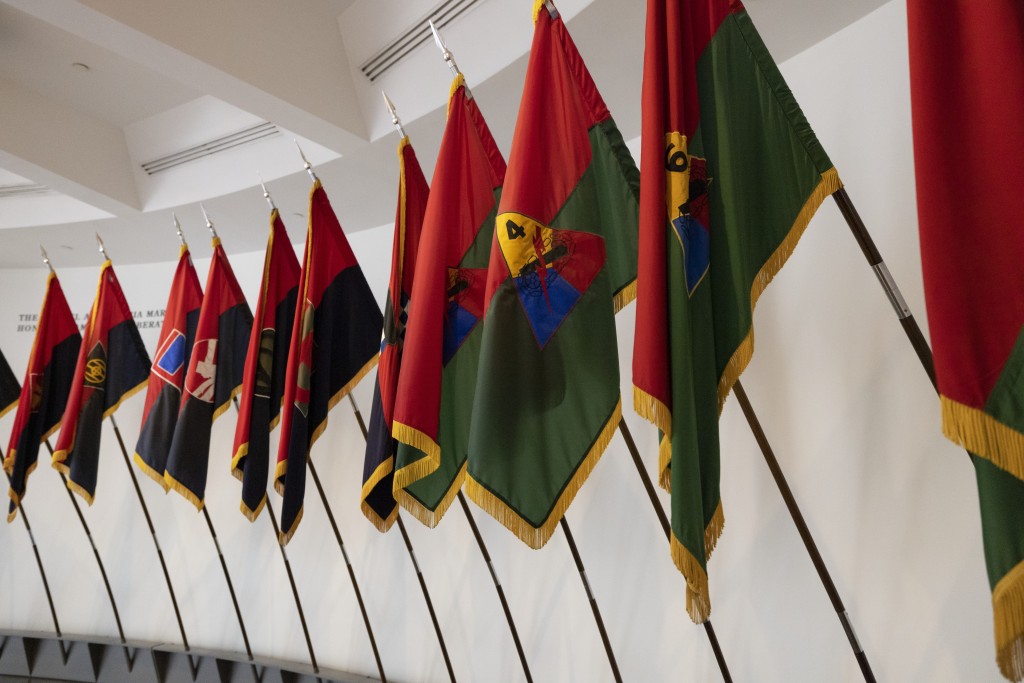
When the USHMM opened in 1993, twenty divisional flags were displayed in The Samuel and Marcia Mark Hall Honoring American Liberators. For thirty years, the flags were regularly rotated and seen by millions of Museum visitors.
In 2023, as part of conservation efforts to preserve the divisional flags, the Museum redesigned the exhibit. Today, the USHMM commemorates the US Army divisions recognized as liberating units with a display of 36 flag graphics and insignia. Through this exhibit, the United States Holocaust Memorial Museum honors the service members who risked their lives during World War II and helped liberate victims of Nazi tyranny.
US Army Divisions and the Camps They Liberated
The following US Army divisions have been recognized as liberators by the United States Holocaust Memorial Museum and the US Army Center of Military History.
Table 1. Infantry divisions of the US Army and the camps they liberated
| Infantry division | Camp or site of detention liberated |
|---|---|
| 1st Infantry Division | Zwodau (Flossenbürg subcamp) |
| 2nd Infantry Division | Leipzig-Schönefeld (Buchenwald subcamp) Spergau (labor education camp) |
| 4th Infantry Division | Haunstetten (Dachau subcamp) |
| 8th Infantry Division | Wöbbelin (Neuengamme subcamp) |
| 26th Infantry Division | Gusen (Mauthausen subcamp) |
| 29th Infantry Division | Dinslaken (civilian labor camp) |
| 30th Infantry Division | Weferlingen (Buchenwald subcamp) |
| 36th Infantry Division | Kaufering camps (Dachau subcamps) |
| 42nd Infantry Division | Dachau concentration camp |
| 45th Infantry Division | Dachau concentration camp |
| 63rd Infantry Division | Kaufering camps (Dachau subcamps) |
| 65th Infantry Division | Flossenbürg subcamp |
| 69th Infantry Division | Leipzig-Thekla (Buchenwald subcamp) |
| 71st Infantry Division | Gunskirchen (Mauthausen subcamp) |
| 80th Infantry Division | Buchenwald concentration camp Ebensee (Mauthausen subcamp) |
| 83rd Infantry Division | Langenstein (Buchenwald subcamp) |
| 84th Infantry Division | Hannover-Ahlem (Neuengamme subcamp) Salzwedel (Neuengamme subcamp) |
| 86th Infantry Division | Attendorn (civilian forced-labor camp) |
| 89th Infantry Division | Ohrdruf (Buchenwald subcamp) |
| 90th Infantry Division | Flossenbürg concentration camp |
| 95th Infantry Division | Werl (prison and civilian labor camp) |
| 99th Infantry Division | Dachau subcamps |
| 103rd Infantry Division | Kaufering camps (Dachau subcamps) |
| 104th Infantry Division | Dora-Mittelbau concentration camp |
Table 2. Armored divisions of the US Army and the camps they liberated
| Armored division | Camp or site of detention liberated |
|---|---|
| 3rd Armored Division | Dora-Mittelbau concentration camp Boelcke-Kaserne (Dora-Mittelbau subcamp) |
| 4th Armored Division | Ohrdruf (Buchenwald subcamp) |
| 6th Armored Division | Buchenwald concentration camp |
| 8th Armored Division | Halberstadt-Zwieberge (Buchenwald subcamp) |
| 9th Armored Division | Zwodau (Flossenbürg subcamp) |
| 10th Armored Division | Dachau subcamp |
| 11th Armored Division | Mauthausen concentration camp Gusen (Mauthausen subcamp) |
| 12th Armored Division | Dachau subcamps |
| 14th Armored Division | Dachau subcamps |
| 20th Armored Division | Dachau concentration camp |
Table 3. Airborne divisions of the US Army and the camps they liberated
| Airborne division | Camp or site of detention liberated |
|---|---|
| 82nd Airborne Division | Wöbbelin (Neuengamme subcamp) |
| 101st Airborne Division | Kaufering IV (Dachau subcamp) |
Critical Thinking Questions
What challenges did troops face when they encountered the camps?
Investigate liberating units from countries other than the United States.