Browse an alphabetical list of film clips that feature important events before, during, and after the Holocaust and World War II. These clips include home movies, propaganda films, newsreels, and more.
<< Previous | Displaying results 76-100 of 191 for "Film" | Next >>
This footage from German newsreels shows German forces in action during the invasion of Poland.
Adolf Hitler's foreign policy aimed at establishing a European empire for Germany through war. This policy required the rapid expansion of Germany's military capabilities. The Geneva Disarmament Conference, beginning in 1932, sought to avoid another European war by negotiating a reduction in armaments. Hitler repudiated this effort by withdrawing Germany from the conference in October 1933. At the same time, he rejected collective security in international affairs by withdrawing from the League of Nations.…
This footage shows Joseph Goebbels, Nazi minister for propaganda and public education, speaking at the September 1935 Nazi Party Congress in Nuremberg. In the speech, Goebbels—a fanatic antisemite—linked Bolshevism with international Jewry and warned Nazi party members of an alleged international Jewish conspiracy to destroy western civilization. Goebbels led the purge of Jewish and other so-called "un-German" influences from the cultural institutions of Nazi Germany.
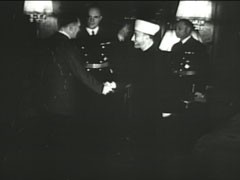
In this German propaganda newsreel, the former Mufti of Jerusalem, Hajj Amin al-Husayni, an Arab nationalist and prominent Muslim religious leader, meets Hitler for the first time on November 28, 1941 in Berlin, Germany. During the meeting, held in in the Reich chancellery, Hitler declined to grant al-Husayni’s request for a public statement—or a secret but formal treaty—in which Germany would: 1) pledge not to occupy Arab land, 2) recognize Arab striving for independence, and 3) support the…
This film clip shows the use of headphones at the International Military Tribunal. English, French, Russian, and German were the official languages of the Nuremberg trials. Translators provided simultaneous translations of the proceedings. Each participant in the trial had a set of headphones.

Adolf Hitler speaks at a Nazi campaign event in the town of Waldenburg, Germany (today Wałbrzych, Poland), on July 22, 1932. In the speech, Hitler condemned Germany’s democratic government (called the Weimar Republic) and promised that the Nazis would bring salvation for the German nation.
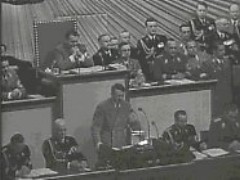
On January 30, 1939, Nazi leader Adolf Hitler gave a speech before the Reichstag (German parliament). Towards the end of his lengthy speech, Hitler addressed the “Jewish Question.” He proclaimed that if there was another world war, it would be the fault of Jewish people and that such a war would lead to the "annihilation of the Jewish race in Europe." His speech referenced multiple antisemitic conspiracy theories, falsely blaming Jews for both war and Communism. Hitler gave this speech at a time of…
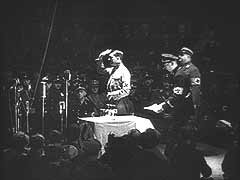
In this German newsreel footage, Hitler addresses members of the SA and the SS in the Sportpalast, a sports arena in Berlin, Germany. He thanks them for their support and sacrifice during the Nazi struggle for power.
One day after France signed an armistice with Germany in June 1940, Adolf Hitler celebrated the German victory over France with a tour of Paris. Here, Hitler's train arrives in Paris. Hitler's tour included the Paris opera, the Champs-Elysees, the Arc de Triomphe, and the Eiffel Tower. After visiting Napoleon's tomb and the Sacré-Cœur Basilica, Hitler left Paris. In all, Hitler spent about three hours in the city. In July, Hitler returned in triumph to Berlin, Germany.

The German army (Wehrmacht) regarded the war in the east as a crusade against communism and not subject to the "normal rules" of war. After the German invasion of the Soviet Union in June 1941, Soviet soldiers followed a "scorched earth" policy to hinder the German advance. In this German newsreel footage, German soldiers approach a burning village, one of many destroyed during the invasion of the Soviet Union.
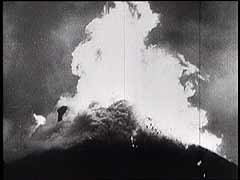
Marshal Ion Antonescu was ruler of Romania from 1940 to 1944. Following the defeat of German forces at Stalingrad, Hitler suspected that some of the countries allied with Germany intended to negotiate a separate peace. In this German newsreel footage, Antonescu meets with Hitler in Berchtesgaden, Germany, primarily to reassure Hitler that Romania remained committed to the German war effort. In the year following this meeting, King Michael of Romania arrested Antonescu and signed an armistice with the…
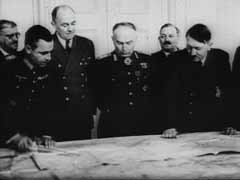
World War II in the Pacific theater ended with the Japanese surrender on September 2, 1945. The surrender was signed in Tokyo Bay aboard the American battleship USS "Missouri." Foreign Minister Shigemitsu headed the Japanese delegation. General Douglas MacArthur accepted the surrender on behalf of the Allies. Admiral Nimitz signed for the US and Admiral Fraser for Britain. Representatives of all the Allied nations attended the signing.
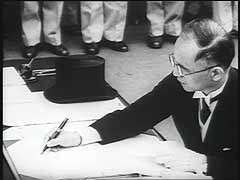
In the 1930s, famous Tennessee jazz musician Valaida Snow was known as “Little Louis” because her talent with a trumpet rivaled the legendary Louis Armstrong. She performed around the world, but it was a tour of Europe that would haunt her for the rest of her life. While in German-occupied Denmark, Snow is said to have been arrested and imprisoned in Copenhagen. It is still unclear why she was arrested or what was done to her while she was held, but after her release in a May 1942 prisoner exchange,…
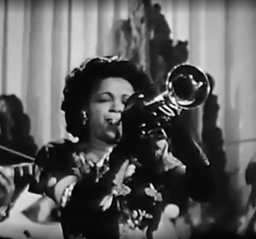
Soldiers of the Jewish Brigade, British Eighth Army, in the Faenza area of Italy. The Jewish Brigade took part in the final stages of the Allied offensive in Italy.
Beginning in 1941, the Germans deported Jews in Germany to the occupied eastern territories. At first, they deported thousands of Jews to ghettos in Poland and the Baltic states. Those deported would share the fate of local Jews. Later, many deportation transports from Germany went directly to the killing centers in occupied Poland. In this footage, a German propaganda unit films recent arrivals from Magdeburg, Germany, in a collection center run by the Jewish council in the Warsaw ghetto. In July 1942,…
The ship "Henrietta Szold," carrying more than 500 Jewish "illegal" immigrants from Greece to Palestine, arrived in Haifa on August 14, 1946. British authorities immediately interned the immigrants and deported them to British internment camps on the island of Cyprus.
The postwar movement of about 250,000 mainly eastern European Jewish survivors to displaced persons camps and to the West, with the goal of reaching Palestine, was known as the "Brihah" ("flight"). Here, Jewish refugees cross illegally into Italy, probably to charter a ship to sail to Palestine. The British restricted Jewish immigration into Palestine and deported "illegal" immigrants to detention camps in Cyprus.
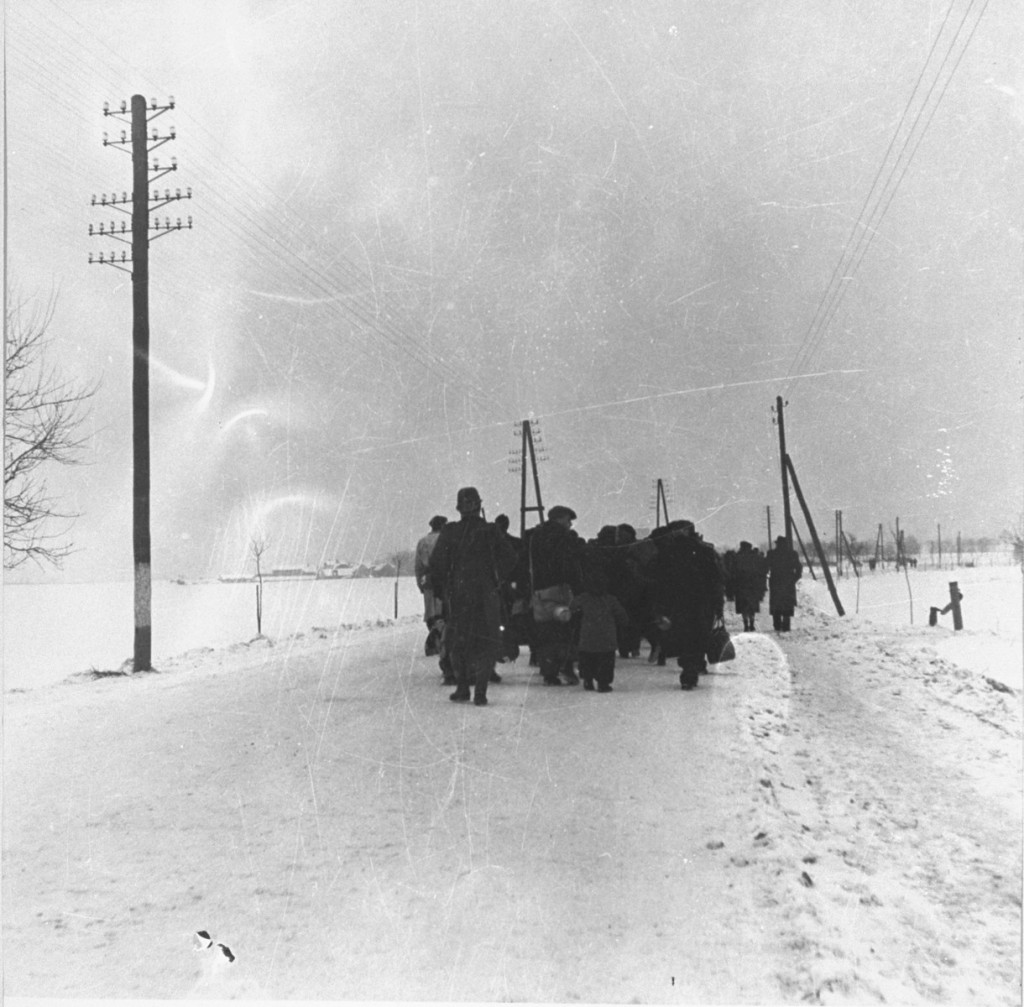
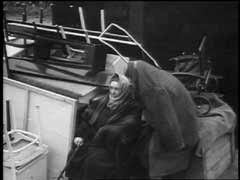
After the Munich agreement and the Czech surrender of the Sudetenland to Germany, German authorities expelled these Jewish residents of Pohorelice from the Sudetenland to Czechoslovakia. The Czech government, fearing a flood of refugees, refused to admit them. The Jewish refugees were then forced to camp in the no-man's-land between Bruno and Bratislava on the Czech frontier with Germany.
US forces liberated the Dachau concentration camp in Germany in April 1945. Here, survivors of the camp stand during the singing of "Hatikva" ("Hope") before Rabbi David Eichhoren, a US army chaplain, leads one of the first Jewish prayer services after liberation.

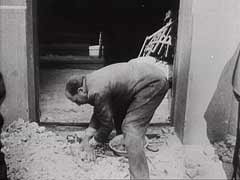
Shortly after the German occupation of Belgrade, Yugoslavia, in April 1941, the Germans forced Jews to clear the rubble caused by the heavy bombardment of the city. This German newsreel footage shows Jews clearing some of the rubble. Most of the city's Jews were later arrested and interned in camps. The German army later shot the Jewish men in retaliation for Serb resistance; the Germans killed the Jewish women and children in gas vans. Only about 2,200 Jews of Belgrade returned to the city after the war.
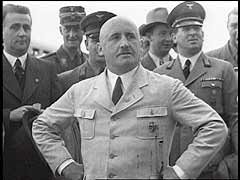
In 1935, Julius Streicher, a regional Nazi leader and publisher of the antisemitic newspaper Der Stürmer, gave a brief antisemitic statement on camera. In this statement, he accused Jews of trying to control the world and exploiting non-Jews. He stated, "without a solution to the Jewish question, there is no solution for mankind."
Japanese pilots used the tactic of Kamikaze (suicidal) dive-bombing attacks on enemy warships in 1944 and 1945. The "USS Nevada," despite an escort and efforts to fight off a Kamikaze attack, sustained such a hit in early 1945 off the coast of Japan. The "USS Ticonderoga," a carrier, also sustained such a hit in early 1945 off Formosa (Taiwan). The impact of Kamikaze attacks decreased during the final months of the war in the Pacific, in part because of an improvement in Allied evasion tactics.
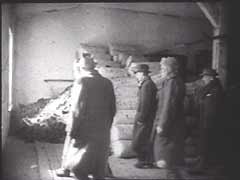
Film showing footage of the Auschwitz camp after liberation. This footage was taken by Soviet military film crews.When Soviet forces liberated the Auschwitz concentration camp complex in January 1945, they found evidence of the crimes committed at the camp by Nazi German authorities. This evidence included warehouses of clothes, suitcases, and other plundered belongings. The Nazis had stolen these items from Jews they had murdered or imprisoned in the camp. The Soviets also found masses of human hair that…
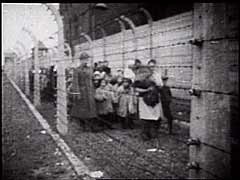
Soviet military footage showing children who were liberated at Auschwitz by the Soviet army in January 1945.
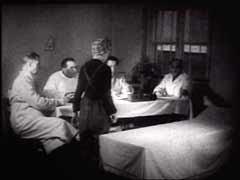
Soviet troops entered the Auschwitz killing center in January 1945 and liberated thousands of sick and exhausted prisoners. This Soviet military footage was filmed shortly after the camp was liberated. It shows Soviet doctors examining victims of sterilization, poisonous injection, and skin graft experiments.
We would like to thank Crown Family Philanthropies, Abe and Ida Cooper Foundation, the Claims Conference, and BMF for supporting the ongoing work to create content and resources for the Holocaust Encyclopedia. View the list of all donors.