![A transport of Jewish prisoners marches through the snow from the Bauschovitz train station to Theresienstadt. [LCID: 69720]](https://encyclopedia.ushmm.org/images/large/781755a6-1ba5-4d8e-8b2b-9f25bdf3687f.jpg)
Browse an alphabetical list of photographs. These historical images portray people, places, and events before, during, and after World War II and the Holocaust.
<< Previous | Displaying results 251-275 of 2697 for "Photo" | Next >>
Crematorium 4 under construction. This crematorium was later destroyed during an uprising in the camp. Auschwitz-Birkenau, Poland, winter 1942-1943.

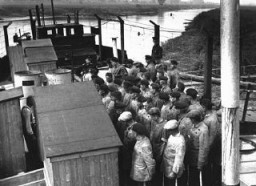
Many of the early concentration camps were improvised. Here, roll call is held for political prisoners aboard a ship used as a floating concentration camp. Ochstumsand camp, near Bremen, Germany, 1933 or 1934.
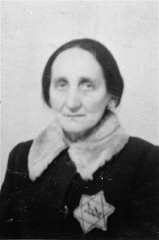
Portrait of an elderly Jewish woman wearing a Jewish badge in the Olkusz ghetto. Olkusz , Poland, 1941.
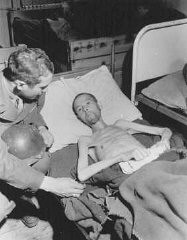
Soon after liberation, a US Army doctor examines an emaciated forced laborer, a Soviet prisoner of war. Dortmund, Germany, April 30, 1945.
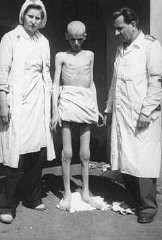
Shortly after liberation, an emaciated concentration camp inmate stands between two members of the International Red Cross. Theresienstadt, Czechoslovakia, May 1945.
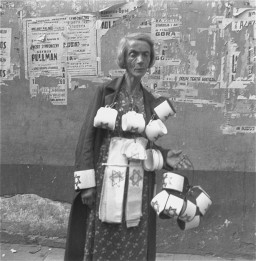
An emaciated woman sells the compulsory Star of David armbands for Jews. In the background are concert posters; almost all are destroyed. Warsaw ghetto, Poland, September 19, 1941.This photograph was taken by Heinrich Joest, a German army sergeant during World War II. On September 19, 1941, he took 140 images of every aspect of life and death in the Warsaw ghetto.
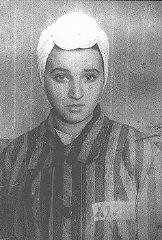
14-year-old Sara Bialovadska, imprisoned in the Kaiserwald concentration camp near Riga. Latvia, 1943.
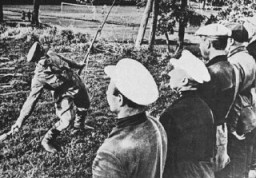
A Soviet army instructor trains partisans in the use of grenades. Soviet Union, wartime.
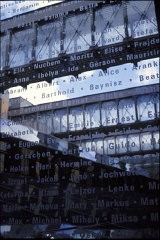
Detail of an interior bridge at the United States Holocaust Memorial Museum with the names of victims etched in glass. Washington, DC, 1996.
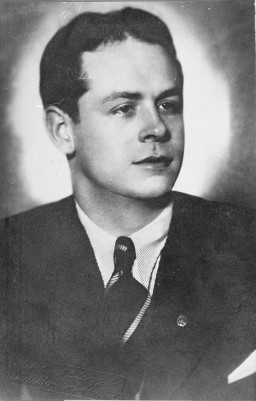
Interior designer from Duesseldorf who was charged with homosexuality and imprisoned for 18 months. Duesseldorf, Germany, date uncertain.
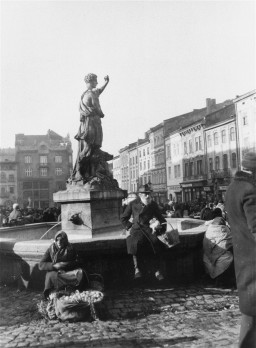
This photograph shows a market scene at the main square in Lwów, Poland, shortly before the outbreak of World War II. Sitting on the fountain is a man holding a chicken and a basket, likely filled with groceries. His long beard and style of dress, including the overcoat and fedora, identify him as a more traditional, religious Jew. Traditionally, observant Jewish men wore beards and kept their heads covered.An elderly woman selling produce sits on the pavement near the man. In contrast to the man, the…
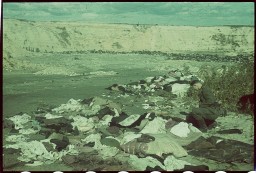
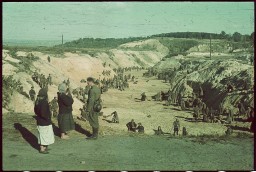
An SS guard examines piles of clothing belonging to the more than 33,000 Jews murdered at the nearby Babyn Yar killing site. The SS forced the victims to undress and leave their belongings behind. The Jews were then marched or driven to the shooting site. Kyiv (Kiev), German-occupied Soviet Union, after September 30, 1941.
An SS guard watches prisoner laborers at construction work. Neuengamme concentration camp, Germany, wartime.
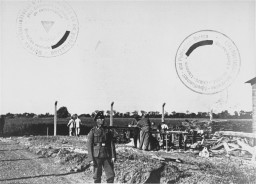
An SS guard speaks with local Ukrainian women while Soviet prisoners of war carry out forced labor. A German Propaganda Company photographer took this image shortly after the SS murdered over 33,000 Jews on September 29-30,1941 at the nearby Babyn Yar killing site. Kyiv (Kiev), German-occupied Soviet Union, after September 30, 1941.
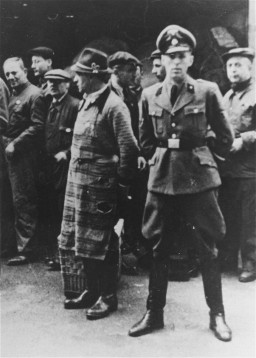
An SS officer stands in front of Jews assembled for deportation. Vienna, Austria, 1941-1942.
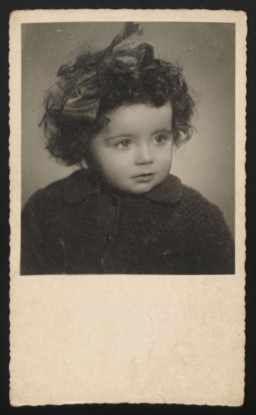
A photograph of a young Anita Epstein (née Künstler), who was born to Jewish parents in the Kraków ghetto in 1942. This photograph was taken while she was in hiding with a Catholic family in German-occupied Poland during World War II (circa 1943–1945).
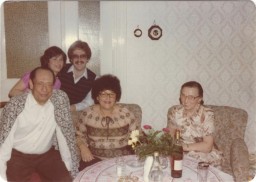
Anna Gutman (Boros) (left) and her daughter, Carla (second from left), visit with Dr. Mohamed Helmy (second from right) and his wife, Emmi (right), in Berlin in 1968. Dr. Helmy hid Gutman in his home for the duration of World War II.
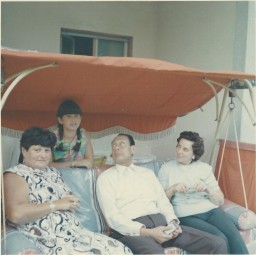
Anna Gutman (Boros) (seated, center), her daughter, and son-in-law visit Dr. Mohamed Helmy (seated, left) and his wife, Emmi (seated, right), in Berlin in 1980. Dr. Helmy hid Gutman in his home for the duration of World War II.
Anne Frank at 11 years of age, two years before going into hiding. Amsterdam, the Netherlands, 1940.
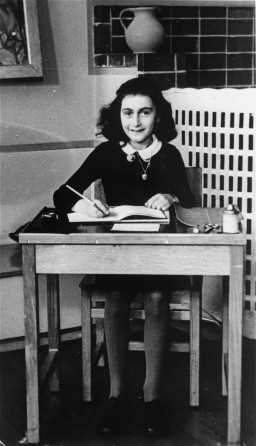
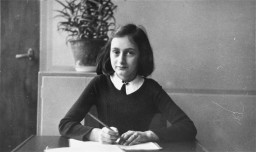
Anne Frank, age twelve, at her school desk. Amsterdam, the Netherlands, 1941.
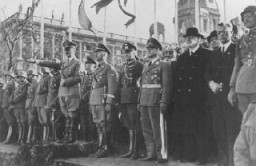
Adolf Hitler and his entourage view a military parade following the annexation of Austria (the Anschluss). Vienna, Austria, March 1938.
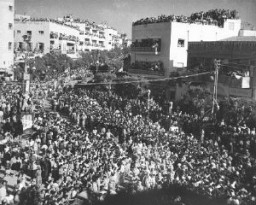
Crowds gathered in the streets of Tel Aviv celebrate the anniversary of the establishment of Israel with an independence day parade. Tel Aviv, Israel, May 1949.
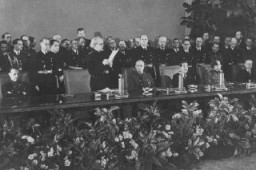
Slovak prime minister Vojtech Tuka (front row, standing) announces Slovakia's entry into the Axis alliance (initially Germany, Italy, and Japan; also joined by Hungary, Romania, and Bulgaria). Berlin, Germany, November 1940.
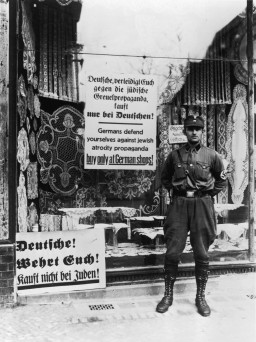
During the anti-Jewish boycott, an SA man stands outside a Jewish-owned store with a sign demanding that Germans not buy from Jews. Berlin, Germany, April 1, 1933.
We would like to thank Crown Family Philanthropies, Abe and Ida Cooper Foundation, the Claims Conference, EVZ, and BMF for supporting the ongoing work to create content and resources for the Holocaust Encyclopedia. View the list of donor acknowledgement.