![A transport of Jewish prisoners marches through the snow from the Bauschovitz train station to Theresienstadt. [LCID: 69720]](https://encyclopedia.ushmm.org/images/large/781755a6-1ba5-4d8e-8b2b-9f25bdf3687f.jpg)
Browse an alphabetical list of artifacts from the Holocaust and World War II. Each object tells a story about the history and demonstrates human experiences during the time period.
<< Previous | Displaying results 171-180 of 235 for "Artifact" | Next >>
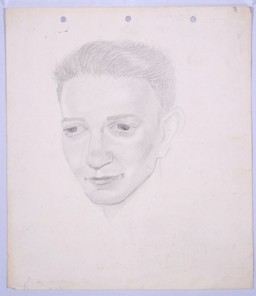
Portrait of Semek Kushner, in pencil, by Yonia Fain. Kushner's father and brother were killed in Shanghai near the end of the war during an American air raid on Hongkew. [From the USHMM special exhibition Flight and Rescue.]
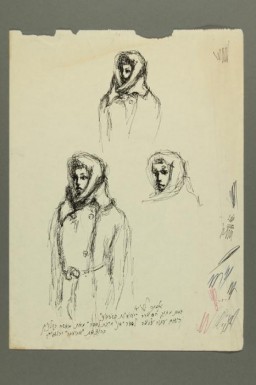
"Portrait of Masha Rolnik, Leibisch concentration camp, 1944" by Esther Lurie. This image shows three sketches of Masha Rolnikaite (Rolnik) drawn by Esther Lurie, in approximately 1965, for the cover of Masha's memoir, Ikh muz dertseyin [I have to tell]. They reproduce the drawing of Masha that Esther made when both were prisoners in a forced-labor camp. Esther Lurie was active in documenting scenes of life in the Kovno ghetto and in forced-labor camps. She buried most of her works in the hope that they…
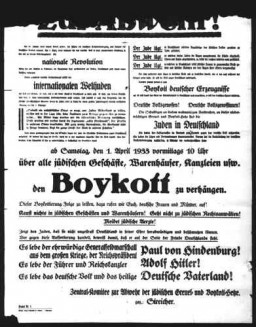
This poster from Munich, Germany, proclaims the April 1, 1933, boycott of Jewish-owned businesses and services offered by Jewish professionals. It calls on all Germans to honor the boycott, which began at 10 a.m. The poster was signed by the radical Nazi antisemite, Julius Streicher, official organizer of the boycott.
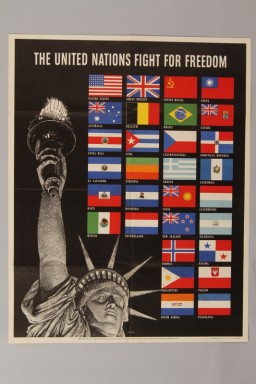
Poster titled “The United Nations Fight For Freedom.” It was one of many posters produced by the Office of War Information, the United States’s official propaganda agency during World War II. Canadian-American commercial artist Steve Broder (1902-1992) designed this work to bolster confidence in the Allied war effort against the Axis Powers (Nazi Germany, Fascist Italy, and Imperial Japan). It depicts the 30 flags of countries that signed the Declaration by the United Nations and declared war on the…
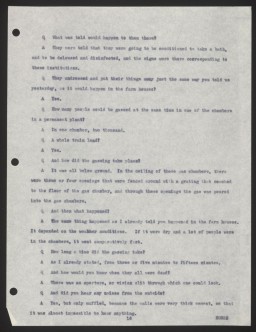
A page from the transcript of the testimony given by Rudolf Höss at the International Military Tribunal at Nuremberg. At the trial, Höss testified about the gassing of Jews of Auschwitz, where he was commandant. He responded in German and communicated through a translator. Testimony dated April 2, 1946.
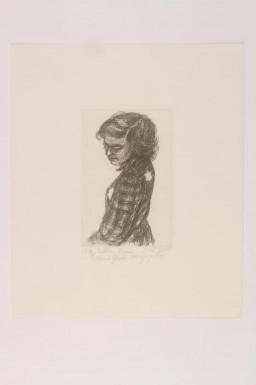
This image shows a print of a portrait drawing by artist Esther Lurie. Lurie documented scenes of life in the Kovno ghetto and contributed to the secret archives there.The subject of the portrait is a young woman in a checked dress with two Star of David patches. This print is a version of the drawing, "Portrait of a Young Girl with Two Yellow Badges," which Lurie did in the Kovno ghetto and for which she was awarded the Dizengoff Prize in 1946 in Palestine.Because the majority of Lurie's works were not…
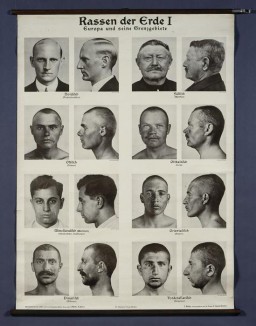
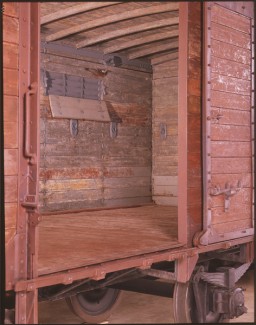
Many different kinds of railway cars were used for deportations. They varied in size and weight. The railway car on display in the United States Holocaust Memorial Museum's Permanent Exhibition is of just one type used. The dimensions of the railway car in the Museum's exhibition are as follows: Total length 31 feet 6 inches (9.6 meters); interior space for deportees 26 feet 2 inches (8 meters). Total height 14 feet (4.3 meters) from the bottom of the wheel to the highest point of the car; interior space…
Eva Ostwalt was born in Cologne, Germany, to Jewish parents. She had two younger sisters, Kate and Trude. In 1927, Eva moved with her daughter, Heidemarie, and non-Jewish husband to Dresden. Eva and Karl later divorced, and Eva received custody of Heidemarie. Mother and daughter moved to Merano, Italy. When Eva’s passport expired in 1938, she had to return to Germany. Believing that Heidemarie would be safer with her father, Eva gave custody back to Karl in Dresden. Eva returned to Cologne, where both…
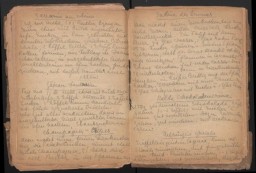
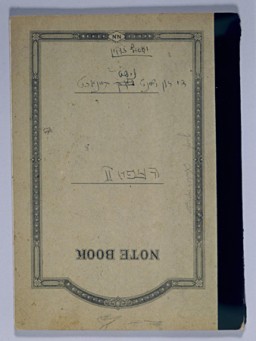
Notebook of Josef Fiszman, a refugee writer from Warsaw. He sold articles to Jewish newspapers in Shanghai and Harbin but still needed help to live from the American Jewish Joint Distribution Committee. Writing in Yiddish, Fiszman rotated the notebook in order to write from right to left (the words "Note book" thus appear to be upside down in this image). [From the USHMM special exhibition Flight and Rescue.]
We would like to thank Crown Family Philanthropies, Abe and Ida Cooper Foundation, the Claims Conference, EVZ, and BMF for supporting the ongoing work to create content and resources for the Holocaust Encyclopedia. View the list of donor acknowledgement.