![A transport of Jewish prisoners marches through the snow from the Bauschovitz train station to Theresienstadt. [LCID: 69720]](https://encyclopedia.ushmm.org/images/large/781755a6-1ba5-4d8e-8b2b-9f25bdf3687f.jpg)
Browse an alphabetical list of artifacts from the Holocaust and World War II. Each object tells a story about the history and demonstrates human experiences during the time period.
<< Previous | Displaying results 31-40 of 235 for "Artifact" | Next >>
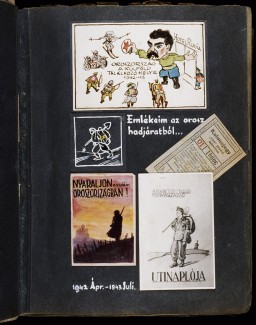
Collage entitled: "Mementos from the Russian campaign," which includes a watercolor of Stalin with the caption: 'Russia a meeting place for foreigners 1942-43' (top); a commuter train ticket issued to military personnel who carried the special SAS [Hurry, Immediate, Urgent] draft notice (middle, right); a pseudo travel brochure cover entitled 'Spend your summer vacation in merry Russia' (bottom, left); and the original design for the cover of the labor company's journal entitled 'Hungarian Royal 109/13…
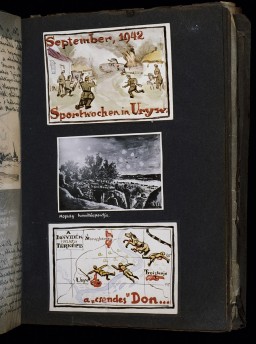
(top) "Watercolor entitled 'Sports weeks in Uryv, September 1942' in which a Russian tank attacks a Hungarian unit in Uryv."; (bottom) "Watercolor entitled 'Quiet Don: a detailed map of the Don River area' featuring images of dead soldiers, horses and spilled blood on a map of the Don River." [Photograph #58060]
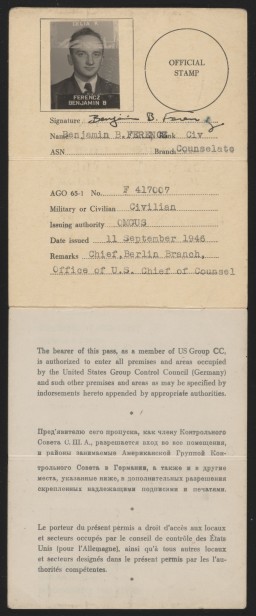
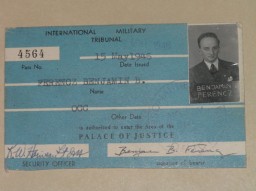
Pass issued to Benjamin Ferencz, war crimes investigator and later chief prosecutor in the Einsatzgruppen Trial. This pass granted the bearer free movement within the US-occupied zone of postwar Germany.
International Military Tribunal entry pass for Benjamin Ferencz, war crimes investigator and later chief prosecutor in the Einsatzgruppen Trial.
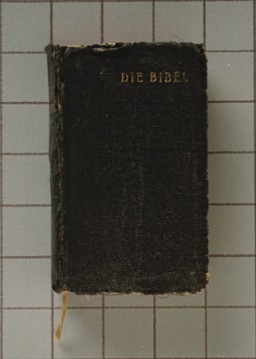
Soviet forces liberated the Sachsenhausen concentration camp in April 1945. In the camp, Soviet soldiers found this German edition of the Old and New Testaments on a dead prisoner, a Jehovah's Witness. The bible was sent to the prisoner's surviving family members.
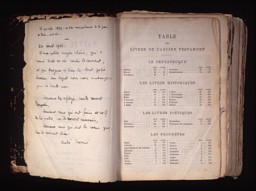
The family bible shown here belonged to Andre Trocme and contains annotations he made in preparation for his sermons. Trocme was a Protestant pastor in Le Chambon-sur-Lignon, France. During the war, he and the town's residents helped shield Jews, especially Jewish children, and others from the Germans. The operation saved thousands of refugees, including about 5,000 Jews. His handwritten inscription in French reads, in part, "Happy are those hungry and thirsty of justice; for they will be satisfied."
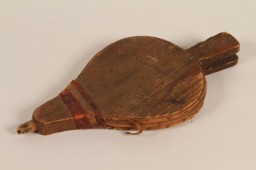
These blacksmith's bellows were used by Romani (Gypsy) artisan Juri Cervenuak in Trebisov, Slovakia, in 1939. Many Roma traditionally worked as craftsmen and were blacksmiths, cobblers, tinsmiths, horse dealers, and toolmakers.
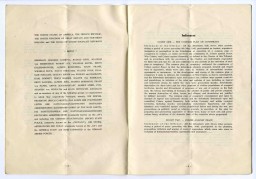
Second and third pages of a program booklet distributed during the International Military Tribunal at Nuremberg. Note the definitions of the conspiracy charge and crimes against peace, brought in the indictment.
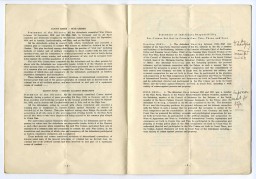
Fourth and fifth pages of a program booklet distributed during the International Military Tribunal at Nuremberg. Page four defines the charges of war crimes and crimes against humanity. The fifth page begins the list of IMT defendants. Handwritten notes in the margin record each defendant's sentence as it was read aloud in the courtroom.
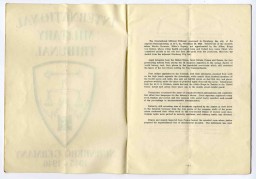
First page of a program booklet distributed during the International Military Tribunal at Nuremberg. The dramatic text sets the scene in the courtroom.
We would like to thank Crown Family Philanthropies, Abe and Ida Cooper Foundation, the Claims Conference, EVZ, and BMF for supporting the ongoing work to create content and resources for the Holocaust Encyclopedia. View the list of donor acknowledgement.