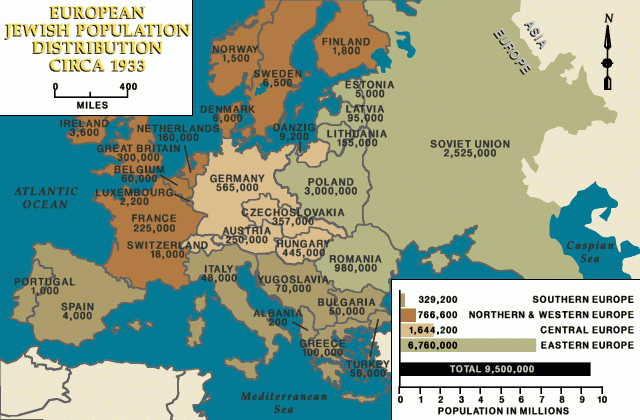
Jews have lived in Europe for more than two thousand years. The American Jewish Yearbook placed the total Jewish population of Europe at about 9.5 million in 1933. This number represented more than 60 percent of the world's Jewish population, which was estimated at 15.3 million. Most European Jews resided in eastern Europe, with about 5 1/2 million Jews living in Poland and the Soviet Union. Before the Nazi takeover of power in 1933, Europe had a dynamic and highly developed Jewish culture. In little more than a decade, most of Europe would be conquered, occupied, or annexed by Nazi Germany and most European Jews—two out of every three—would be dead.
Item View![Major death marches and evacuations, 1944-1945 [LCID: gge72100]](https://encyclopedia.ushmm.org/images/large/8f63a32e-543e-40fe-b690-44b030bfc971.gif "Major death marches and evacuations, 1944-1945 [LCID: gge72100]")
In January 1945, the Third Reich stood on the verge of military defeat. As Allied forces approached Nazi camps, the SS organized death marches of concentration camp inmates, in part to keep large numbers of concentration camp prisoners from falling into Allied hands. The term "death march" was probably coined by concentration camp prisoners. It referred to forced marches of concentration camp prisoners over long distances under heavy guard and extremely harsh conditions. During death marches, SS guards brutally mistreated the prisoners and killed many. The largest death marches were launched from Auschwitz and Stutthof.
Item View![Major Nazi camps in Greater Germany, 1944 [LCID: gge72050]](https://encyclopedia.ushmm.org/images/large/e2090857-ff94-4d49-babf-1c7c82f2a849.gif "Major Nazi camps in Greater Germany, 1944 [LCID: gge72050]")
The Nazi camp system expanded rapidly after the beginning of World War II in September 1939, as forced labor became important in war production. Labor shortages in the German war economy became critical after German defeat in the battle of Stalingrad in 1942–1943. This led to the increased use of concentration camp prisoners as forced laborers in German armaments industries. Especially in 1943 and 1944, hundreds of subcamps were established in or near industrial plants. Subcamps were generally smaller camps administered by the main camps, which supplied them with the required number of prisoners. Camps such as Auschwitz in German-occupied Poland, Buchenwald in central Germany, Gross-Rosen in eastern Germany, Natzweiler-Struthof in eastern France, Ravensbrück near Berlin, and Stutthof near Danzig on the Baltic coast became administrative centers of huge networks of subsidiary forced-labor camps.
Item View![Major deportations to killing centers, 1942-1944 [LCID: eur78940]](https://encyclopedia.ushmm.org/images/large/7bbc2613-3771-45d9-b906-a740cc398124.gif "Major deportations to killing centers, 1942-1944 [LCID: eur78940]")
This map shows some of the major deportations of Jews from all over Europe to Nazi killing centers in 1942–1944. It depicts transports from transit camps, ghettos, and major cities. Most Jews on these transports were murdered in gas chambers upon their arrival at the killing centers. The Nazis and their allies and collaborators coordinated these deportations as part of the “Final Solution”—the Nazi plan to murder all of Europe’s Jews
On this map, the Majdanek camp is marked as a killing center. In the past, many scholars counted Majdanek (located just outside the city of Lublin) as a sixth killing center. However, based on newer research, Majdanek is usually classified as a concentration camp (officially Konzentrationslager Lublin).
Item View![Killing centers in occupied Poland, 1942 [LCID: pol72090]](https://encyclopedia.ushmm.org/images/large/467bd15d-d804-4915-bf66-acca71f40778.gif "Killing centers in occupied Poland, 1942 [LCID: pol72090]")
Killing centers (also referred to as "extermination camps" or "death camps") were designed to carry out genocide. Between 1941 and 1945, the Nazis established five killing centers in German-occupied Poland—Chełmno, Belzec, Sobibor, Treblinka, and Auschwitz-Birkenau (part of the Auschwitz camp complex). Chełmno and Auschwitz were established in areas annexed to Germany in 1939. The other camps (Belzec, Sobibor, and Treblinka) were established in the General Government (an administrative unit of occupied Poland). Auschwitz functioned as concentration and forced-labor camps, as well as a killing center. The overwhelming majority of the victims of the killing centers were Jews. An estimated 2.7 million Jews were killed in these five killing centers as part of the "Final Solution." Other victims murdered in the killing centers included Roma (Gypsies) and Soviet prisoners of war.
On this map, the Majdanek camp is labeled as a killing center. In the past, many scholars counted the Majdanek camp (located just outside the city of Lublin) as a sixth killing center. However, based on newer research, Lublin-Majdanek is usually classified as a concentration camp. According to this research, German authorities used Majdanek primarily as a place to concentrate Jews who were being temporarily spared for use as forced laborers. Occasionally, especially after Belzec ceased operating in late 1942, Jews were sent to Majdanek as part of Operation Reinhard to undergo selection. Jews selected as unfit for labor were murdered at Lublin-Majdanek either by shooting or in the camp's gas chambers.
Item View![Major Nazi camps in Europe, January 1944 [LCID: eur72160]](https://encyclopedia.ushmm.org/images/large/db2e26ad-3a0a-4946-9ce2-70e513ed39d5.gif "Major Nazi camps in Europe, January 1944 [LCID: eur72160]")
This map shows some of the Nazi camps that existed in German-occupied Europe in 1943–1944. These include killing centers, concentration camps, labor camps, and transit camps.
Between 1933 and 1945, Nazi Germany established tens of thousands of camps. The regime imprisoned millions of people in these camps. The Nazis used these sites for many purposes, including the imprisonment of real and perceived enemies and the mass murder of Jewish people. Nazi camps were sites of cruelty, torture, deprivation, unchecked disease, grueling forced labor, and extreme violence.
Item View
![Einsatzgruppen massacres in eastern Europe [LCID: eur73960]](https://encyclopedia.ushmm.org/images/large/e71749ea-5732-47f0-8439-edc291ee884a.gif "Einsatzgruppen massacres in eastern Europe [LCID: eur73960]")
![Major ghettos in occupied Europe [LCID: eur74910]](https://encyclopedia.ushmm.org/images/large/94820267-20ca-4726-a90b-6abe63ac3419.gif "Major ghettos in occupied Europe [LCID: eur74910]")
During the Holocaust, the Nazis and their allies imprisoned Jewish people in ghettos. Ghettos were areas of cities or towns where authorities forced Jews to live under miserable conditions separated from the non-Jewish population.
In total, the Nazis and their allies (including Hungary and Romania) established more than 1,300 ghettos. Most of these ghettos were located in German-occupied Poland, the German-occupied Baltic states, and the occupied Soviet Union. Additionally, the Germans created the Theresienstadt (Terezín) ghetto in the Protectorate of Bohemia and Moravia (the occupied Czech lands) and several ghettos in Salonika (Thessaloniki) in German-occupied Greece. There were no ghettos in western Europe.
Ghettos were a key means of isolating, controlling, and ultimately murdering millions of Jews.
Item View![Persecution of Roma (Gypsies), 1939-1945 [LCID: eur72110]](https://encyclopedia.ushmm.org/images/large/f528d3f1-1758-4a5a-87b2-b51720502b75.gif "Persecution of Roma (Gypsies), 1939-1945 [LCID: eur72110]")
Roma (Gypsies) were among the groups singled out on racial grounds for persecution by the Nazi regime. Roma were subjected to internment, deportation, and forced labor, and were sent to killing centers. Einsatzgruppen also killed tens of thousands of Roma in the German-occupied eastern territories. The fate of the Roma closely paralleled that of Jews.
Item View!["Euthanasia" centers, Germany 1940-1945 [LCID: ger73070]](https://encyclopedia.ushmm.org/images/large/51696999-44d4-4cf6-af6c-8a5135466d2e.gif "\"Euthanasia\" centers, Germany 1940-1945 [LCID: ger73070]")
In Nazi usage, “euthanasia” referred to the systematic killing of those Germans whom the Nazis deemed "unworthy of life" because of alleged genetic diseases or defects. Beginning in the fall of 1939, gassing installations were established at Bernburg, Brandenburg, Grafeneck, Hadamar, Hartheim, and Sonnenstein. Patients were selected by doctors and transferred from clinics to one of these centralized gassing installations and killed. After public outrage forced an end to centralized killings, doctors instead administered lethal injections to those selected for “euthanasia” in clinics and hospitals throughout Germany. In this way, the Euthanasia Program continued and expanded until the end of World War II.
Item View![Nazi concentration camps, 1933-1939 [LCID: ger72160]](https://encyclopedia.ushmm.org/images/large/98bbe43a-8a84-4820-a5e7-bb154084974e.gif "Nazi concentration camps, 1933-1939 [LCID: ger72160]")
The first concentration camps in Germany were established soon after Hitler's appointment as chancellor in January 1933. The Storm Troopers (SA) and the police established concentration camps to handle the masses of people arrested as alleged political opponents of the regime. These camps were established on the local level throughout Germany. Gradually, most of these early camps were disbanded and replaced by centrally organized concentration camps under the exclusive jurisdiction of the SS (Schutzstaffel; the elite guard of the Nazi state). By 1939, seven large concentration camps had been established. Besides Dachau, they were Sachsenhausen (1936) north of Berlin, Buchenwald (1937) near Weimar, Neuengamme (1938) near Hamburg, Flossenbürg (1938), Mauthausen (1938), and Ravensbrück (1939).
Item View![European rail system, 1939 [LCID: eur69090]](https://encyclopedia.ushmm.org/images/large/04107927-96a0-4030-815b-18d6919b9dba.gif "European rail system, 1939 [LCID: eur69090]")
The European rail network played a crucial role in the implementation of the “Final Solution.” Jews from Germany and German-occupied Europe were deported by rail to killing centers in occupied Poland, where they were killed. The Germans attempted to disguise their intentions, referring to deportations as "resettlement to the east." The victims were told they were to be taken to labor camps, but in reality, from 1942 onward, deportation meant transit to killing centers for most Jews. Deportations on this scale required the coordination of numerous German government ministries, including the Reich Security Main Office (RSHA), the Transport Ministry, and the Foreign Office. The RSHA coordinated and directed the deportations; the Transport Ministry organized train schedules; and the Foreign Office negotiated with German-allied states to hand over their Jews.
Item View![European Jewish population distribution, ca. 1950 [LCID: eur77870]](https://encyclopedia.ushmm.org/images/large/7ee11f56-7c91-4648-80f4-853a8c3163a9.gif "European Jewish population distribution, ca. 1950 [LCID: eur77870]")
We would like to thank Crown Family Philanthropies, Abe and Ida Cooper Foundation, the Claims Conference, and BMF for supporting the ongoing work to create content and resources for the Holocaust Encyclopedia. View the list of all donors.