![A transport of Jewish prisoners marches through the snow from the Bauschovitz train station to Theresienstadt. [LCID: 69720]](https://encyclopedia.ushmm.org/images/large/781755a6-1ba5-4d8e-8b2b-9f25bdf3687f.jpg)
Browse an alphabetical list of photographs. These historical images portray people, places, and events before, during, and after World War II and the Holocaust.
<< Previous | Displaying results 2526-2549 of 2697 for "Photo" | Next >>
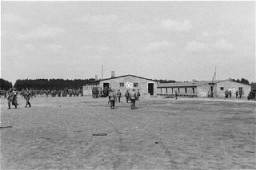
On May 2, 1945, the 8th Infantry Division and the 82nd Airborne Division encountered the Wöbbelin concentration camp. This photograph shows US troops in the Wöbbelin camp. Germany, May 4–6, 1945.
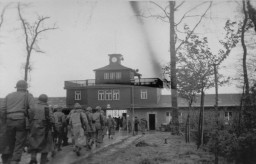
US soldiers enter the Buchenwald concentration camp following the liberation of the camp. Buchenwald, Germany, after April 11, 1945.
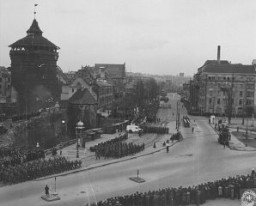
The inhabitants of Nuremberg watch a parade of US troops through their city. Nuremberg, Germany, 1946.
US troops land on Guadalcanal, in the Solomon Islands group. Guadalcanal was the focus of crucial battles in 1942–43. American victory in the Solomons halted the Japanese advance in the South Pacific. Guadalcanal, August 1942.
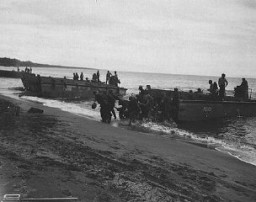
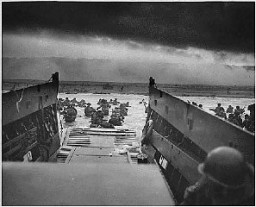
US troops wade through the surf on their arrival at the Normandy beaches on D-Day. Normandy, France, June 6, 1944.

US troops land on Guadalcanal, in the Solomon Islands groups. Guadalcanal was the focus of crucial battles in 1942–43. American victory in the Solomons halted the Japanese advance in the South Pacific. Guadalcanal, date uncertain.
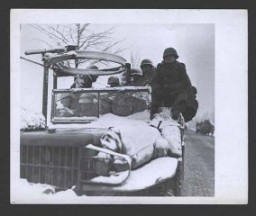
During the Battle of the Bulge, US troops move up to the front in open trucks in subzero weather to stop the German advance. December 22, 1944. US Army Signal Corps photograph taken by J Malan Heslop.
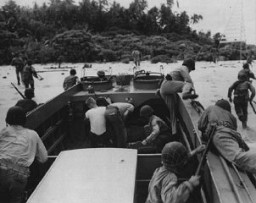
US troops pull the survivors of a sunken craft onto the shores of the Normandy beaches on D-Day. Normandy, France, June 6, 1944.

Troops of the American 82nd Airborne Division view bodies of inmates at Wöbbelin, a subcamp of the Neuengamme concentration camp. Germany, May 6, 1945.
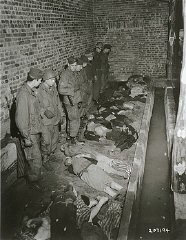
US troops view corpses of prisoners massacred by SS guards in a wooded area near the Kaufering IV subsidiary camp of the Dachau concentration camp. Landsberg- Kaufering, Germany, April 30, 1945.

US troops wade ashore at Normandy on D-Day, the beginning of the Allied invasion of France to establish a second front against German forces in Europe. Normandy, France, June 6, 1944.
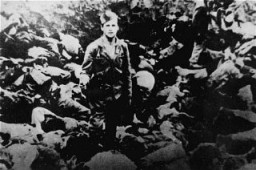
A Ustasa (Croatian fascist) guard stands amid corpses at the Jasenovac concentration camp, Yugoslavia, 1942.
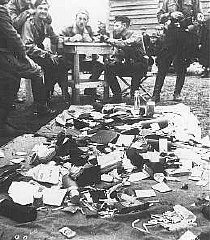
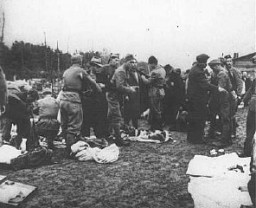
Ustasa (Croatian fascist) guards alongside belongings of prisoners at the Jasenovac concentration camp. Yugoslavia, between 1941 and 1945.
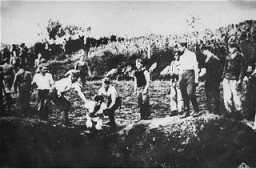
Ustasa (Croatian fascist) guards force a prisoner into a pit to be shot. Jasenovac concentration camp. Yugoslavia, probably 1942.
Ustasa (Croatian fascist) camp guards order a Jewish man to remove his ring before being shot. Jasenovac concentration camp, Yugoslavia, between 1941 and 1945.
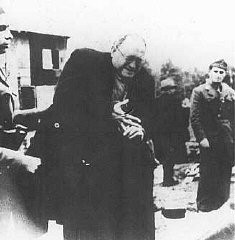
Ustasa (Croatian fascist) guards search prisoners and take their belongings upon arrival at Jasenovac concentration camp. Yugoslavia, between 1941 and 1945.
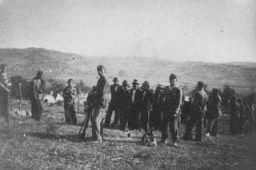
Ustaša (Croatian fascist) soldiers oversee the deportation of a group of civilians from Kozara region to a concentration camp, in the pro-German fascist state of Croatia established following the partition of Yugoslavia. Croatia, between 1941 and 1944.
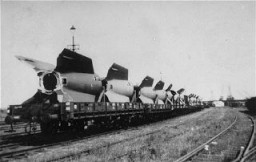
Sections of V-2 rockets, the so-called Vengeance Weapons, are removed by rail from the Dora-Mittelbau camp after liberation. Near Nordhausen, Germany, June 1945.
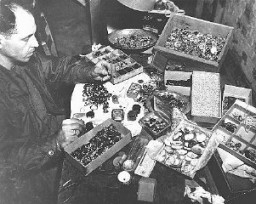
The valuables displayed here were confiscated from prisoners by German guards at the Buchenwald concentration camp and later found by soldiers of the Third US Army after the liberation of the camp. Buchenwald, Germany, after April 1945.
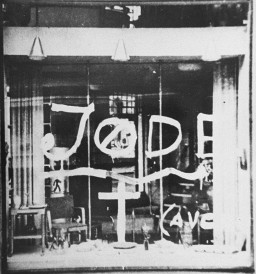
Antisemitic graffiti on the window of a Jewish-owned store. Norway, wartime.
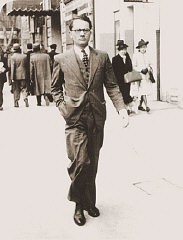
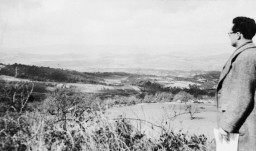
Varian Fry looks over an expanse of land, likely near the French-Spanish border, circa 1940-1941. Fry was an American journalist who helped artists and intellectuals escape from France during World War II.
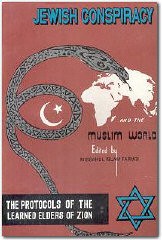
King Faisal of Saudi Arabia regularly presented copies of this edition of the Protocols to state visitors during the early 1970s. Published in Karachi, Pakistan, 1969. Courtesy of Hassan Mneimneh.
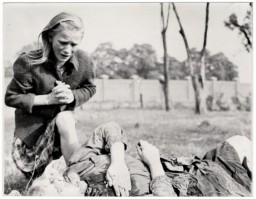
A ten-year-old Polish girl, Kazimiera Mika, mourns the death of her older sister, who was killed in a field in Warsaw, Poland, during a German air raid. Photographed by US documentary filmmaker, Julien Bryan, on September 13, 1939.
We would like to thank Crown Family Philanthropies, Abe and Ida Cooper Foundation, the Claims Conference, EVZ, and BMF for supporting the ongoing work to create content and resources for the Holocaust Encyclopedia. View the list of donor acknowledgement.