

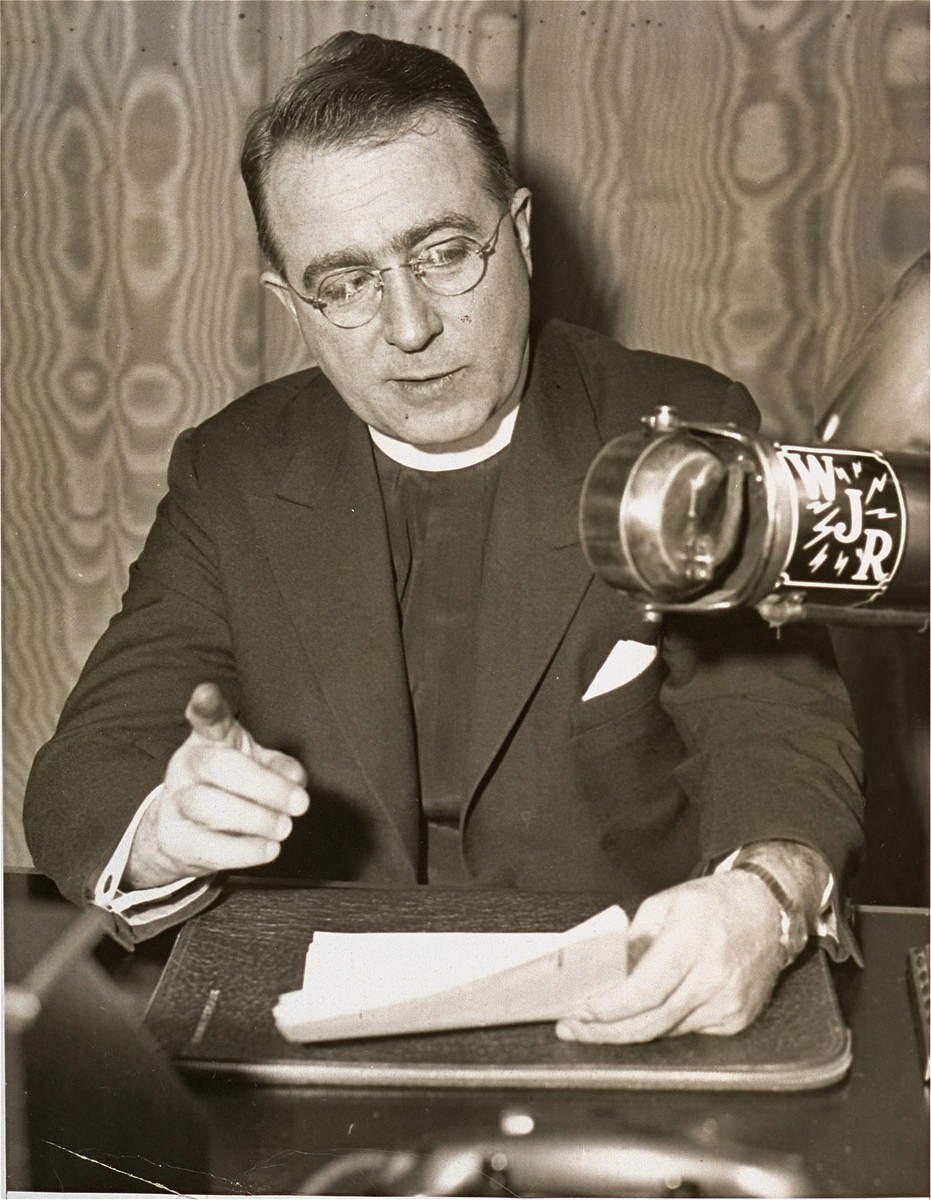
The Radio Priest: Charles E. Coughlin and American Antisemitism
Father Charles E. Coughlin, a Catholic priest based in the metro Detroit area, used the radio to spread antisemitic ideas. He made false charges that Jewish people promoted communism, and that they were not loyal Americans. He also accused Jews of controlling the world economy for their own benefit. His broadcasts reached tens of millions of American listeners.
Key Facts
-
1
Father Coughlin was an influential Catholic priest who used radio broadcasts and his newspaper, Social Justice, to spread antisemitic ideas to millions of Americans.
-
2
Coughlin made the false claim that Jews were to blame for communism. He said that the Nazi regime’s persecution of Jews was a justifiable way to fight against communism.
-
3
Coughlin said that the United States should stay out of World War II. He supported isolationism even after the United States entered the war in December 1941. Coughlin’s actions led the US government to investigate him for sedition.
Antisemitism is prejudice against or hatred of Jewish people. It has existed for thousands of years. It has also existed in many parts of the world, including in the United States. This article is about Father Charles E. Coughlin, a Catholic priest who became one of America’s most influential radio personalities in the 1930s. Coughlin used his popular radio broadcasts to promote antisemitism in the United States.
Father Charles E. Coughlin was one of the most popular media personalities in the United States during the 1930s. He spread lies on the radio about Jewish people’s political loyalties and economic influence. Coughlin portrayed himself as a champion of the working class. He claimed that he was giving voice to the concerns of ordinary Americans. His opposition to the United States’ involvement in World War II contributed to the decline of his popularity.
Early Life and Career
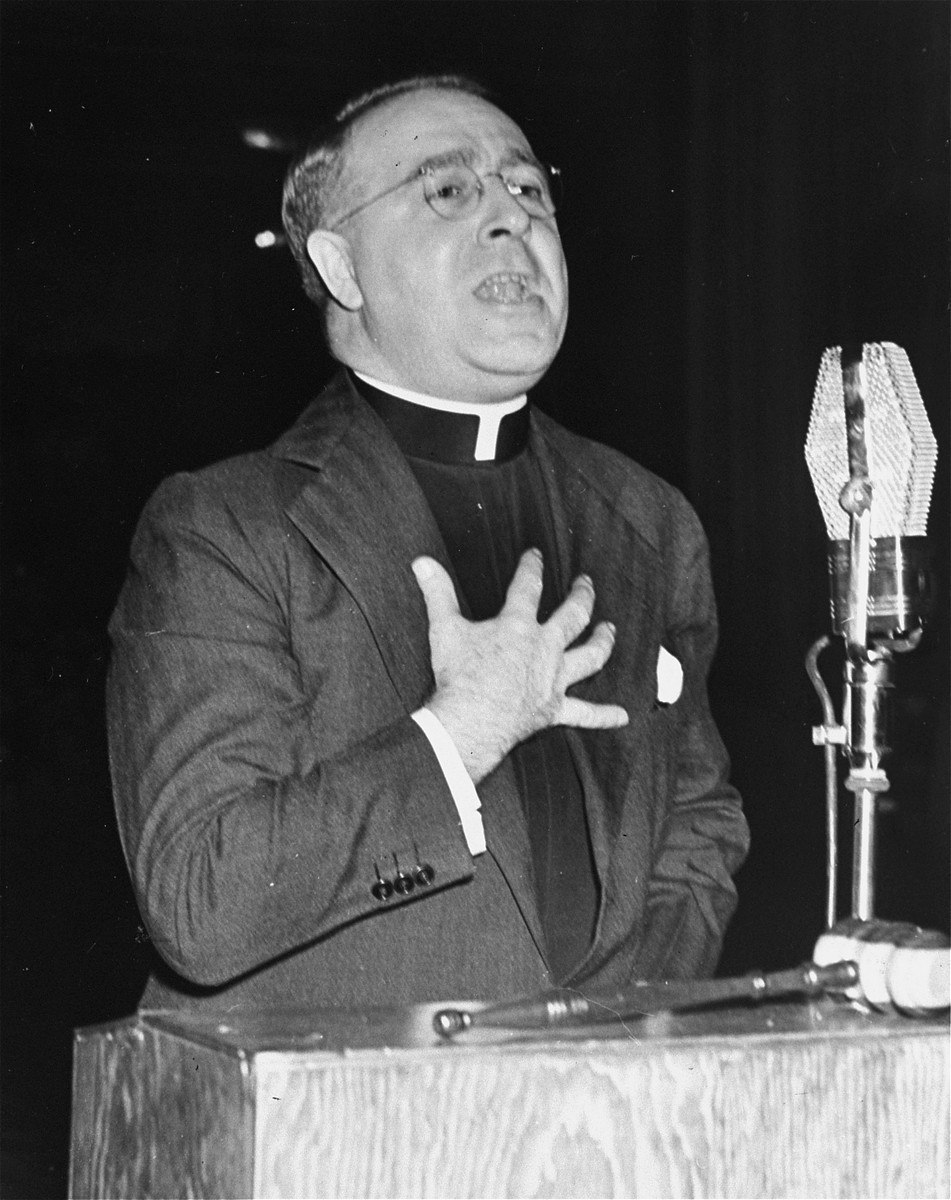
Charles E. Coughlin (1891–1979) was born in Ontario, Canada, to an Irish Catholic family. He was ordained as a Roman Catholic priest in 1916. Afterward, Coughlin began teaching history, literature, and other subjects at Assumption College, a boys’ school in Sandwich (later Windsor), Ontario.
While teaching at Assumption, Coughlin traveled many times to Detroit, Michigan, just over the US-Canada border from Windsor. In Detroit, he spoke at churches, clubs, and local events. Coughlin soon gained a reputation in the Detroit area as a talented and entertaining speaker.
Eventually, the bishop of the diocese of Detroit gave Coughlin the opportunity to establish a new parish in Royal Oak, a suburb north of Detroit. Coughlin accepted the appointment and left Assumption College in 1924. In Royal Oak, Coughlin helped to establish a church called the Shrine of the Little Flower. There, he ministered to a community made up mostly of automobile plant employees and other industrial workers. He served as Shrine’s pastor for more than 40 years, even as his influence reached well beyond his home church.
Coughlin Takes to the Radio
As Father Coughlin established himself at his new parish, he also started broadcasting on the radio. He delivered his first radio address on October 17, 1926. At the time, commercial radio was a new, powerful form of media that had been around for only six years. After Coughlin’s first radio address, five listeners sent him fan letters. And his popularity only grew from there. The number of fan letters increased significantly, and some listeners even donated money to the Shrine of the Little Flower. Just one year after his first broadcast, Coughlin could be heard on 20 stations in Michigan and surrounding states.
Religious and Political Messages
During Coughlin’s first broadcasts, he taught catechism classes for children. However, he soon began to include political opinions alongside religious instruction. Coughlin spoke out against using birth control. He also criticized the Ku Klux Klan, a white supremacist terror organization that targeted African Americans, Catholics, Jews, and immigrants. After the Great Depression began in 1929, Coughlin embraced populism. He claimed to be a voice for American workers who had lost their sense of economic and psychological security.
Building a Popular Audience
Coughlin quickly built up a large audience. By 1930, his addresses were broadcast on a national network, the Columbia Broadcasting System (CBS). He regularly had 30 million listeners, at a time when the entire US population was approximately 122 million. A new post office was built in Royal Oak just to receive the letters that listeners sent in each week—80,000 on average.
Despite Coughlin’s popularity, officials at CBS became concerned that his radio programs had become too political. In 1931, the network did not renew his contract. But, owners of individual stations were drawn to his program in part because it was so popular and profitable. Coughlin began to arrange his own contracts with many individual stations. By 1934, he could be heard on more than 30 radio stations.
Coughlin’s Populist Crusade
During his radio broadcasts, Father Coughlin shared populist ideas and claimed to speak for people who lacked power, especially the working class. He often said that justice could not prevail when wealth was concentrated among the upper classes. Coughlin linked these populist ideas to Catholic social activism that sought to combat mass poverty and political radicalism. His ideas were aligned with Catholic teachings on social justice.
Coughlin also encouraged his listeners to ask how the once strong US economy could fail so spectacularly and why workers had to suffer. He answered these questions by blaming financial institutions and demonizing communism. When he talked about financial institutions, he referred to bankers as “money changers.” This term came from the gospels of the Christian Bible and was often used as an antisemitic code for “Jews.” According to Coughlin, “money changers” were evil actors who benefited while ordinary American workers struggled.
In a February 1933 radio speech, Coughlin warned that “modern Shylocks” had “perpetuated the ancient crime of usury” and were profiting from the Great Depression. This single statement amplified multiple antisemitic stereotypes. It echoed the false idea that Jews controlled banking and finance, despite the fact that most Jews did not work in these professions. It also relied on the antisemitic slur “Shylock,” which referred to a vengeful moneylending character in William Shakespeare’s play The Merchant of Venice. Coughlin's mention of “usury” referred to the practice of lending money at high interest rates. This practice was condemned as a sin by Christians and was associated with Jews who allegedly took economic advantage of non-Jews.
Coughlin’s populism often included other barely veiled references to Jews as a driving force behind both financial institutions and communism. He frequently used the term “international bankers” as a code for the false assertion that Jews controlled the banks and world financial markets in order to exploit non-Jews. Although he did not always mention Jews explicitly, many of Coughlin’s references were antisemitic. They were most likely recognizable to his listeners across the United States.
Coughlin and President Roosevelt
In 1932, Charles Coughlin enthusiastically supported Franklin D. Roosevelt’s presidential candidacy. After Roosevelt won the election, Coughlin tried to gain influence in his administration. He championed New Deal programs being implemented to address the economic crisis of the Great Depression. In 1933, Roosevelt’s first year in office, Coughlin announced: “The New Deal is Christ’s Deal!” This was Coughlin’s effort to encourage his listeners to see Roosevelt’s agenda as aligned with Christian religious teachings.
The Roosevelt administration, however, generally tried to keep its distance from Coughlin. When he realized that he was not going to play a key role in Roosevelt's cabinet, Coughlin changed his opinions about Roosevelt and his policies. Coughlin began to criticize both the president and the New Deal for serving the interest of corporations, rather than workers. A gulf between Coughlin and Roosevelt grew gradually between 1934 and 1936, when Roosevelt was reelected for a second presidential term. Coughlin did not support Roosevelt in the 1936 election.
National Union for Social Justice: An Alternative Politics
As he shifted away from supporting President Roosevelt, Coughlin set up his own political organization: the National Union for Social Justice (NUSJ). In its early days, the NUSJ encouraged its members to support candidates for office who shared Coughlin’s principles. The NUSJ also harshly criticized the excesses of capitalism and the dangers of communism. It vehemently opposed President Roosevelt.
Although not originally envisioned as a political party, the NUSJ morphed into the Union Party prior to the 1936 election. The party ran William Lemke, a US Congressman from North Dakota, as a presidential candidate in 1936. Lemke won less than 2 percent of the popular vote. The party ceased to exist after this poor showing in the election. The NUSJ dissolved in 1937.
Coughlin continued to speak out passionately against communism following the 1936 election. He criticized Roosevelt and tried to convince his radio listeners that the New Deal was a Communist plot. As Coughlin’s politics became more radical, his audience declined. Nevertheless, he still regularly had several million listeners.
Social Justice Newspaper: Antisemitism and Misinformation
In 1936, Coughlin founded a national weekly newspaper called Social Justice. Although he did not hold the title of editor, he determined much of the paper’s content. His name appeared under the newspaper’s title as its founder. Social Justice advanced the aims of the NUSJ in articles on religion and news of the world. It also gave Coughlin a regular opportunity to promote his personal views and respond to critics.
Social Justice took a significant turn toward antisemitism in 1937 and 1938. It ran multiple articles falsely suggesting that a conspiratorial group of Jews had financial control over the world. Its pages were filled with lies about Jews’ negative influence on world politics and culture.
In 1938, Social Justice also serialized The Protocols of the Elders of Zion, a fraudulent book that promotes conspiracies and hatred of Jews. Even though the Protocols already had been exposed as fraud by the 1930s, Social Justice published articles that echoed the book’s themes. The articles claimed that the book was a true record of a Jewish plot to control the world. The newspaper also amplified other common antisemitic conspiracy theories, especially those that blamed Jews for the spread of communism.
Coughlin’s Antisemitism Intensifies
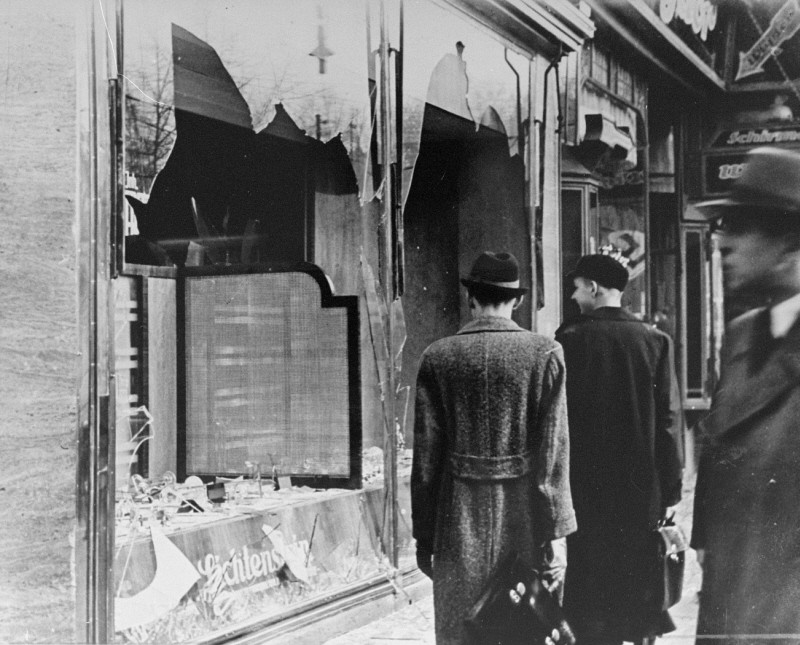
On the night of November 9–10, 1938, Nazi German leaders unleashed a nationwide riot known as Kristallnacht (Night of Broken Glass) that targeted Jewish people, homes, shops, and synagogues. The violence was covered extensively by US newspapers. President Roosevelt denounced Nazi Germany’s attack on Jews.
Ten days after Kristallnacht, Coughlin delivered a radio address called “Persecution—Jewish and Christian.” On air, he justified the violence of the Nazi regime by claiming that it was a reaction to the danger of Jewish communism. Coughlin attempted to deflect attention from the Nazi terror against Jews. He claimed that Jews received favorable news coverage around the world because they “controlled the radio and the press.” He also said that Roman Catholics were suffering under the oppression of “Jewish Communists.” Coughlin’s message stood in sharp contrast to an earlier broadcast from the Catholic University of America. The university’s broadcast denounced Nazi cruelty against Jews and affirmed Catholic support for Jewish communities.
As the Nazi regime’s persecution of Jews intensified, Coughlin continued to be inspired by Nazi propaganda. A month after Kristallnacht, an article in Social Justice published under Coughlin’s name copied sections directly from a speech delivered three years earlier by Nazi Minister of Propaganda Joseph Goebbels.
Coughlin Loses Support
Following the broadcast about Kristallnacht, Coughlin’s support began to decline. Several radio stations refused to air his program unless they could approve scripts in advance. Over the next two years, many stations canceled his broadcasts entirely. Some Catholic leaders in the United States also said publicly that Coughlin’s views did not represent the views of the church.
The Christian Front
In July 1939, Coughlin began to encourage his supporters to back a new political association called the Christian Front. Coughlin promised that the Christian Front would defend the United States from Communists and Jews.
The militia-like Christian Front organized “Buy Christian” rallies throughout the United States. Some of its members supported the German American Bund, a pro-Nazi organization in the United States. At times, Christian Front members took to the streets to harass Jews, including Jewish women and children. The Christian Front made national headlines in 1940 when the Federal Bureau of Investigation (FBI) arrested 18 members in Brooklyn, New York, on suspicion of conspiring to overthrow the government.
Coughlin told his listeners that the Christian Front’s path forward would be difficult. He celebrated its members’ suffering by comparing them to Jesus Christ. Coughlin spoke of a “call to arms,” where Christian Front members would fight against Jewish Communists, who he often referred to as Judeo-Bolshevists.
Coughlin’s Isolationism
When World War II began in Europe in September 1939, the majority of Americans hoped the United States would stay out of the war. Many adopted an isolationist stance, seeing World War II (1939–1945) as a foreign war. They also remembered the atrocities of World War I (1914–1918), which had resulted in the deaths of more than 116,000 US soldiers.
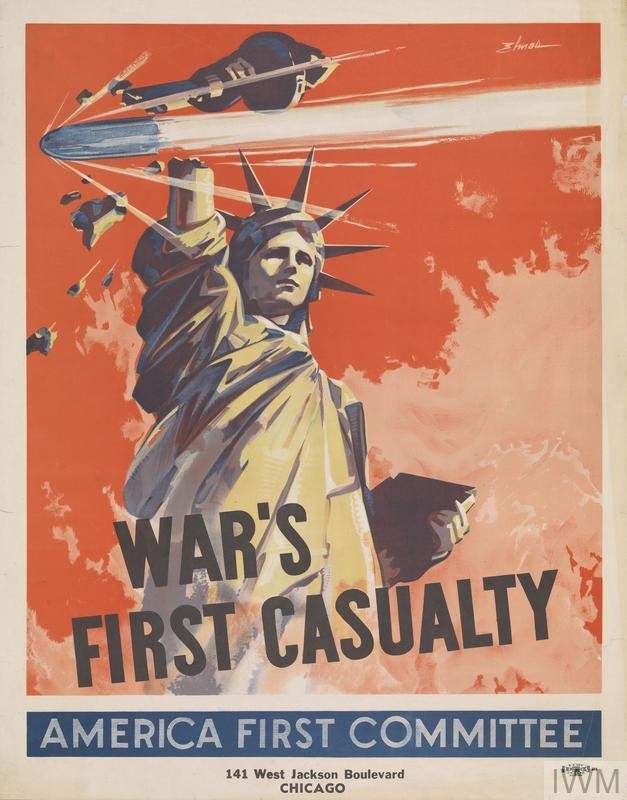
Coughlin was among the isolationists. He vigorously opposed US involvement in World War II. He told his listeners to join the America First Committee, the leading isolationist group in the United States. Even after Japan’s attack on Pearl Harbor on December 7, 1941, Coughlin said the United States should not have entered the war.
Coughlin often justified his isolationism using antisemitic arguments. He falsely blamed Jews for planning the war. He also repeatedly said that Jewish people across the world had conspired with the British government and the Roosevelt administration to involve the United States.
Decline
In 1942, the US Justice Department claimed that Coughlin's Social Justice newspaper had circulated “enemy propaganda” in the United States. FBI agents raided Coughlin's church and seized all parish records and personal papers. US authorities barred Coughlin from using the US Postal Service to disseminate Social Justice because it contained seditious material, including pro-Nazi propaganda. The US government also claimed that Coughlin’s newspaper published anti-American articles that hampered the US war effort and therefore violated the Espionage Act of 1917.
The Catholic Church also began to move decisively away from Coughlin during this period. In 1941, Detroit Archbishop Edward Mooney ordered Coughlin to stop broadcasting on the radio. With support from the US Department of Justice, the church also ordered Social Justice to cease publishing in spring 1942. On May 1, 1942, Archbishop Mooney instructed Coughlin to stop engaging in non-pastoral activities or risk being defrocked. The US government dropped its grand jury investigation into Coughlin after the church took these actions.
Retirement and Death
Father Coughlin continued to lead the Shrine of the Little Flower until his retirement in 1966. He died in 1979.
Footnotes
-
Footnote reference1.
Charles Coughlin, radio speech, February 19, 1933, quoted in Donald Warren, Radio Priest: Charles Coughlin, The Father of Hate Radio (New York: Free Press, 1996), 133.
-
Footnote reference2.
Charles Coughlin, “Persecution–Jewish and Christian,” November 20, 1938, quoted in Nazis of Copley Square: The Forgotten Story of the Christian Front (Cambridge, MA: Harvard University Press, 2021), 36.
Critical Thinking Questions
What pressures and motivations may have moved citizens to listen to and agree with Father Coughlin?
How can citizens respond responsibly to demagogues like Coughlin, who usually inflame divisions and denigrate groups in society?