![A transport of Jewish prisoners marches through the snow from the Bauschovitz train station to Theresienstadt. [LCID: 69720]](https://encyclopedia.ushmm.org/images/large/781755a6-1ba5-4d8e-8b2b-9f25bdf3687f.jpg)
Browse an alphabetical list of artifacts from the Holocaust and World War II. Each object tells a story about the history and demonstrates human experiences during the time period.
<< Previous | Displaying results 81-90 of 235 for "Artifact" | Next >>
Evidence tag from the trial of Klaus Barbie in Lyon, France. This standard police form lists Barbie's infractions as crimes against humanity and complicity, concepts defined at the International Military Tribunal at Nuremberg decades earlier. The line in which the victims' names would be recorded is left blank. February 25, 1983.
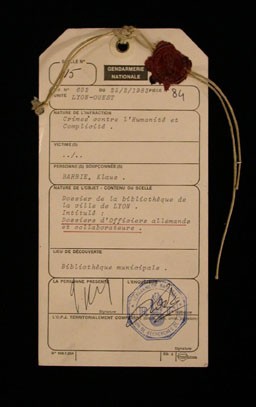
Evidence tag from the trial of Klaus Barbie in Lyon, France. This standard police form lists Barbie's infractions as crimes against humanity and complicity, concepts defined at the International Military Tribunal at Nuremberg decades earlier. The line in which the victims' names would be recorded is left blank. February 25, 1983.
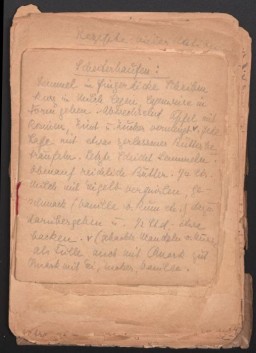
Eva Ostwalt was born in Cologne, Germany, to Jewish parents. She had two younger sisters, Kate and Trude. In 1927, Eva moved with her daughter, Heidemarie, and non-Jewish husband to Dresden. Eva and Karl later divorced, and Eva received custody of Heidemarie. Mother and daughter moved to Merano, Italy. When Eva’s passport expired in 1938, she had to return to Germany. Believing that Heidemarie would be safer with her father, Eva gave custody back to Karl in Dresden. Eva returned to Cologne, where both…
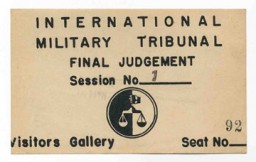
Reproduction of entry pass to the International Military Tribunal visitors' gallery for the sentencing of the defendants. October 1946.
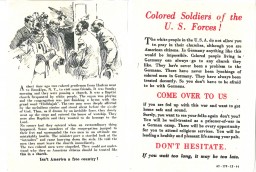
German propaganda leaflet targeting African American servicemen, November 1944. The leaflets falsely suggested that African Americans would receive better treatment by the German military and encouraged them to surrender to German troops.
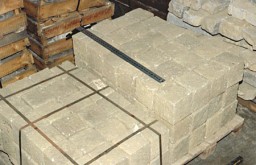
This photograph shows some of the 190 granite blocks donated to the United States Holocaust Memorial Museum by the Mauthausen Public Memorial in Austria. The Nazis established the Mauthausen concentration camp in 1938 near an abandoned stone quarry. Prisoners were forced to carry these granite blocks up more than 180 steps. The small blocks weighed between 30 and 45 pounds each. The larger blocks could each weigh more than 75 pounds. Prisoners assigned to forced labor in the camp quarry were quickly worked…
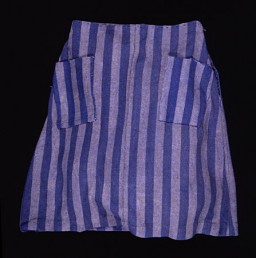
Hana Mueller altered this skirt issued to her in the Auschwitz concentration camp in 1944 by using the hem to make pockets.
A red and yellow floral handkerchief belonging to Judit Gondos that she took with her when she left Budapest on the Kasztner rescue train.

Diaries reveal some of the most intimate, heart-wrenching accounts of the Holocaust. They record in real time the feelings of loss, fear, and, sometimes, hope of those facing extraordinary peril.The diary of Hans Vogel, who fled Paris with his family while his father was interned, contains hand-drawn and colored maps of their flight. This page describes receiving papers allowing the family to immigrate to the United States. Hans was born in Cologne, Germany on December 3, 1926. The family left Germany in…
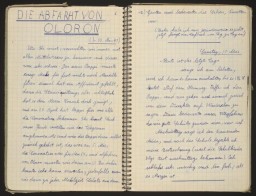
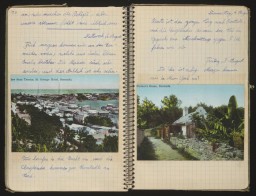
Hans Vogel and his family fled Paris following the German invasion. They eventually received papers allowing them to immigrate to the United States. During this time, Hans kept a diary that contains postcards, hand-drawn maps, and other illustrations of their flight. This page describes the voyage on board the Nyassa to the United States. Hans was born in Cologne, Germany on December 3, 1926. The family left Germany in 1936, settling in Paris. They remained there until the outbreak of World War II. Hans's…
We would like to thank Crown Family Philanthropies, Abe and Ida Cooper Foundation, the Claims Conference, EVZ, and BMF for supporting the ongoing work to create content and resources for the Holocaust Encyclopedia. View the list of donor acknowledgement.