![A transport of Jewish prisoners marches through the snow from the Bauschovitz train station to Theresienstadt. [LCID: 69720]](https://encyclopedia.ushmm.org/images/large/781755a6-1ba5-4d8e-8b2b-9f25bdf3687f.jpg)
Browse an alphabetical list of photographs. These historical images portray people, places, and events before, during, and after World War II and the Holocaust.
<< Previous | Displaying results 126-150 of 2697 for "Photo" | Next >>
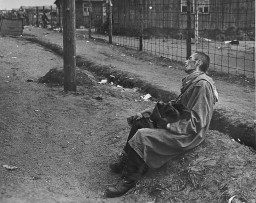
A survivor of the Bergen-Belsen camp, photographed soon after liberation. Bergen-Belsen, Germany, after April 12, 1945.

An survivor of the Bergen-Belsen camp, after liberation. Bergen-Belsen, Germany, after April 15, 1945.
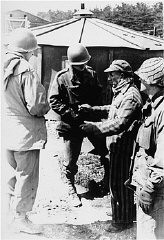
A survivor of Kaufering IV, one of the Dachau subcamps in the Landsberg-Kaufering area, with US soldiers after liberation. Kaufering, Germany, after April 27, 1945.
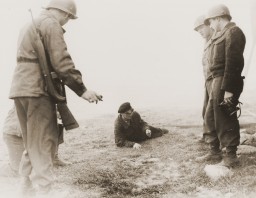
Bonde Gaza, a Hungarian musician who survived the Gardelegen atrocity, demonstrates to American soldiers how he managed to escape from the barn which the SS had set on fire. Germany, April 14–18, 1945.
A former concentration camp prisoner receives care from a mobile medical unit of the United Nations Relief and Rehabilitation Administration. Photograph taken at the Bergen-Belsen displaced persons camp. Germany, May 1946.
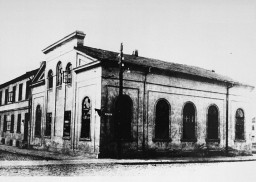
A synagogue in the town of Koło, Poland, where Jews were held before they were taken to and killed at the Chełmno (Kulmhof) killing center, 1945.The town of Koło was located less than 10 miles from the Chełmno killing center. German authorities used Koło as a transfer point during the transport of Jews from the Łódź ghetto to the Chełmno killing center. While the procedure in Koło varied over time, in early 1942, Jews from Łódź were typically brought to Koło by train. German authorities then…
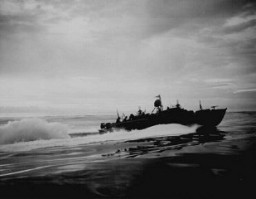
A US PT (Patrol Torpedo) boat off the coast of New Guinea, during an American counteroffensive against Japanese advances in the Solomon Islands in the eastern Pacific Ocean, 1943.
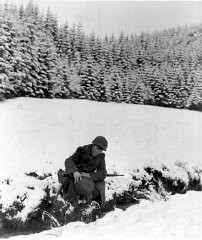
An American GI using his steel helmet to draw water from a stream during the Battle of the Bulge. December 22, 1944. US Army Signal Corps photograph taken by J Malan Heslop.
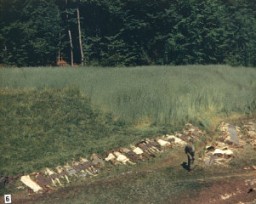
A US soldier stands among the corpses of prisoners exhumed from a mass grave in a ravine near Nammering. On April 19, 1945, a freight train with nearly 4,500 prisoners from Buchenwald pulled onto the railroad siding at Nammering. Hundreds of prisoners who had died on the train were buried in the mass grave along with the prisoners who were forced to carry the corpses to the ravine and were then shot. Germany, ca. May 6, 1945.
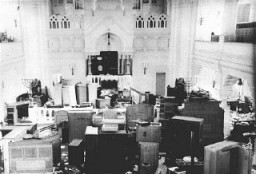
Following the Axis invasion of Yugoslavia in April 1941, Hungarian authorities in Novi Sad began confiscating property from Jewish families. The city's synagogue served as a warehouse for the stolen goods.
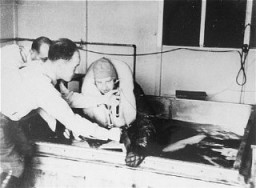
A victim of a Nazi medical experiment is immersed in icy water at the Dachau concentration camp. SS doctor Sigmund Rascher oversees the experiment. Germany, 1942.
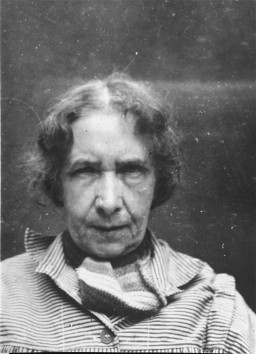
A victim of the Nazi Euthanasia Program. Hospitalized in a psychiatric ward for her nonconformist beliefs and writings, she was murdered on January 26, 1944. Germany, date uncertain.
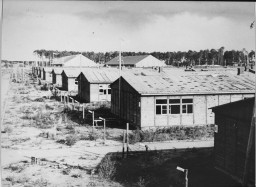
A view of barracks in the Stutthof concentration camp. This photograph was taken after the liberation of the camp. Stutthof, near Danzig, 1945.
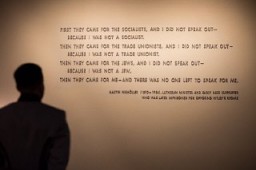
A visitor stands in front of the quotation from Martin Niemöller that is on display in the Permanent Exhibition of the United States Holocaust Memorial Museum. Niemöller was a Lutheran minister and early Nazi supporter who was later imprisoned for opposing Hitler's regime.
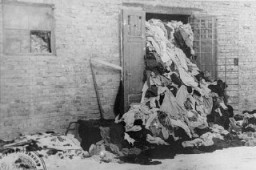
One of many warehouses at Auschwitz in which the Germans stored clothing taken from victims of the camp. This photograph was taken after the liberation of the camp. Auschwitz, Poland, after January 1945.
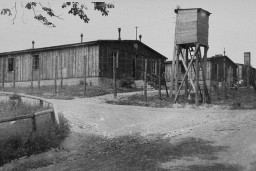
A watchtower and barracks at the Ohrdruf subcamp of the Buchenwald concentration camp. This photograph was taken after the US 4th Armored Division liberated the camp. Ohrdruf, Germany, June 1945.
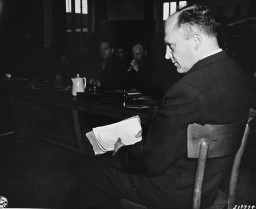
A witness testifies during the Mauthausen concentration camp trial. The man standing in the background is defendant Willy Eckert, a member of the SS. The trial took place before an American Military Tribunal in Dachau, Germany. March-May 1936.
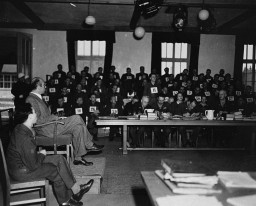
At an American military tribunal held in Dachau, a witness for the prosecution identifies a doctor who had denied medical care to prisoners at the Dora-Mittelbau concentration camp. Dachau, Germany, 1947.
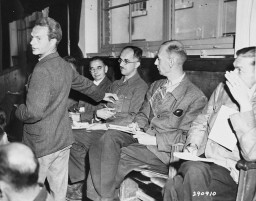
Friedrich Hoffman, holding a stack of death records, testifies about the murder of 324 Catholic priests who were exposed to malaria during Nazi medical experiments at the Dachau concentration camp. Dachau, Germany, November 22, 1945.
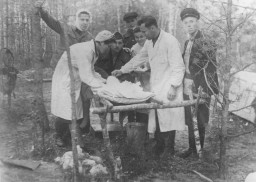
A wounded partisan is treated in a field hospital belonging to the Shish detachment of the Molotov brigade. Among those pictured are Dr. Ivan Khudyakov, the brigade's physician (second from the right), and Fanya Lazebnik (Faye Schulman), a photographer and partisan nurse (left). The wounded partisan's name is Sergei. Pinsk, 1942–44.
A young man in the Jewish quarter of Paris wears the mandatory Jewish badge. Paris, France, after June 1942.

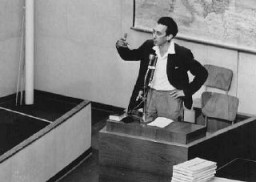
Jewish partisan and poet Abba Kovner, a survivor of the Vilna ghetto, testifies during Adolf Eichmann's trial. Jerusalem, Israel, May 4, 1961.
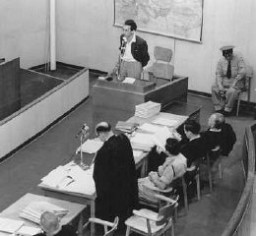
Former Jewish partisan leader Abba Kovner testifies for the prosecution during the trial of Adolf Eichmann. May 4, 1961.
We would like to thank Crown Family Philanthropies, Abe and Ida Cooper Foundation, the Claims Conference, EVZ, and BMF for supporting the ongoing work to create content and resources for the Holocaust Encyclopedia. View the list of donor acknowledgement.