![A transport of Jewish prisoners marches through the snow from the Bauschovitz train station to Theresienstadt. [LCID: 69720]](https://encyclopedia.ushmm.org/images/large/781755a6-1ba5-4d8e-8b2b-9f25bdf3687f.jpg)
Browse an alphabetical list of photographs. These historical images portray people, places, and events before, during, and after World War II and the Holocaust.
<< Previous | Displaying results 176-200 of 2698 for "Photo" | Next >>
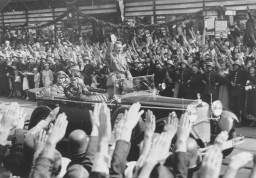
Standing in an open car, Adolf Hitler salutes a crowd in Hamburg, Germany. Photo dated August 17, 1934.
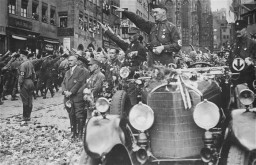
Nazi Party leader Adolf Hitler salutes a passing SS formation at the third Nazi Party congress (Reichsparteitag) in 1927. Nuremberg, Germany, August 1927.The SS (Schutzstaffel, or Protection Squad) was an elite Nazi Party paramilitary unit. It was originally established as Adolf Hitler’s personal bodyguard unit. In the 1930s and 1940s, the SS was led by Heinrich Himmler. It became an increasingly powerful organization in Nazi Germany. It became closely intertwined with the German police. The SS was…
Hitler salutes the youth ranks at the Nazi Party Congress. Nuremberg, Germany, September, 1935.

Adolf Hitler stands with a unit of the SA (Sturmabteilung, often called Stormtroopers) during a 1931 Nazi parade in Weimar, the capital city of the German state of Thuringia. On April 1, 1931, Nazi Wilhelm Frick was removed from his position in the Thuringian state government after a no-confidence vote. Frick, who had been appointed in 1930, was the first Nazi to hold a position in a state government. Weimar, Germany, 1931.
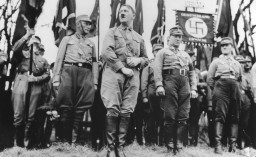
Adolf Hitler (center) walks and converses with other Nazi officials, date unknown.
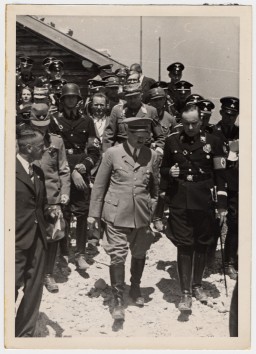
Adolf Hitler (front row, far left) served in the German military on the western front in World War I (1914–1918). During the course of the war, he was decorated for service, wounded, and temporarily blinded in a mustard gas attack. He used his veteran status in later election campaigns.
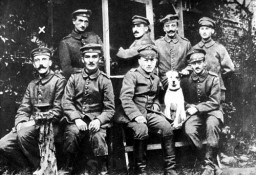
Adolf Hitler and Eva Braun review photographs as German photographer Heinrich Hoffmann (left) looks on. Hoffmann’s photographs helped shape the public image of Hitler. Berchtesgaden, Germany, 1942.

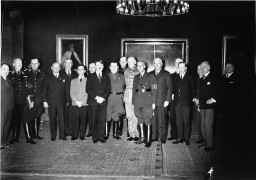
Adolf Hitler poses with his cabinet shortly after assuming power as chancellor of Germany. Hitler is flanked by Joseph Goebbels (left) and Hermann Göring (right). Berlin, Germany, 1933.
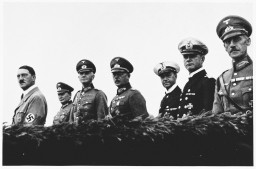
Adolf Hitler stands with his military high command at an inspection of German armed forces. From left to right: Hitler, Hermann Göring, Werner von Blomberg (armed forces), Erich von Fritsch (army) and Erich Raeder (navy). Germany, 1935.
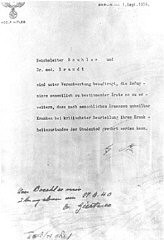
Adolf Hitler's authorization for the Euthanasia Program (Operation T4), signed in October 1939 but dated September 1, 1939.
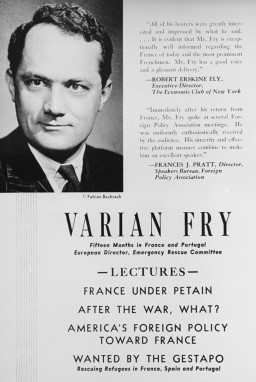
An advertisement for a series of lectures by Varian Fry, who worked in France to help anti-Nazi artists and intellectuals escape to the United States. New York, United States, 1942.
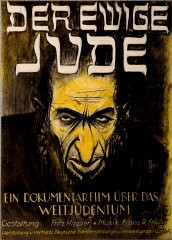
Advertising poster for the antisemitic film, Der ewige Jude (The Eternal Jew), directed by Fritz Hippler. Germany, ca. 1940.
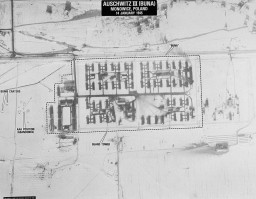
Aerial photograph of the Auschwitz III (Monowitz) camp, which was adjacent to the I.G. Farben plant. The photograph was taken following US bombing missions. Poland, January 14, 1945.
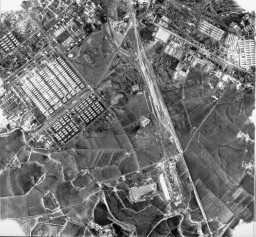
Aerial photograph of Auschwitz II (Birkenau). Poland, December 21, 1944.This image is one of a series of aerial photographs taken by Allied reconnaissance units under the command of the 15th US Army Air Force during missions dating between April 4, 1944, and January 14, 1945.
An aerial photograph of Babi Yar taken by the German air force. September 26, 1943.
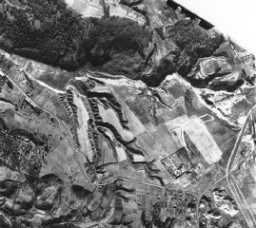
An aerial photograph of Babi Yar taken by the German air force. September 26, 1943.

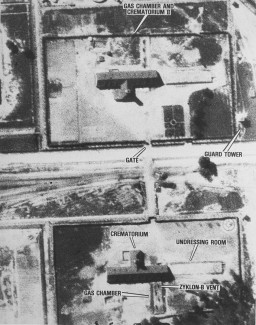
Aerial photograph of Auschwitz-Birkenau taken by Allied planes on August 25, 1944, during a reconnaissance mission. Decades after World War II, this and other images taken that day were rediscovered in American records. The English language labels were added in the 1970s.This image shows two of the gas chamber and crematorium complexes at the Auschwitz-Birkenau killing center. Specifically, it shows crematorium II and crematorium III, both of which had underground gas chambers and above ground…
Aerial view of the Nuremberg Palace of Justice, where the International Military Tribunal tried 22 leading German officials for war crimes. Nuremberg, Germany, November 1945.
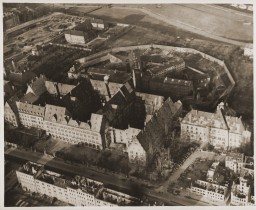
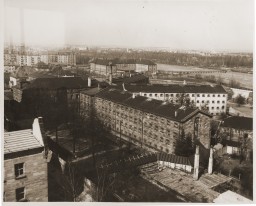
An aerial view of the Nuremberg prison, where defendants in the International Military Tribunal war crimes trial were held. Photograph taken in Nuremberg, Germany, between October 1945 and October 1946.
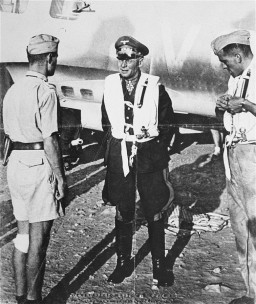
Erwin Rommel (center), German commander of the Africa Corps, at an airfield in Libya during an Axis offensive into neighboring Egypt. British troops decisively defeated Rommel's forces at El Alamein. Libya, September 8, 1942.
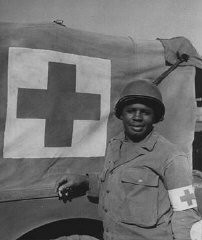
African American soldier Warren Capers was recommended for a Silver Star for his actions during the Allied invasion of France. He and his medical detachment aided more than 330 soldiers. France, August 18, 1944.
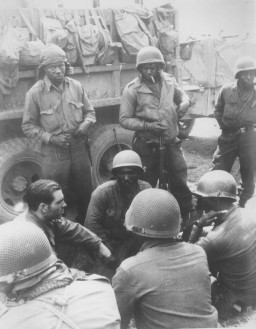
Members of the 12th Armored Division, which included African American platoons, await their orders. Germany, April 1945.
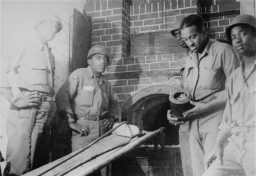
African American soldiers pose next to an oven in the crematorium of the Ebensee concentration camp.
Crowd views the aftermath of a massacre at Lietukis Garage, where pro-German Lithuanian nationalists killed more than 50 Jewish men. The victims were beaten, hosed, and then murdered with iron bars. Kovno, Lithuania, June 27, 1941.

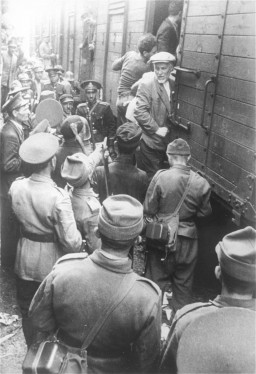
Police force Romanian Jews, survivors of a pogrom in Iasi, to board a train during their expulsion from Iasi to Calarasi. Iasi, Romania, late June 1941.
We would like to thank Crown Family Philanthropies, Abe and Ida Cooper Foundation, the Claims Conference, EVZ, and BMF for supporting the ongoing work to create content and resources for the Holocaust Encyclopedia. View the list of donor acknowledgement.