Artifact
Browse an alphabetical list of artifacts from the Holocaust and World War II. Each object tells a story about the history and demonstrates human experiences during the time period.
<< Previous | Displaying results 101-125 of 232 for "Artifact" | Next >>
-
Hotel Reichshof flyer
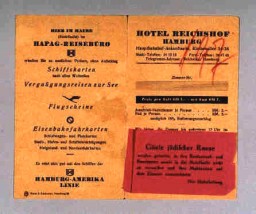
Artifact1939 flyer from the Hotel Reichshof in Hamburg, Germany. The red tag informed Jewish guests of the hotel that they were not permitted in the hotel restaurant, bar, or in the reception rooms. The hotel management required Jewish guests to take their meals in their rooms. Following the Nuremberg Laws of 1935, Jews were systematically excluded from public places in Germany.
-
Ice Skates
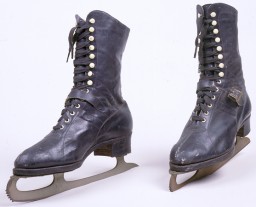
ArtifactThese ice skates were among the few personal belongings Hanni Sondheimer took with her on her journey from Kaunas (Kovno) to Shanghai. Hanni, who was then only a teenager, also carried a pair of red shoes and a picture of Gary Cooper. [From the USHMM special exhibition Flight and Rescue.]
-
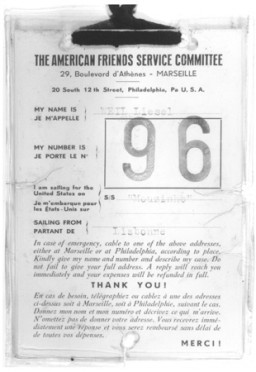
Identification tag issued by the American Friends Service Committee
ArtifactIdentification tag issued to Liesel Weil by the American Friends Service Committee for her voyage to the United States on board the Mouzinho. More than 100 children sailed to New York aboard the Mouzinho, a Portuguese liner. The transport was sponsored by the American Friends Service Committee, and representatives of several Jewish organizations met the children in New York. Marseille, France, 1941.
-
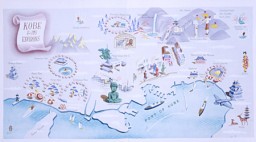
Illustration from tourist guide to Kobe and its environs
ArtifactThe Kobe Municipal Office issued an English-language tourist guide to Kobe and its environs. This illustration comes from the interior pages of the guide. Jewish refugees in Kobe used such pieces of information. Kobe, Japan, 1940-1941. [From the USHMM special exhibition Flight and Rescue.]
-
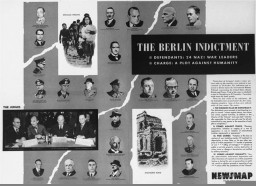
Insert for American soldiers published in Newsmap for the Armed Forces
ArtifactAn insert prepared for American soldiers. This diagram, published in the overseas edition of "Newsmap for the Armed Forces," explains the indictment against the Nuremberg defendants. 1945.
-
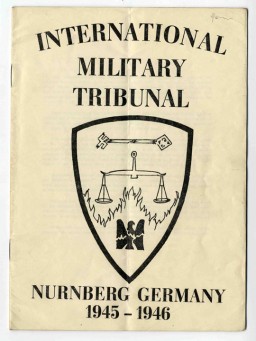
International Military Tribunal booklet cover
ArtifactCover of program booklet distributed at the International Military Tribunal at Nuremberg.
-
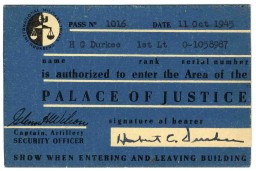
International Military Tribunal prison pass
ArtifactEntry pass to the prison housing war criminals at the International Military Tribunal. This pass was issued to a U.S. military guard.
-
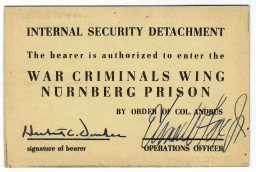
International Military Tribunal prison pass
ArtifactBack side of an entry pass to the prison housing war criminals at the International Military Tribunal. This pass was issued to a U.S. military guard.
-
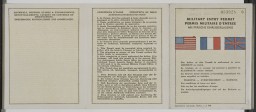
Jadwiga Dzido's military entry permit
ArtifactMilitary entry permit allowing Jadwiga Dzido to travel through occupied Germany to appear as a witness in the Medical Case trial at Nuremberg. 1946.
-
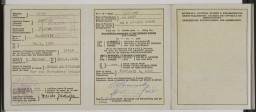
Jadwiga Dzido's military entry permit
ArtifactReverse side of a military entry permit allowing Jadwiga Dzido to travel through occupied Germany to appear as a witness in the Medical Case trial at Nuremberg. 1946.
-
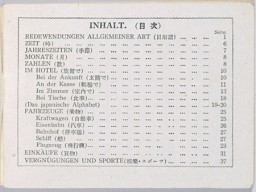
Japanese-German phrase book (interior)
ArtifactThe table of contents from a Japanese-German phrase book purchased by German Jewish refugees shortly after their arrival in Japan. The phrase book offers useful expressions in Japanese relating to travel, hotel stays, eating, and shopping in Japan. Japan, 1940-1941. [From the USHMM special exhibition Flight and Rescue.]
-
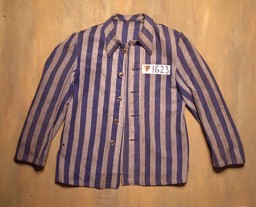
Julian Noga's prisoner uniform jacket
ArtifactA blue and gray striped jacket from the Flossenbürg concentration camp. The letter "P" on the left front of the jacket indicates that it was worn by a Polish, non-Jewish prisoner. "P" stands for "Pole" in German. The jacket was donated to the United States Holocaust Memorial Museum by the prisoner who wore it, Julian Noga.
-
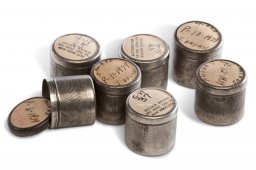
Julien Bryan's film canisters
ArtifactJulien Bryan stored his still photo negatives from Nazi Germany 1937 and Poland 1939 in these carefully marked metal canisters.
-
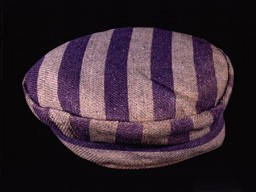
Karel Bruml's concentration camp cap
ArtifactAfter being deported from Theresienstadt to the Auschwitz concentration camp in 1942, Karel Bruml wore this cap as a forced laborer in the Buna synthetic rubber works located in the Buna-Monowitz section of the camp.
-
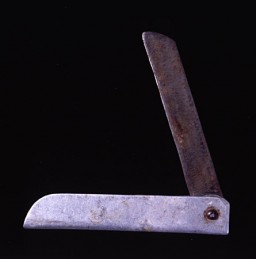
Knife made by Yona Wygocka Dickmann
ArtifactYona Wygocka Dickmann fashioned this jackknife from aluminum and part of a saw after the SS transferred her from Auschwitz to forced labor at an airplane factory in Freiburg, Germany, in November 1944. She used the knife to extend her daily ration of bread by cutting it in half.
-
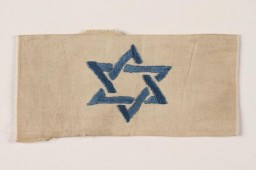
Krakow ghetto armband
ArtifactIn December 1939, German authorities required Jews residing in the Generalgouvernement (which included Krakow) to wear white armbands with blue Stars of David for purposes of identification. The armband pictured here was donated to the United States Holocaust Memorial Museum in 2001 by Akiva Kohane.
-
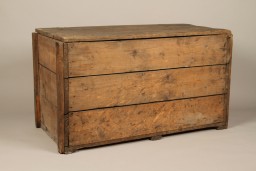
Large wooden crate used by Żegota to hide false documents
ArtifactThis large, lidded wooden chest was used by the Council for Aid to Jews (codenamed “Żegota”) to hide false identity documents from Nazi authorities. Żegota was an underground rescue organization of Poles and Jews in German-occupied Poland and operated from December 1942 to January 1945. Supported by the Polish government-in-exile, it coordinated efforts to save Jews in German-occupied Poland from Nazi persecution and murder. One of Żegota’s most impactful clandestine activities was producing and…
-
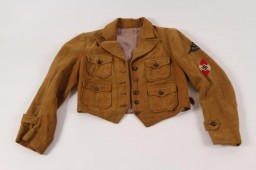
League of German Girls jacket
ArtifactThis League of German Girls jacket has two embroidered cloth patches handstitched to the upper left sleeve: a dark triangle displaying the name of the member’s region, South Franconia (Süd Franken), and a Hitler Youth insignia. Beginning in 1933, the Hitler Youth and its organization for girls and young women, the League of German Girls, played an important role in the new Nazi regime. Through these organizations, the Nazi regime indoctrinated young people with Nazi ideology, including antisemitism and…
-
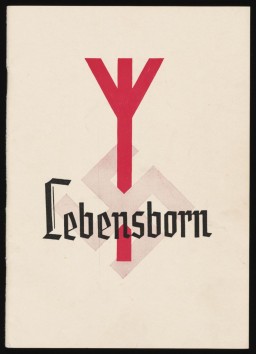
Lebensborn program brochure
ArtifactFront cover of a brochure advertising the Lebensborn program. The brochure describes the program's maternity homes and requirements that expectant mothers must meet to be accepted.
-
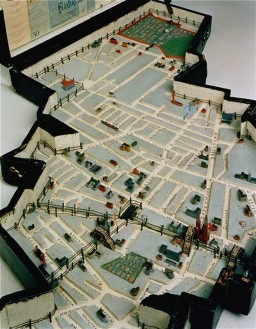
Lodz ghetto model
ArtifactLeon Jakubowicz, a shoemaker by training and a native of Lodz, began constructing this model of the Lodz ghetto soon after his arrival there from a prisoner-of-war camp in April 1940. The case holds a scale (1:5000) model of the ghetto, including streets, painted houses, bridges, churches, synagogue ruins, factories, cemeteries, and barbed wire around the ghetto edges. The model pieces are made from scrap wood. The case cover interior is lined with a collection of official seals, a ration card, and paper…
-
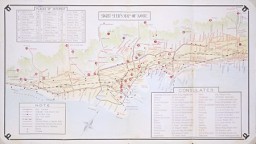
Map of Kobe, Japan, from tourist guide to Kobe
ArtifactThe Kobe Municipal Office issued an English-language tourist guide to Kobe and its environs. The tourist map of Kobe pictured here was included with the guide. Jewish refugees in Kobe used such pieces of information. Kobe, Japan, 1940-1941. [From the USHMM special exhibition Flight and Rescue.]
-
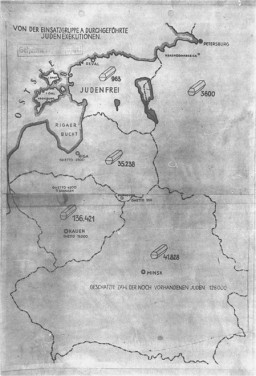
Map titled "Jewish Executions Carried Out by Einsatzgruppen A"
ArtifactThis map accompanied a secret undated German report on the mass murder of Jews by Einsatzgruppen A (mobile killing unit A). During the International Military Tribunal at Nuremberg, the map was introduced as evidence by both the American and British prosecution teams. The document, entitled "Jewish Executions Carried Out by Einsatzgruppen A" and stamped "Secret Reich Matter," shows the number of Jews executed (symbolized by coffins) in the Baltic states and Belorussia by late 1941. The legend near the…
-
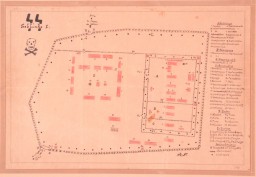
Map used as trial evidence
ArtifactThis map of the Treblinka I forced-labor camp was drawn by Holocaust survivor Manfred Kort in 1946. In 1990 Kort donated the map to the United States Holocaust Memorial Musem. In March 1997, at the request of the Office of Special Investigations, the Museum sent the original drawing to Chicago to be used as evidence at the trial of one Bronislaw Hajda. At the conclusion of Hajda's trial on April 10, 1997, the U.S. Department of Justice announced that "a federal judge in Chicago has revoked the naturalized…
-
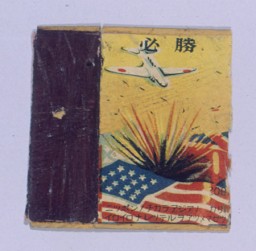
Matchbox cover with Japanese propaganda illustration
ArtifactDuring the war the Japanese flooded Shanghai with anti-American and anti-British propaganda, including this image from a matchbox cover. It depicts a Japanese plane dropping a bomb on the U.S. and British flags. Shanghai, China, between 1943 and 1945. [From the USHMM special exhibition Flight and Rescue.]
-
Matchbox cover with Japanese propaganda illustration
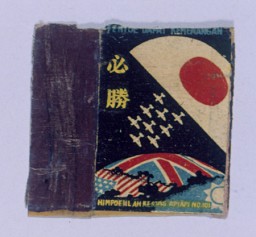
ArtifactDuring the war the Japanese flooded Shanghai with anti-American and anti-British propaganda, including this image from a matchbox cover. It depicts Japanese planes flying in formation over the U.S. and British flags, with the Japanese flag rising in triumph. Shanghai, China, between 1943 and 1945. [From the USHMM special exhibition Flight and Rescue.]