
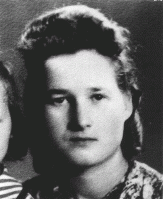
Stefania (Fusia) Podgórska
Born: June 2, 1921
Lipa, Poland
Stefania was born to a Catholic family in a village near Przemyśl, Poland. They lived on a large farm and cultivated several different crops. While her father worked with the farmhands in the fields, Stefania's mother managed the house and cared for her eight children.
1933-39: Stefania's father died in in the late 1930s. As a teenager, Stefania moved to the city of Przemyśl. There, she worked in a grocery store owned by the Diamants, a Jewish couple. Stefania quickly became close with the couple and their children—even moving into their home. In September 1939, Nazi Germany and the Soviet Union invaded Poland and divided it between them. The demarcation line divided the city of Przemyśl in two. Part of the city came under German occupation and the other part came under Soviet occupation. Stefania and the Diamants initially lived under the Soviet occupation.
1940-44: In June 1941, Nazi Germany attacked the Soviet Union and occupied all of Przemyśl. Eventually, the Diamants and other Jews were imprisoned in the Przemyśl ghetto. Despite the danger, Stefania helped the Diamants by exchanging their valuables for food. During the war, Stefania also took care of her much younger sister Helena after their mother was sent to Nazi Germany for forced labor.
The Germans soon began sending Jews from the Przemyśl ghetto to the Belzec killing center. Among those killed were Mr. and Mrs. Diamant. One of the sons, Max (later Josef Burzminski), jumped from a deportation train and made his way back to Przemyśl. There, Stefania and six-year-old Helena sheltered him for a short time before he returned to the ghetto.
In summer 1943, Max feared the Germans would soon liquidate the ghetto and murder the remaining residents. Max asked Stefania if she would be willing to find a new home, large enough to hide him and other Jews. She quickly found a cottage with a large attic located at 3 Tatarska Street. Stefania and Helena hid and cared for Max and twelve other Jews until Soviet forces retook the city in July 1944. Later, Stefania and Max married. They eventually immigrated to the United States.