![A transport of Jewish prisoners marches through the snow from the Bauschovitz train station to Theresienstadt. [LCID: 69720]](https://encyclopedia.ushmm.org/images/large/781755a6-1ba5-4d8e-8b2b-9f25bdf3687f.jpeg)
Browse an alphabetical list of geographic and thematic maps that depict important locations before, during, and after the Holocaust and World War II. These maps also show sites of camps, ghettos, and mass killings, and various geographical movements, such as military operations, deportations, or invasions.
<< Previous | Displaying results 1-12 of 12 for "Map" | Next >>
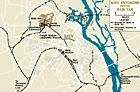
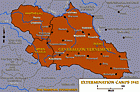
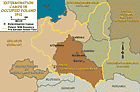
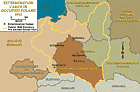
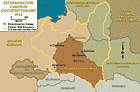
Killing centers (also referred to as "extermination camps" or "death camps") were designed to carry out genocide. Between 1941 and 1945, the Nazis established five killing centers in German-occupied Poland—Chełmno, Belzec, Sobibor, Treblinka, and Auschwitz-Birkenau (part of the Auschwitz camp complex). Chełmno and Auschwitz were established in areas annexed to Germany in 1939. The other camps (Belzec, Sobibor, and Treblinka) were established in the General Government (an administrative unit of occupied…
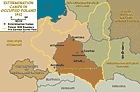
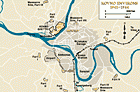
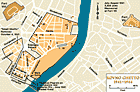
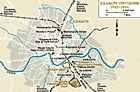

During World War II, Oskar Schindler ran an enamelware factory that employed Jewish forced laborers from the Kraków ghetto. The factory, commonly called "Emalia," was located in the Zabłocie suburb of Kraków. It was near the ghetto and several kilometers from the Plaszow camp. Eventually, a subcamp of Plaszow was established on the grounds of the Emalia factory complex. Jewish forced laborers lived in the subcamp and worked for Emalia and other nearby factories. Thanks to Schindler, conditions at the…
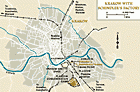
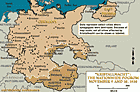
Kristallnacht, often referred to in English as the "Night of Broken Glass," was a violent pogrom (anti-Jewish riot). It took place on November 9 and 10, 1938 throughout Germany, which by then included both Austria and the Sudetenland region of Czechoslovakia. During Kristallnacht, Nazis burned more than 1,400 synagogues, vandalized thousands of Jewish-owned businesses, broke into Jewish people’s apartments and homes, and desecrated Jewish religious objects. They also humiliated, assaulted, and killed…
We would like to thank Crown Family Philanthropies, Abe and Ida Cooper Foundation, the Claims Conference, and BMF for supporting the ongoing work to create content and resources for the Holocaust Encyclopedia. View the list of all donors.