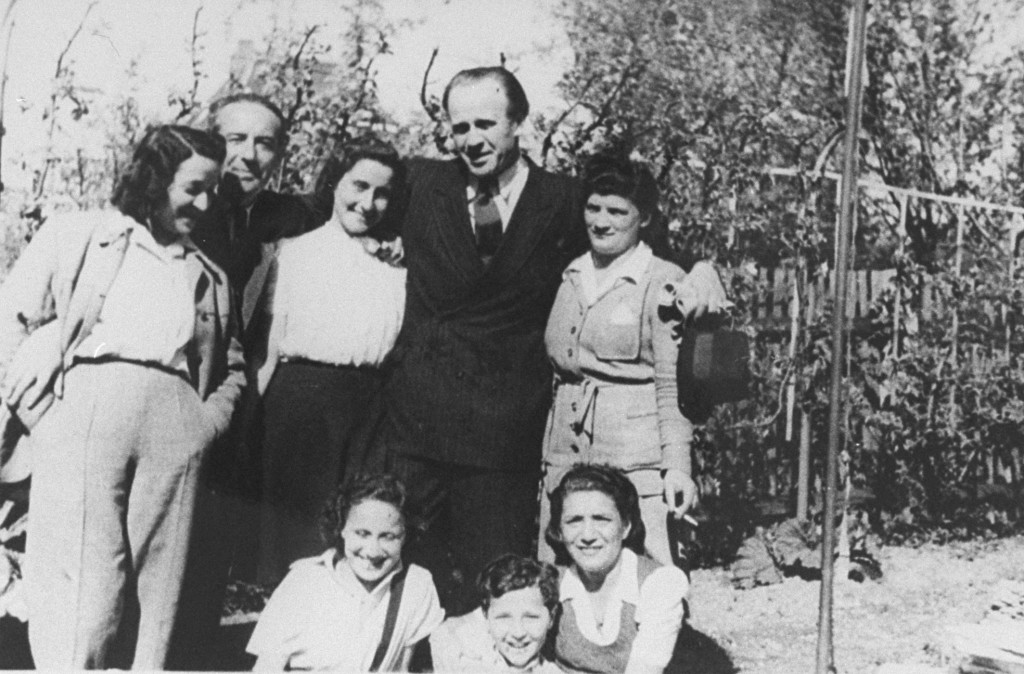
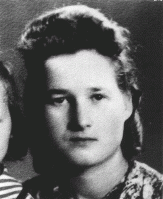
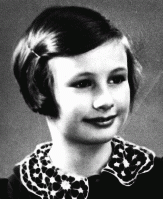
Hanne Hirsch Liebmann (1924–2026) grew up in Karlsruhe, Germany. She was raised by her mother, Ella, who was widowed in 1925. In January 1933, when Hanne was 8 years old, the Nazis came to power in Germany. Nazis targeted the family's photo studio during the April 1933 anti-Jewish boycott. In November 1938, Hanne experienced the violence and terror of Kristallnacht. Then, in October 1940, the Nazi regime deported Hanne and her family to France, where they were imprisoned in the Gurs internment camp. In Gurs, Hanne met Max Liebmann, who had also been deported from Germany. In September 1941, the Children's Aid Society (OSE) rescued Hanne and placed her in a children's home in Le Chambon-sur-Lignon. In 1943, Hanne obtained false papers and crossed into Switzerland. There, she reunited with Max. They married and had a daughter. In 1948, the family immigrated to the United States. Hanne's mother was deported from France to Auschwitz in 1942. She did not survive the Holocaust.
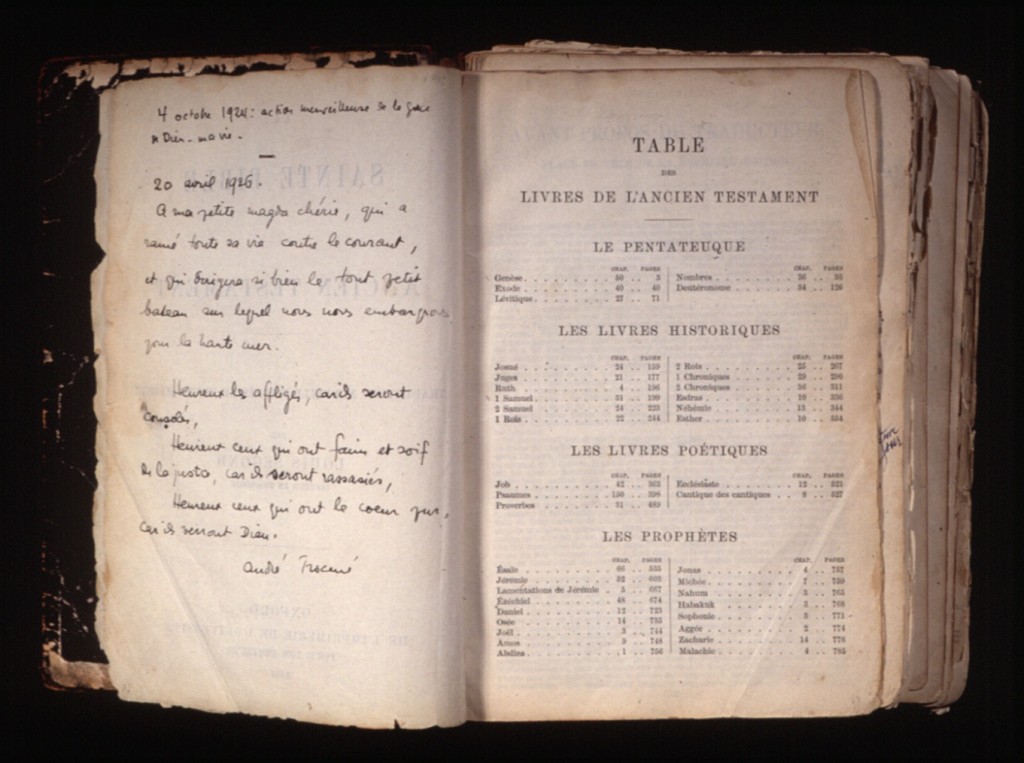
The family bible shown here belonged to Andre Trocme and contains annotations he made in preparation for his sermons. Trocme was a Protestant pastor in Le Chambon-sur-Lignon, France. During the war, he and the town's residents helped shield Jews, especially Jewish children, and others from the Germans. The operation saved thousands of refugees, including about 5,000 Jews. His handwritten inscription in French reads, in part, "Happy are those hungry and thirsty of justice; for they will be satisfied."
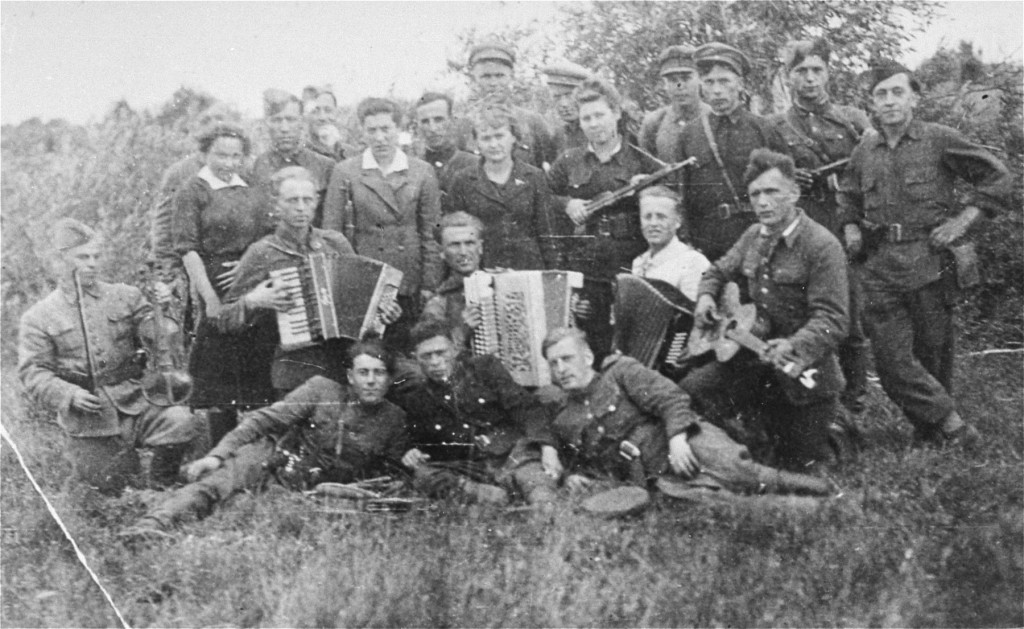
Jewish partisans, including a song and dance group, in the Naroch forest in Belorussia. In addition to armed resistance, Jewish resistance also focused on spiritual resistance—the attempt to preserve traditions and culture. Soviet Union, 1943.
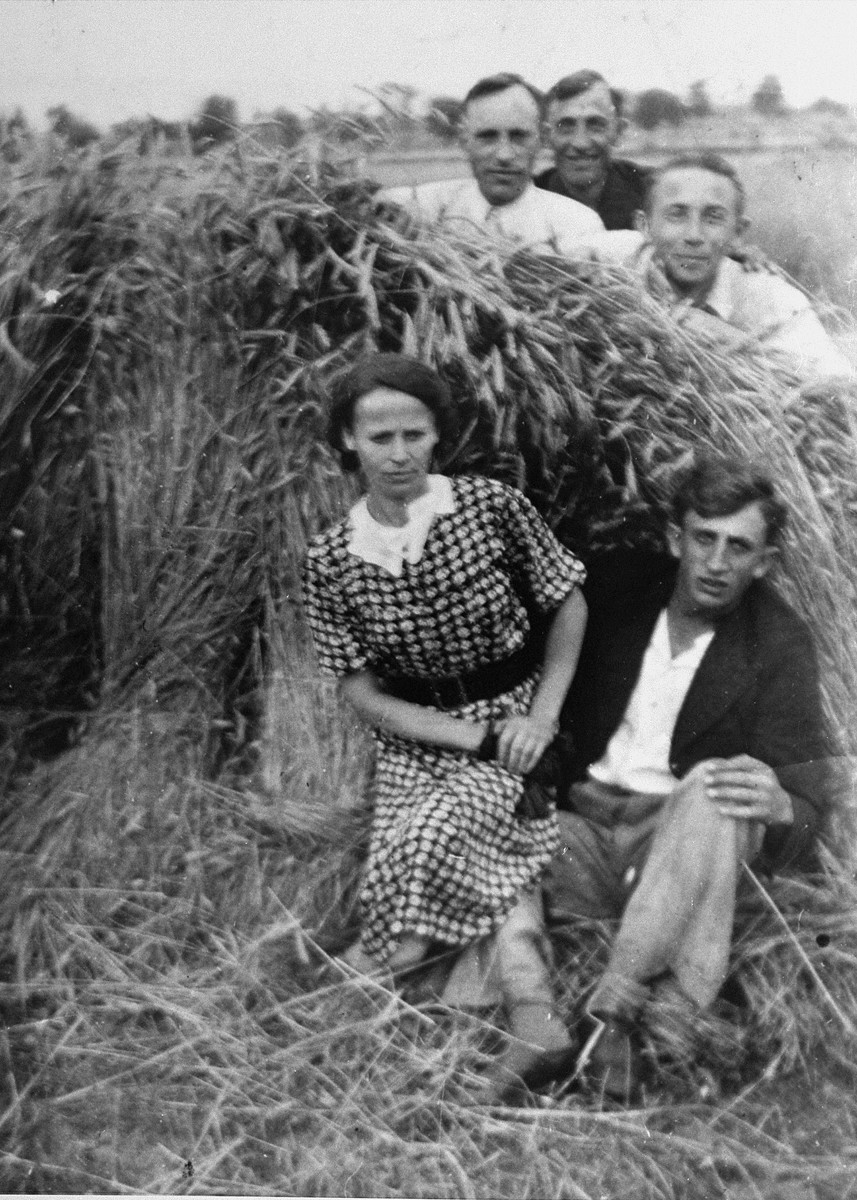
Lisa was one of three children born to a religious Jewish family. Following the German occupation of her hometown in 1939, Lisa and her family moved first to Augustow and then to Slonim (in Soviet-occupied eastern Poland). German troops captured Slonim in June 1941, during the invasion of the Soviet Union. In Slonim, the Germans established a ghetto which existed from 1941 to 1942. Lisa eventually escaped from Slonim, and went first to Grodno and then to Vilna, where she joined the resistance movement. She joined a partisan group, fighting the Germans from bases in the Naroch Forest. Soviet forces liberated the area in 1944. As part of the Brihah ("flight," "escape") movement of 250,000 Jewish Holocaust survivors from eastern Europe, Lisa and her husband Aron sought to leave Europe. Unable to enter Palestine, they eventually settled in the United States.
Germany invaded Poland on September 1, 1939. After the German occupation, Sarah (then just three years old) and her mother were forced into a ghetto. One day, a Polish Catholic policeman warned them that the ghetto was about to be liquidated. He sheltered Sarah and her mother first in his house, then in a potato storage bunker, and then in a chicken coop on his property. Sarah hid there for more than two years, until the area was liberated by Soviet forces. After the war, Sarah emigrated from Europe—first to Israel in 1947 and then to the United States in 1963.
Stefania was born to a Catholic family in a village near Przemyśl, Poland. They lived on a large farm and cultivated several different crops. While her father worked with the farmhands in the fields, Stefania's mother managed the house and cared for her eight children.
1933-39: Stefania's father died in in the late 1930s. As a teenager, Stefania moved to the city of Przemyśl. There, she worked in a grocery store owned by the Diamants, a Jewish couple. Stefania quickly became close with the couple and their children—even moving into their home. In September 1939, Nazi Germany and the Soviet Union invaded Poland and divided it between them. The demarcation line divided the city of Przemyśl in two. Part of the city came under German occupation and the other part came under Soviet occupation. Stefania and the Diamants initially lived under the Soviet occupation.
1940-44: In June 1941, Nazi Germany attacked the Soviet Union and occupied all of Przemyśl. Eventually, the Diamants and other Jews were imprisoned in the Przemyśl ghetto. Despite the danger, Stefania helped the Diamants by exchanging their valuables for food. During the war, Stefania also took care of her much younger sister Helena after their mother was sent to Nazi Germany for forced labor.
The Germans soon began sending Jews from the Przemyśl ghetto to the Belzec killing center. Among those killed were Mr. and Mrs. Diamant. One of the sons, Max (later Josef Burzminski), jumped from a deportation train and made his way back to Przemyśl. There, Stefania and six-year-old Helena sheltered him for a short time before he returned to the ghetto.
In summer 1943, Max feared the Germans would soon liquidate the ghetto and murder the remaining residents. Max asked Stefania if she would be willing to find a new home, large enough to hide him and other Jews. She quickly found a cottage with a large attic located at 3 Tatarska Street. Stefania and Helena hid and cared for Max and twelve other Jews until Soviet forces retook the city in July 1944. Later, Stefania and Max married. They eventually immigrated to the United States.
Eva was the only child born to nonreligious Jewish parents. Her father was a journalist. Eva enjoyed spending time with her cousin Susie, who was two years older. Eva also took special vacations with her mother. Sometimes they went skiing in the Austrian alps, and on other occasions they stayed at her uncle's cabin along the Danube River.
1933-39: When the Germans annexed Austria in 1938, life changed. Eva's father was harassed by the Gestapo for writing articles against the Germans. Her good friends called her bad names because she was Jewish. Eva's parents said they had to escape. Eva and her parents fled by train to Paris. One day there, in her third-grade class, bombs began falling. They raced to the air-raid shelter and put on gas masks. The smell of rubber was overwhelming. Eva felt like she was choking.
1940-44: After the Germans entered Paris in 1940, Eva's family escaped to the unoccupied south. Two years later, when she was 13, Germans occupied the south and they were forced to move on again. During the treacherous trek in the mountains between Switzerland and France, they took refuge in the small French village of St. Martin. The village priest, Father Longeray, let Eva's parents hide in his basement. Eva lived openly in the parish house as a shepherdess. She attended church with the other children and learned the Catholic mass in Latin.
Eva and her parents remained hidden in St. Martin. They were liberated at the end of 1944. In 1948, when Eva was 18, she and her parents immigrated to the United States.
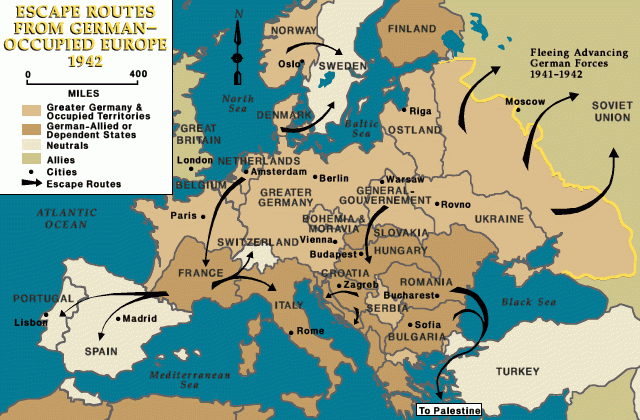
Throughout most of German-occupied Europe, the Germans sought to round up and deport Jews to killing centers in occupied Poland. Some Jews survived by hiding or escaping from German-controlled Europe. Some escape routes out of occupied Europe led to belligerent states (such as the Soviet Union), neutral states (such as Switzerland, Spain, Sweden, and Turkey), and even to states allied with Germany (such as Italy and Hungary before they were occupied by Germany). After the German attack on the Soviet Union, more than a million Soviet Jews escaped eastward, fleeing the advancing German army. Thousands more Jews managed to leave Black Sea ports in Bulgaria and Romania, seeking to reach safety in Palestine.
Some Jews survived the "Final Solution," the Nazi plan to kill the Jews of Europe, by hiding or escaping from German-controlled Europe. Most non-Jews neither aided nor hindered the "Final Solution." Relatively few people helped Jews escape. Those who did aid Jews were motivated by opposition to Nazi racism, by compassion, or by religious or moral principle. In a few rare instances, entire communities as well as individuals helped save Jews. They did so at tremendous risk. In many places, providing shelter to Jews was punishable by death.
The residents of Le Chambon-sur-Lignon, a Protestant village in southern France, helped thousands of refugees, most of them Jews, escape Nazi persecution between 1940 and 1944. Though they knew the danger, they were resolute, inspired by religious conviction and a sense of moral duty. Refugees, including many children, were hidden in private homes and also in nearby Catholic convents and monasteries. Residents of Le Chambon-sur-Lignon also helped smuggle refugees to neutral Switzerland.
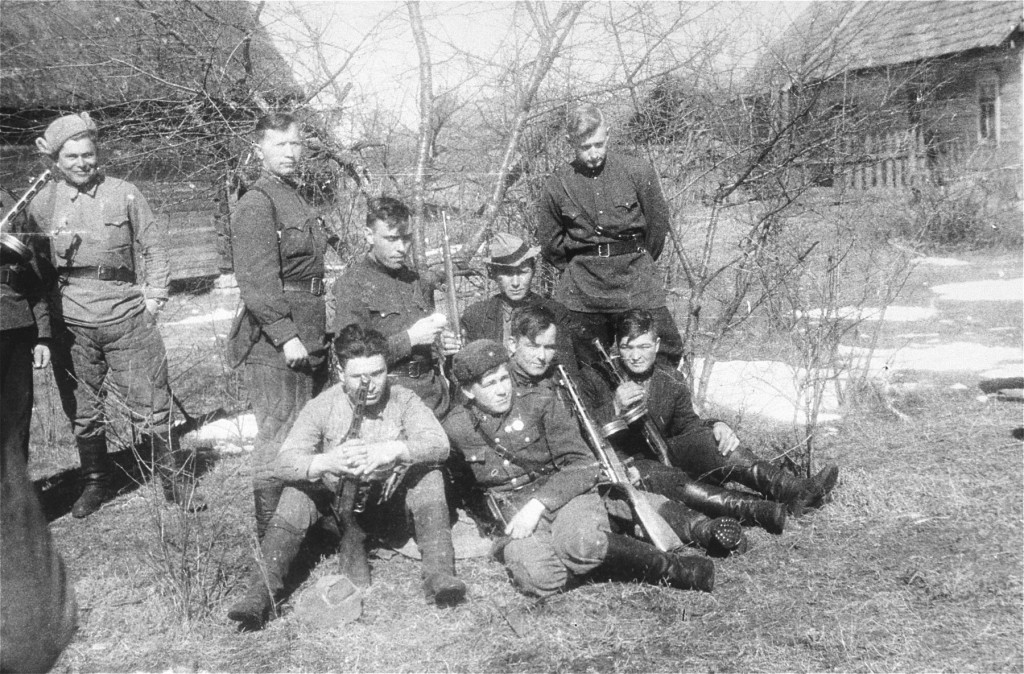
Many Jews throughout occupied Europe attempted armed resistance. Individually and in groups, Jews engaged in both planned and spontaneous opposition to the Germans. Jewish partisan units operated in France and Belgium. They were especially active in the east, where they fought the Germans from bases in dense forests and in ghettos. Because antisemitism was widespread, they found little support among the surrounding population. Even so, as many as between 20,000 and 30,000 Jews fought the Germans in the forests of eastern Europe.
Organized armed resistance was the most direct form of Jewish opposition. In many areas of Europe, Jewish resistance instead focused on aid, rescue, and spiritual resistance. The preservation of Jewish cultural institutions and the continuance of religious observance were acts of spiritual resistance to the Nazi policy of genocide.
Last Edited: Sep 23, 2025
Author(s):
United States Holocaust Memorial Museum, Washington, DC
We would like to thank Crown Family Philanthropies, Abe and Ida Cooper Foundation, the Claims Conference, and BMF for supporting the ongoing work to create content and resources for the Holocaust Encyclopedia.
View the list of all donors.