Your browser is out of date and may not support some of the features of this webpage. Please consider updating your browser or using another.
Jewish Life in Ghettos During the Holocaust
During the Holocaust, the Nazis and their allies imprisoned millions of Jews in ghettos. In the ghettos, Jews experienced starvation and overcrowding. They endured humiliation, abuse, and violence. In many ghettos, Jews tried to resist Nazi persecution. They also tried to maintain their sense of dignity and community.
Ghettos were areas of cities or towns where authorities forced Jews to live under miserable conditions, separated from the non-Jewish population. German authorities or their allies created horrible conditions in ghettos on purpose. Ghettos were overcrowded, unsanitary, and dangerous. Hundreds of thousands of Jews died in the ghettos as a result.
Some ghettos existed for years. Others existed only for months, weeks, or even days. Many ghettos were enclosed by walls, fences, or other barriers. Other ghettos, called open ghettos, were not enclosed. In both cases, guards usually prevented Jews from leaving without permission. Typically, ghettos were governed internally by a Jewish administration.
During the Holocaust, the Nazis and their allies imprisoned millions of Jews in ghettos. In the ghettos, Jews experienced starvation and overcrowding. They endured humiliation, abuse, and violence. In many ghettos, Jews tried to resist Nazi persecution. They also tried to maintain their sense of dignity and community.
Abraham Lewent (1924–2002) was born in Warsaw, Poland in 1924. The Lewent family was living in Warsaw when the Germans invaded Poland in September 1939. Later, the Lewents were confined to the Warsaw ghetto. In summer 1942, Abraham's mother and three younger sisters were rounded up during the Great Action—the mass deportation of Jews from the Warsaw ghetto to the Treblinka killing center. They were likely killed upon arrival. Abraham was not caught in the Great Action, because during the round up he hid in a small space in the ceiling. Afterwards, Abraham found a forced labor assignment at a nearby airfield. He returned to the ghetto in December 1942, reuniting with his father. During the Warsaw ghetto uprising in April–May 1943, Abraham and his father saw the ghetto being burned to the ground. They were eventually rounded up and sent to the Lublin concentration camp (called Majdanek). Abraham's father died there. Later, Abraham was sent to the Skarżysko-Kamienna labor camp, then to Buchenwald and several other camps. US troops liberated Abraham from a train in April 1945.
Gerda Weissmann Klein (1924-2022) was born on May 8, 1924 in Bielsko, Poland. Following the German invasion of Poland in September 1939, Gerda's brother, Arthur, and other Jewish men were ordered to report for forced labor. Eventually, Gerda and her parents learned that this had been a ruse. The men had actually been deported east in freight trains and forced across the border into Soviet occupied territory. In Bielsko, Nazi German authorities imposed anti-Jewish measures. Eventually, Gerda and her parents, Helene and Julius, were imprisoned in the Bielsko ghetto.
In June 1942, when the Germans liquidated the ghetto, Gerda was separated from her parents. She was sent to the Bolkenhain labor camp, where she was forced to work in a textile factory. From there, she was transferred to several other camps before being forced on a death march. American soldiers liberated her in early May 1945, in the Czech town of Volary. In 1946, she married Kurt Klein, one of her liberators. Klein was a German Jew who had immigrated to the United States from Germany in 1937. Gerda's parents and brother did not survive the Holocaust.
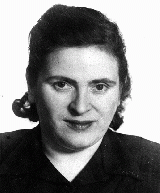
Paula was one of four children born to a religious Jewish family in Łódź, an industrial city with a large Jewish population. As a child, Paula attended public schools and was tutored at home in Jewish studies three times a week. Her father owned a furniture store.
1933-39: Paula, her brothers, and sisters spent a lot of time at the clubhouse of their Zionist group, Gordonia. Their group believed in humanistic values, Jewish self-labor, and in building a Jewish homeland in Palestine. Paula liked to work with her hands and did a lot of knitting, crocheting, and sewing. In September 1939, when she was in secondary school, her studies were cut short when Germany invaded Poland and seized Łódź on September 8th.
1940-44: In early 1940, Paula's family was forcibly relocated to the Łódź ghetto, where they were assigned one room for all six of them. Food was the main problem. At the women's clothing factory where Paula worked, she at least got some soup for lunch. But her family desperately needed to find more food for her younger brother, who was very sick and bleeding internally. From the window at her factory she looked out at a potato field. Knowing that if she was caught, she'd be shot, she crept out one night to the field, dug up as many potatoes as she could, and ran home.
In 1944 Paula was deported to Bremen, Germany, as a forced laborer. She was freed in the Bergen-Belsen camp in 1945. After the war, she immigrated to the United States.
Idzia was the older of two girls born to Jewish parents who lived 35 miles east of Warsaw in the small predominantly Jewish town of Kaluszyn. Idzia's father owned a liquor store and her mother was a housewife. Idzia was close friends with a group of Jewish teenagers who went to the same public school and spent much of their free time and vacations together.
1933-39: Normally, Idzia goes out with her friends on pleasant summer evenings. They like to stroll down the main street together and visit the sweets shop. Sometimes they go to the school building, which is open at night for recreational activities, and play dominoes or checkers. But now, everyone is afraid that war will break out and is staying at home. Every day there's more news about border skirmishes between Polish and German forces.
1940-42: The Germans have occupied Kaluszyn. Acting under German orders, the town mayor has chosen a Jewish council which includes Idzia's father and her friend Majlich's father. They, in turn, chose Majlich, Idzia, and some other young adults to work on the Jewish sanitation committee. One of Idzia's jobs is to take women to the one remaining Jewish bathing facility in town so that they can wash themselves. They've already seen several cases of lice-borne typhus, and they're trying to limit the spread of the deadly disease.
In September 1942 Idzia's parents and some 3,000 other Jews were deported to a killing center. That December, 22-year-old Idzia was also deported to the same camp, where she perished.
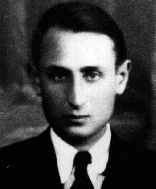
The village in Lithuania where David grew up was located near the Latvian border. His father was a peddler. At age 6, David was sent to Ukmerge, a town known to Jews by its Russian name, Vilkomir, to study traditional Jewish texts at the rabbinical academy there. Six years later, David was called to return home to head the Selznik family because his father had died.
1933-39: David lost his job in 1933, so he left Lithuania and went to the United States and then Portugal. But in 1936 the Baltic states were vulnerable to Stalin and Hitler, and David decided to return home to help his mother and sisters, who had since moved to the city of Kovno. The threat of war loomed over them, but the Jews could not leave. Through business contacts he found a job in a retail outlet for office supplies.
1940-44: In summer 1941 the Germans occupied Kovno and David was forced into a ghetto. Conditions worsened in 1943. The murder of Jews in the ghetto escalated in March 1944. He saw some Ukrainians and Lithuanians helping the Nazis. David watched as they took children to the top floor of a building and dropped them out the window to a guard who stood on the street. The guard then picked them up and knocked their heads against the wall until each child was dead.
In 1944 David fled from a transport as it left the ghetto and hid in a nearby forest for three weeks until the area was liberated. He immigrated to the United States in 1949.
As a young man, Beno used his foreign language skills to land small movie roles. He and his family were deported to the Lodz ghetto, where they struggled daily to find food. In the underground, Beno became an expert at derailing trains. The family was sent to Auschwitz and was separated. All but Beno and one sister, whom he found after the war, died. Beno survived a series of camps and later helped to track war criminals.
During the Holocaust, the Nazis and their allies imprisoned Jewish people in ghettos. Ghettos were areas of cities or towns where authorities forced Jews to live under miserable conditions separated from the non-Jewish population.
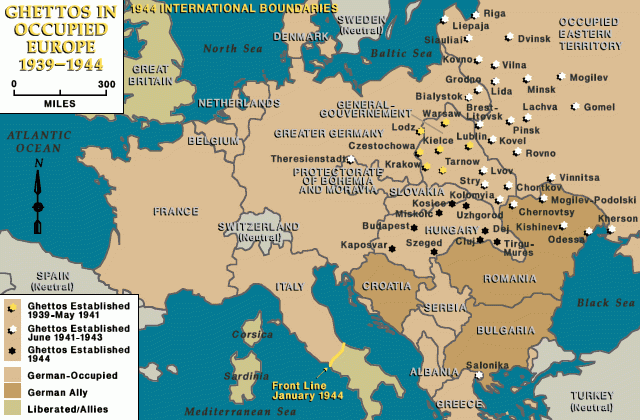
In total, the Nazis and their allies (including Hungary and Romania) established more than 1,300 ghettos. Most of these ghettos were located in German-occupied Poland, the German-occupied Baltic states, and the occupied Soviet Union. Additionally, the Germans created the Theresienstadt (Terezín) ghetto in the Protectorate of Bohemia and Moravia (the occupied Czech lands) and several ghettos in Salonika (Thessaloniki) in German-occupied Greece. There were no ghettos in western Europe.
Ghettos were a key means of isolating, controlling, and ultimately murdering millions of Jews.
How Many Ghettos Were There? Where Were They Located?
The Nazi German authorities began creating ghettos after the German invasion of Poland on September 1, 1939. The first ghetto established during the Holocaust was the Piotrków Trybunalski ghetto. The Germans created it in October 1939 in occupied Poland.
In total, the Nazis and their allies established more than 1,300 ghettos. Just over half of these were located in German-occupied Poland. Most of the other ghettos were located in occupied eastern or central Europe. There were no ghettos in Germany, Austria, or western European countries like France. Countries allied with Nazi Germany also created hundreds of ghettos. These countries included Romania, Bulgaria, and Hungary.
What Rules Did Jews Have to Follow in the Ghettos?
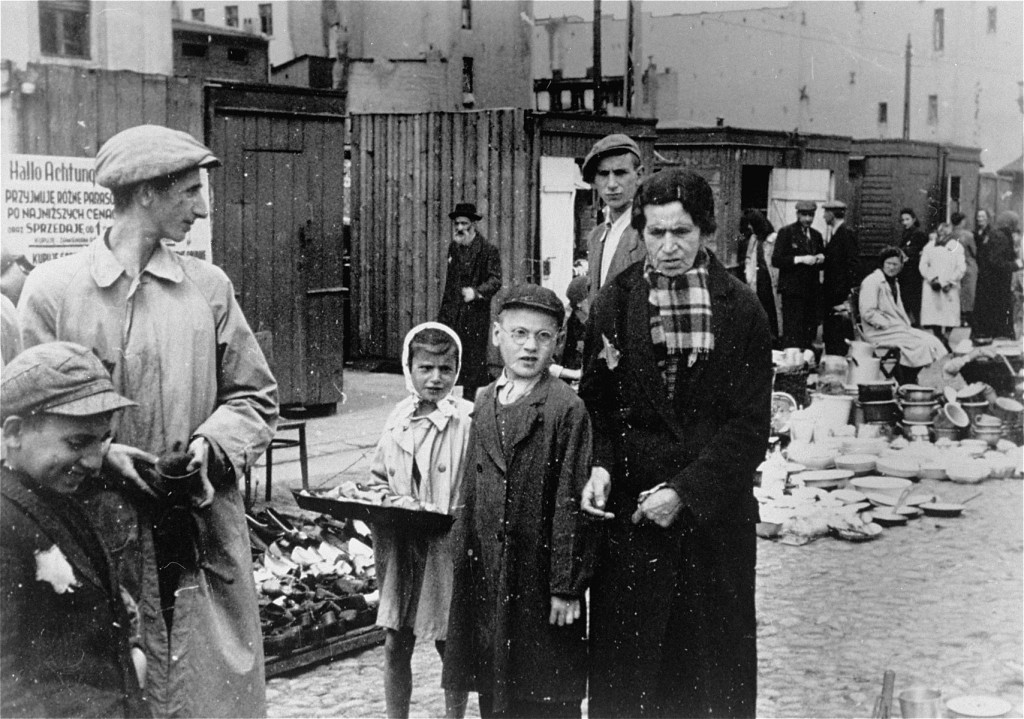
For Jews, life in the ghettos had many strict rules and restrictions. Guards and other authorities decided where Jews could go and when. They imposed curfews, built fences, and posted signs. They banned Jews from leaving the ghettos without permission. Jews had to wear armbands or badges on their clothing, identifying them as Jews. They were also faced with restrictions on what they could bring into the ghettos. They were not allowed to bring most of their personal items or valuables. This made life nearly impossible. Jews imprisoned in ghettos frequently broke the Nazis’ rules in order to stay alive.
What Was Housing and Everyday Life Like in the Ghettos?
Most ghettos were located in existing cities and towns, often in prewar Jewish neighborhoods. The Germans and their allies usually designated a neighborhood or set of streets as a ghetto. They forced non-Jews to move out of these areas. Many of the Jewish people forced to move into ghettos had to leave their homes behind. Some of these Jews came from other neighborhoods, nearby towns, or other countries. Jews who already lived within the ghetto boundaries had to make room for new arrivals. The ghetto areas were too small to safely house all the people imprisoned in them. Overcrowding was common. Multiple families had to share a single dwelling. Contagious diseases spread rapidly in cramped, unsanitary housing.
Was There Food and Medical Care in the Ghettos?
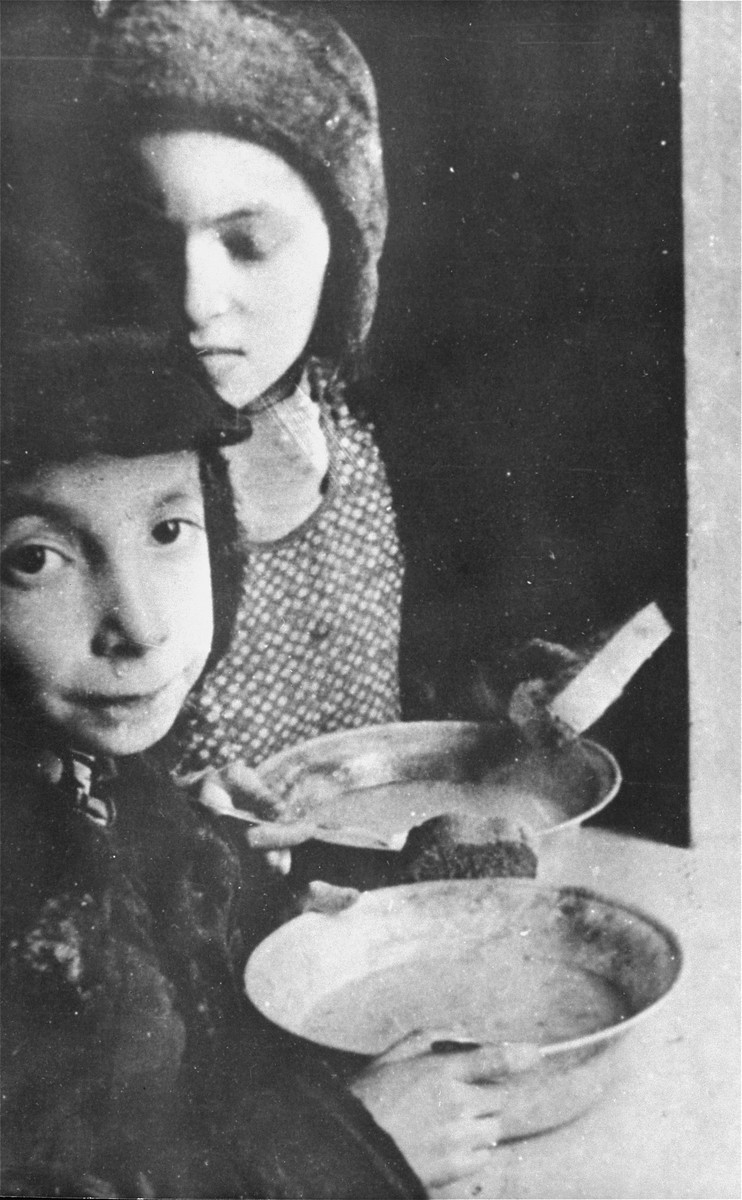
In the ghettos, there was little food and medical care. Germans deliberately tried to starve the Jews imprisoned in the ghettos. People were always hungry. Access to daily items like clothing and basic hygiene supplies was also limited. During the winter, people were constantly cold. Heating fuel was scarce. Many people lacked adequate clothing. People weakened by hunger and exposure to the cold became deathly ill. There was not enough medicine in the ghettos to care for them.
Jews traded, bartered, and smuggled to try to survive. They snuck food, medicine, weapons, and goods into ghettos at enormous risk to their lives. They also created community welfare services, like soup kitchens and hospitals.
Did Jews Have to Work in Ghettos?
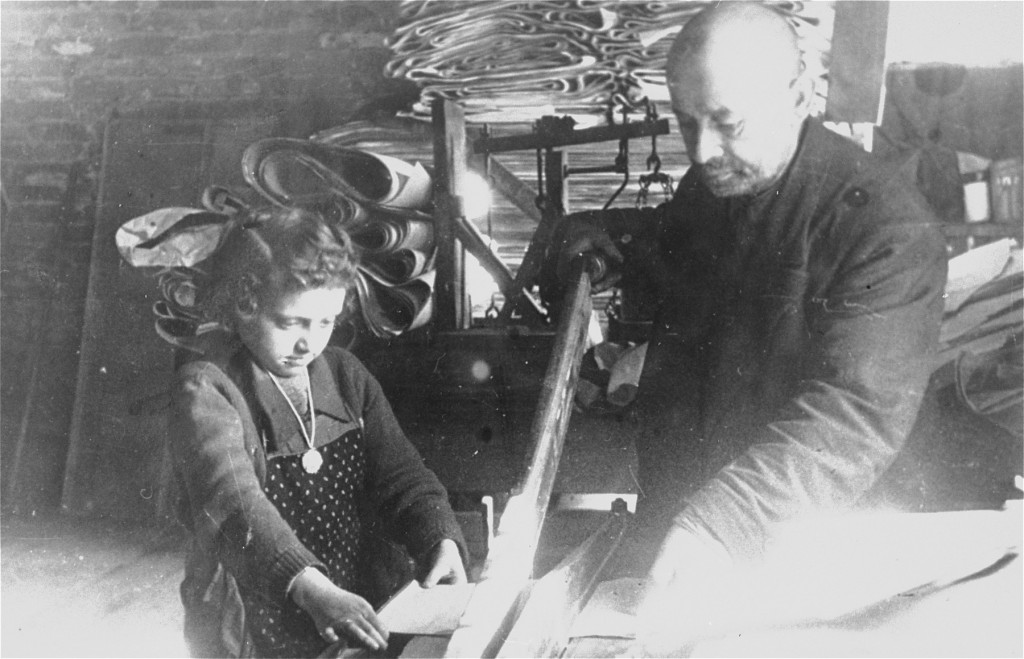
In many ghettos, German authorities exploited Jews for forced labor. Jews had to work in factories, workshops, and on construction sites. Some Jews were forced to clean streets, dig ditches, and repair war-damaged buildings and roads. Jews assigned to forced labor often had a work permit. After the Nazis began to carry out the mass murder of Jews, a work permit could mean the difference between life and death.
What Was Jewish Community Life Like in the Ghettos?
Jews in the ghettos tried to maintain a sense of dignity and community. In ghettos that existed for years, there were many communal institutions. These included schools, libraries, orphanages, hospitals, welfare services, and religious institutions. Jews in ghettos often continued to practice their religion and celebrate Jewish culture, sometimes in secret. In many ghettos, Jews attempted to document their lives. They secretly took photos, recorded their experiences in diaries, or created art, poetry, and songs. In some cases, they even created archives to document their prewar and wartime lives.
Did Jews in the Ghettos Resist?
Many ghettos had secret resistance movements. These groups found many ways to fight back against the Germans and their helpers. They secretly wrote and printed newspapers, pamphlets, and flyers. They built underground bunkers and other places for Jews to hide. These groups also helped plan escapes. They made contact with resistance networks outside the ghettos and collected weapons. Some resistance groups planned and carried out armed revolts against German authorities. The most famous of these is the Warsaw ghetto uprising in April 1943. During this revolt, about 700 ghetto fighters—mostly young adults—fought the German authorities. Armed with pistols, homemade grenades, and a few automatic weapons, they held off Nazi forces for 27 days. The Nazis were shocked by the strength of their resistance. Eventually, Nazi forces took back control of the Warsaw ghetto by burning it down block by block.
The End of Life in the Ghettos
Ghettos were temporary. In 1941, the Nazis began to carry out the “Final Solution”—the mass murder of Europe’s Jews. As part of this, they began to destroy the ghettos. They murdered millions of ghetto residents in mass shooting operations and in gas chambers at killing centers. In some cases, the Germans temporarily kept a very small number of Jews from ghettos alive as forced laborers. By the end of 1944, German authorities had destroyed almost every ghetto they had created.
Last Edited: Aug 6, 2026
Author(s):
United States Holocaust Memorial Museum, Washington, DC
We would like to thank Crown Family Philanthropies, Abe and Ida Cooper Foundation, the Claims Conference, and BMF for supporting the ongoing work to create content and resources for the Holocaust Encyclopedia.
View the list of all donors.